

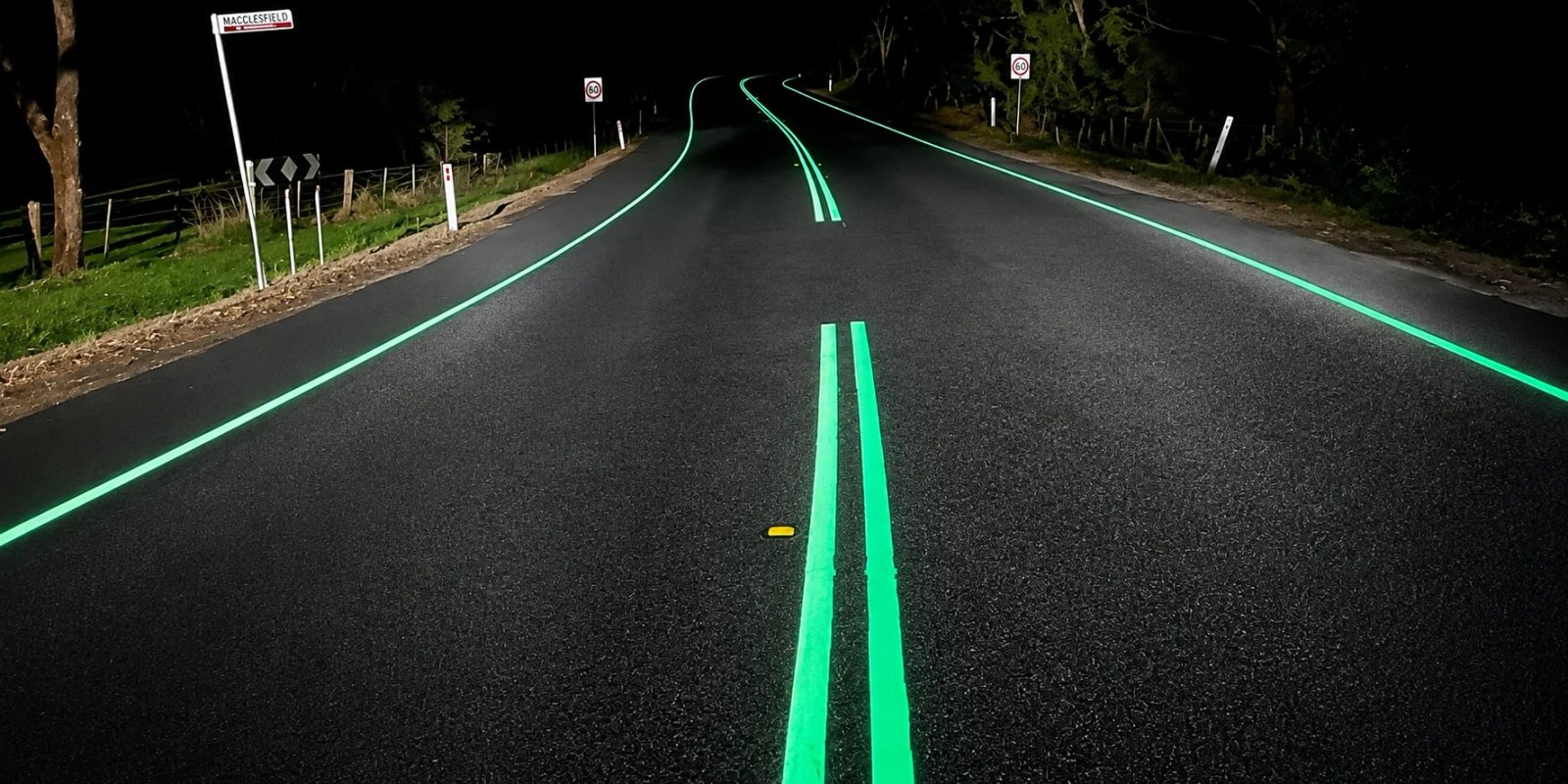
Self-luminous road marking adds passive nighttime visibility to selected roads, parking areas, bicycle paths, pedestrian routes and industrial traffic zones. In most pavement applications, “self-luminous” means photoluminescent: the material stores energy from sunlight or suitable artificial light and releases it as visible afterglow.
Conventional markings usually rely on street lighting or vehicle headlights after dark. A photoluminescent marking can remain noticeable for a period without direct headlight illumination, but it must receive light first. Its performance depends on the complete coating system, the site and the charging conditions.
How self-luminous road marking works
The cycle is light exposure → energy absorption → energy storage → afterglow → recharge. Photoluminescent particles absorb light, gradually release stored energy as the surroundings darken, and recharge when exposed to light again.
They do not continuously generate their own energy. Suitable charging sources may include sunlight, natural daylight, indoor lighting, parking garage lighting and other suitable artificial light sources. Include the charging environment in the project design.
Build a compatible coating system
A self-luminous marking is usually a complete system, with each component serving a different function. Depending on the project, it may contain a primer, white base coating, photoluminescent pigment, transparent binder, anti-slip aggregate and protective topcoat.
Photoluminescent pigment and glow color
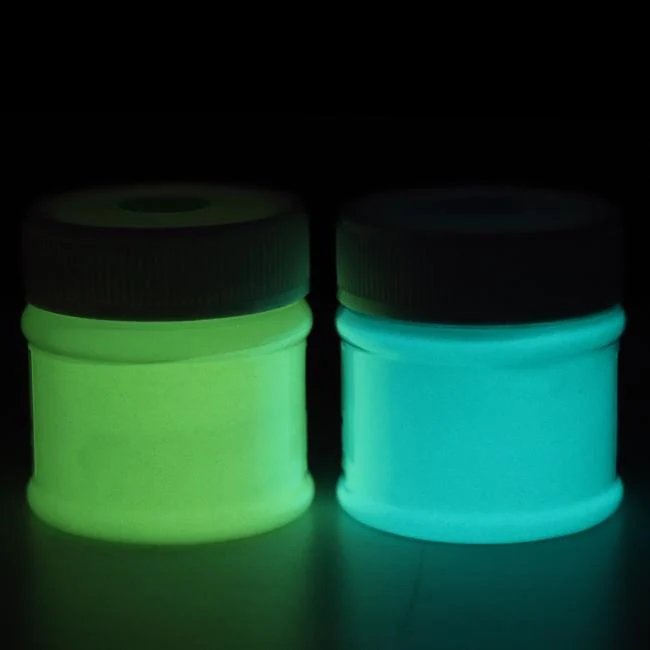
The pigment provides the glow by gradually releasing stored energy after charging. Common colors include:
- Yellow-green: a recognizable glow color, commonly chosen when strong nighttime visibility is desired
- Blue-green: a cooler nighttime appearance, popular for landscape pavement, bicycle paths and modern outdoor projects
Actual performance depends on pigment formulation, particle size, coating structure and charging conditions.
White base coat
A white or light-colored layer beneath the luminous coating can reflect light back through the photoluminescent material and improve its apparent glow. A dark base directly beneath it may reduce apparent brightness in some systems.
A typical layer sequence is asphalt or concrete → primer → white base coat → photoluminescent coating → transparent protective coat.
Transparent binder
Choose a binder compatible with the pigment and the project. It should provide good transparency, strong adhesion, water resistance, weather resistance, wear resistance and suitable curing properties. If it blocks too much incoming light, the pigment may not charge efficiently.
Match applications to traffic and lighting conditions
Potential settings include road lines, bicycle paths, parking areas, pedestrian routes, parks, campuses, residential communities, industrial facilities, underground garages, resorts and scenic areas. Traffic conditions strongly influence the appropriate system.
Road center lines and edge lines
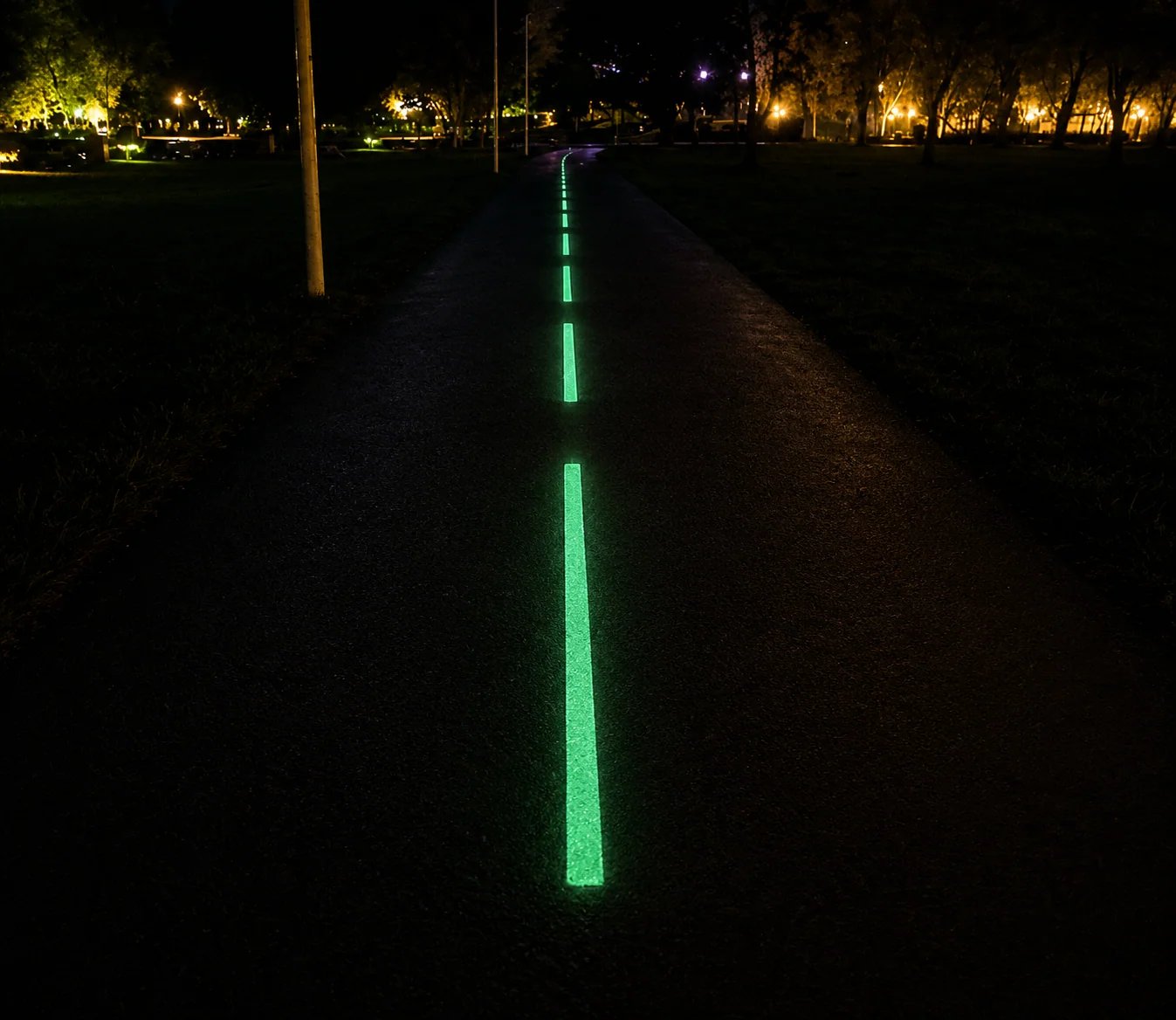
A luminous center line can be visually striking and emphasize a road's direction after dark. Potential locations include scenic, private, park, resort and campus roads, as well as low-speed internal roads. Public-road traffic marking requirements must still be followed.
Continuous luminous edge lines outline the pavement and help define its shape, particularly around curves, landscape roads, bicycle routes and internal access roads.
Bicycle paths and pedestrian walkways
Selected bicycle-path applications include center lines, edge lines, direction arrows, bicycle symbols and intersections. Outdoor paths generally receive daylight that can help recharge photoluminescent materials.
Walking routes may use luminous walkway edges, direction arrows, crossings, landscape paths and emergency guidance routes. Parks and resorts are potential settings where functional guidance is combined with nighttime landscape design.
Parking lots and underground garages
Selected parking-area features include parking bay lines, entry and exit arrows, pedestrian routes, directional markings and ramp edges. Dark asphalt or dark gray floors can provide strong contrast with luminous markings.
Underground garages have limited daylight and normally depend on artificial lighting for charging. Test the material under the actual garage lights before installation, considering lamp type, light intensity, distance from the floor, charging duration and shaded locations. Performance may differ from one part of the garage to another.
Industrial facilities
Factories and warehouses may use photoluminescent markings for selected pedestrian routes, safety lines, emergency routes, equipment zones and internal traffic guidance. Forklifts and vehicles can cause significant abrasion, so select the coating for the expected traffic load.
How to install self-luminous road markings
The exact process depends on the product system. A typical installation may follow these seven steps:
- Inspect the pavement. Check for cracks, loose material, oil, water, dust and damage to existing coatings. Repair serious defects before coating.
- Clean the surface. The pavement should be clean and dry. Remove oil, dust, mud and loose particles that can reduce adhesion.
- Apply a compatible primer. Concrete and asphalt may require different primer systems.
- Apply a light base coat. A white base can improve luminous appearance. Allow it to cure according to the coating system requirements.
- Apply the photoluminescent layer evenly. Depending on the product, use a roller, brush, spray or road-marking equipment. Uniform thickness helps produce more consistent glow.
- Add anti-slip properties. Incorporate compatible anti-slip aggregate where skid resistance is required.
- Apply the protective coating. A transparent topcoat may improve resistance to water, dirt, abrasion and weather exposure. The layer must remain sufficiently transparent.
Balance skid resistance and traffic durability
A marking should never create an unnecessarily slippery surface. Pay particular attention to bicycle lanes, pedestrian crossings, parking ramps, curves and wet outdoor areas. Balance luminous performance, adhesion, wear resistance and skid resistance.
Traffic level has a major effect on service life:
- Pedestrian areas: usually relatively low abrasion
- Bicycle paths: moderate surface wear
- Parking areas: greater abrasion and turning forces from vehicle tires
- Industrial roads: potentially more aggressive wear from forklifts and heavy vehicles
Do not automatically specify the same coating for every environment. Turning areas are particularly demanding because repeated tire movement can wear coatings quickly. In some projects, positioning luminous markings beside the main wheel path rather than under continuous tire traffic may reduce abrasion.
Plan for outdoor weather and wet pavement
Outdoor markings face UV radiation, rain, heat, cold, humidity and dust. Use a binder and protective system designed for exterior exposure.
Rain does not create the luminous effect, but wet pavement can change its appearance. Water, dirt and contamination may reduce visual contrast, so outdoor systems need suitable water resistance and skid resistance.
Understand glow duration and other guidance technologies
How long does the glow last?
Photoluminescent markings normally appear brightest soon after the surroundings become dark, then gradually fade. Performance depends on pigment quality, charging intensity and duration, coating thickness, pigment concentration, ambient darkness and surface cleanliness. Do not expect the material to behave like an electrically powered light.
Reflective and photoluminescent markings
Reflective markings need external light, such as vehicle headlights, and reflect incoming light toward the observer. Photoluminescent markings absorb light beforehand and release visible afterglow, allowing a period of visibility without direct headlight illumination.
Some systems combine headlight reflection and passive afterglow. Test the complete coating because additives and surface layers can affect performance.
Photoluminescent markings and LED guidance
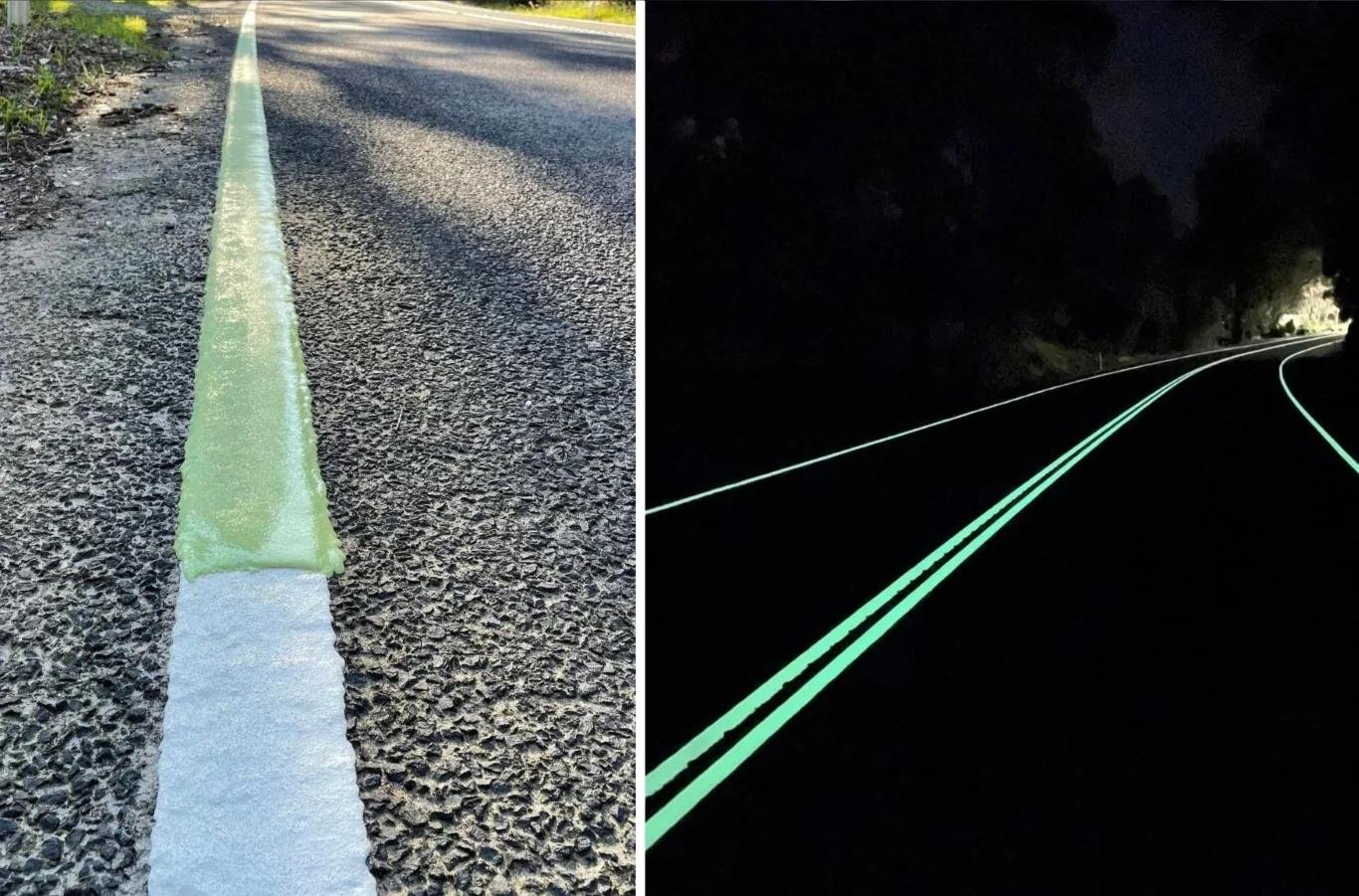
Photoluminescent markings are integrated into the pavement, provide passive afterglow and need no wiring for the afterglow itself. Their brightness gradually decreases.
LED road guidance provides active illumination using electrical or solar power. It has greater installation complexity but can maintain controlled brightness. The systems meet different project requirements.
Clean and inspect the markings
Dust, mud, oil, tire residue and leaves can block light from reaching the luminous layer. Regular cleaning helps maintain charging performance. Inspect worn areas periodically as well.
Retain required lighting and conventional markings
Self-luminous markings cannot replace required streetlights or road lighting. They make pavement features visible but do not illuminate the entire road or provide enough light to identify all pedestrians, vehicles, obstacles, curbs and road hazards. Treat them as supplementary guidance.
Public-road use depends on local regulations. Requirements may cover color, retroreflectivity, line dimensions, skid resistance, placement and durability. A photoluminescent marking should not automatically replace required conventional traffic markings.
Test a sample under real project conditions
Before a large installation, prepare a small test section using the actual pavement, primer, white base coat, photoluminescent material, anti-slip system and protective coating.
Check daytime appearance, charging performance, initial glow, afterglow, adhesion, skid resistance and wear resistance. Real-site evaluation is especially important for underground and high-traffic projects.
Choose the complete system for the site
Self-luminous markings can add passive nighttime visibility to selected road lines, parking areas, bicycle paths, pedestrian routes, industrial facilities, landscape pavement and underground garages. Good performance depends on more than adding glow pigment to paint: combine a suitable pigment, compatible binder, light base coat, surface preparation, skid resistance, protective layer and proper charging.
Select the system according to the pavement, traffic level, lighting conditions and environment. FUXIN supplies photoluminescent pigments, self-luminous road marking materials, glow-in-the-dark pavement coatings and luminous traffic marking materials for parking areas, bicycle paths, pedestrian routes, landscape pavement and industrial applications.
Contact us for product samples, quotations or project material recommendations.