

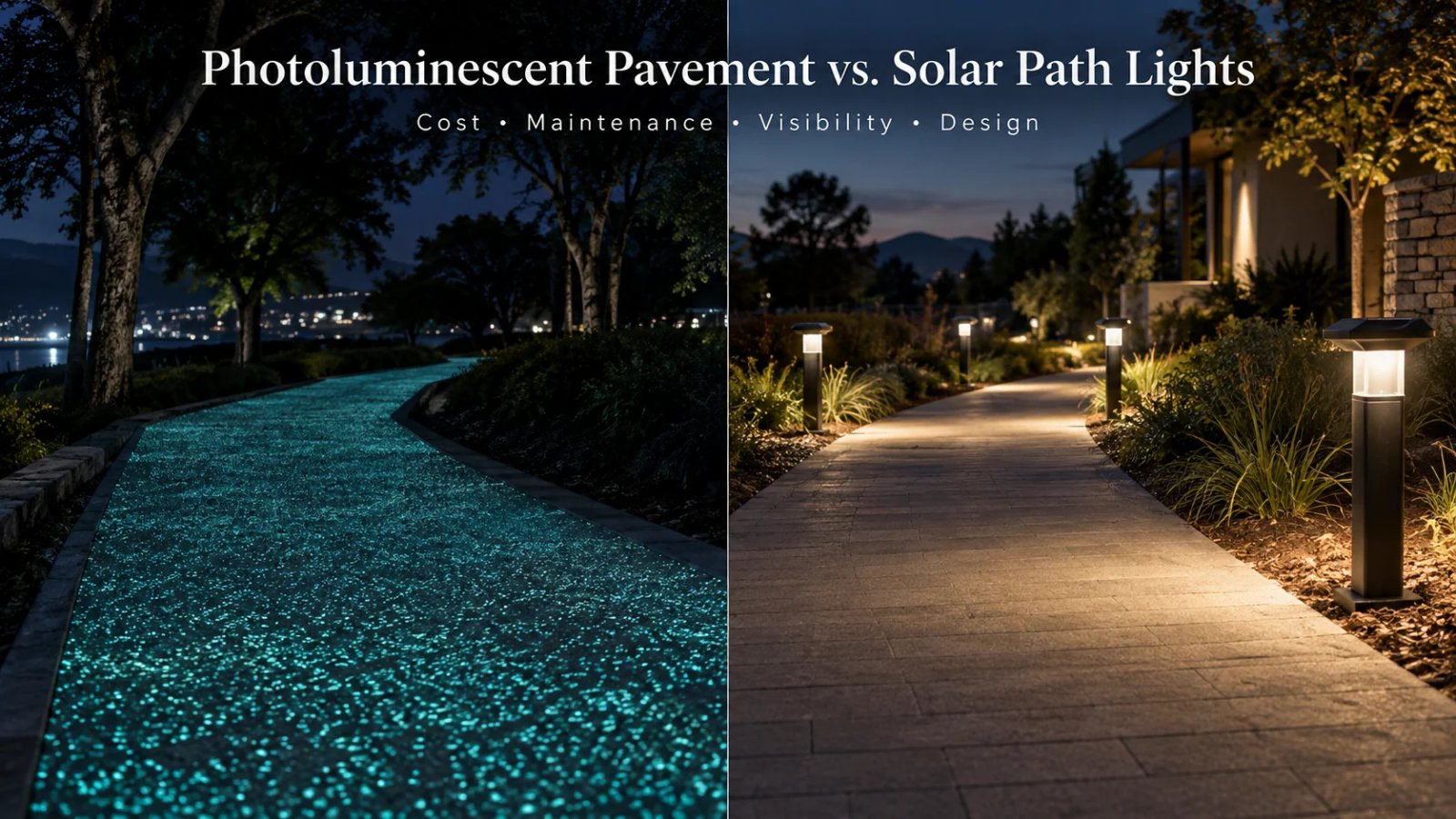
Photoluminescent pavement and solar path lights create different nighttime effects. Glow aggregate embedded in the paving surface provides a soft afterglow, while solar panels and batteries power LED fixtures that provide more concentrated illumination.
For a garden path, park trail, resort walkway or landscape route, the choice depends on the project. Consider whether the pavement is new or existing, how much daylight the site receives, the required illumination, maintenance needs and the desired appearance.
This guide compares installation, upkeep, site conditions and total project cost, including when the two systems can work together. Photoluminescent pavement should complement applicable lighting and safety requirements rather than automatically replace them.
How Photoluminescent Pavement Works
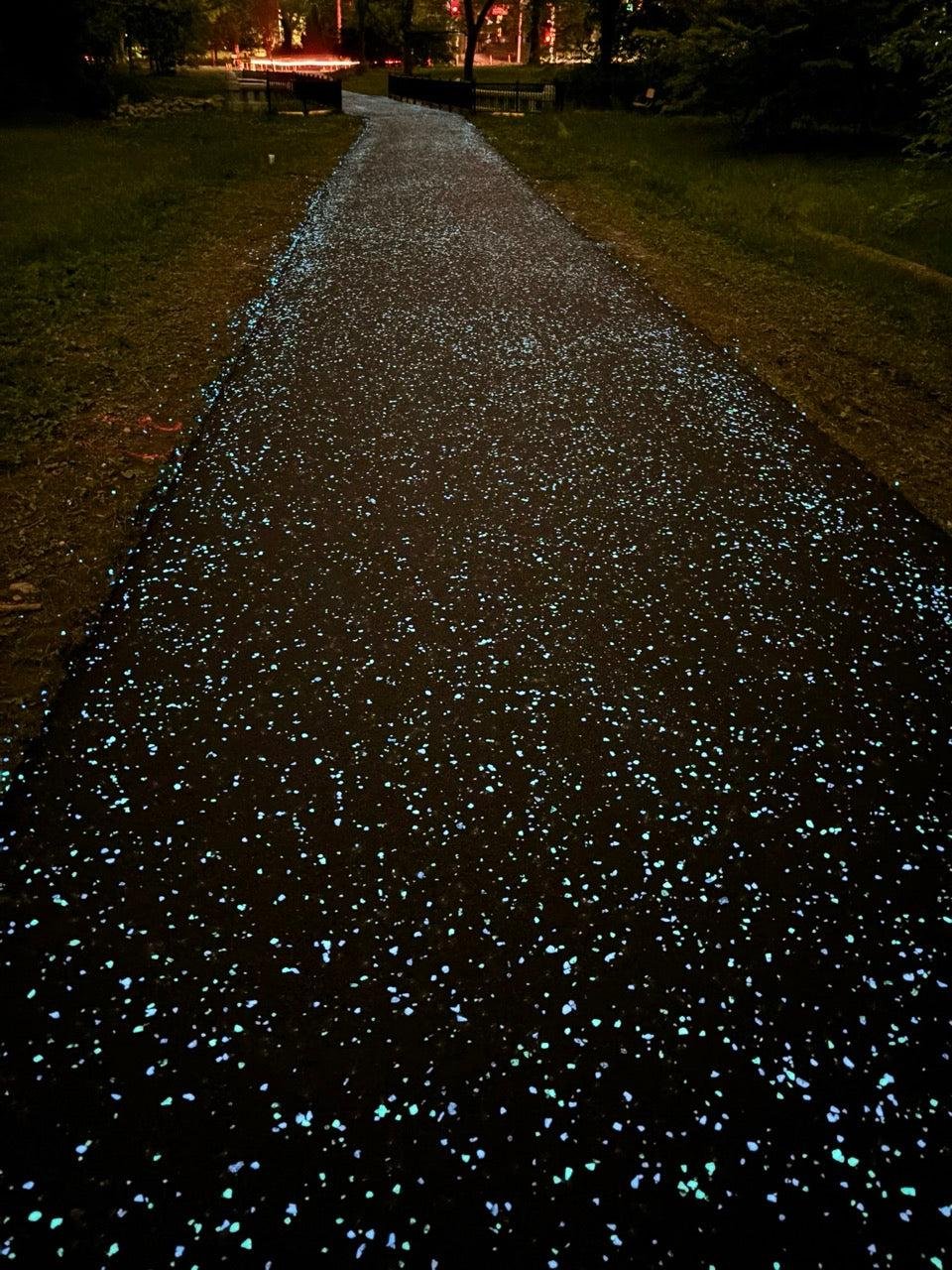
Photoluminescent aggregate absorbs available light during the day and gradually releases that stored energy after dark.
The luminous material can be incorporated into:
-
concrete
-
exposed aggregate concrete
-
asphalt
-
resin-bound paving
-
decorative landscape surfaces
Once installed, the glowing points become part of the pavement itself.
There are no individual electrical wires connected to each stone.
The effect is usually soft and distributed rather than bright like a lamp.
How Solar Path Lights Work
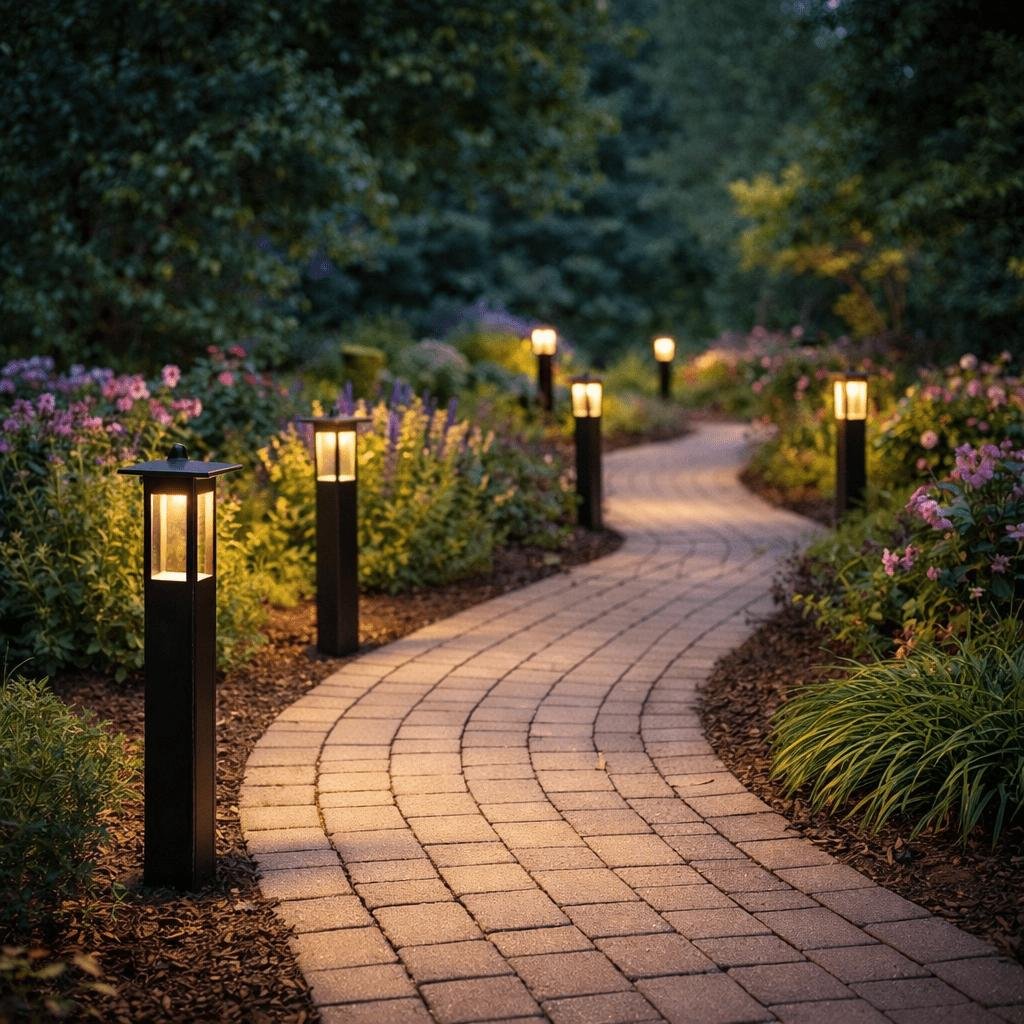
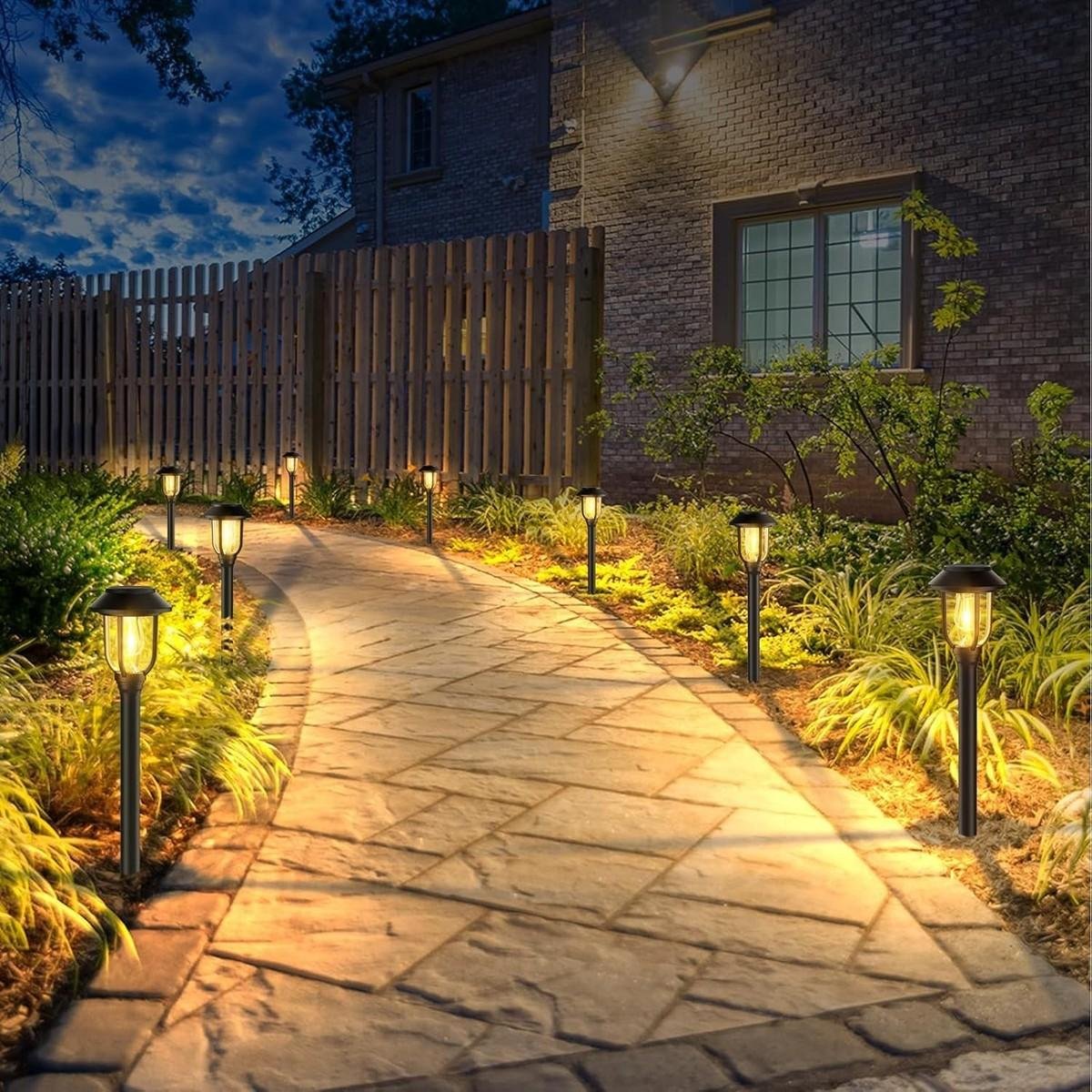
Solar path lights use a small photovoltaic panel to charge an internal battery during the day.
After dark, the battery powers an LED light.
They are often installed:
-
beside garden paths
-
along lawns
-
around driveways
-
in landscape borders
-
near steps and entrances
Solar lights provide a more concentrated light source.
Photoluminescent aggregate provides a passive glowing surface.
That difference is important.
Illumination vs. Surface Glow: The Key Difference
Solar lights behave like small lamps.
They project light into the surrounding area.
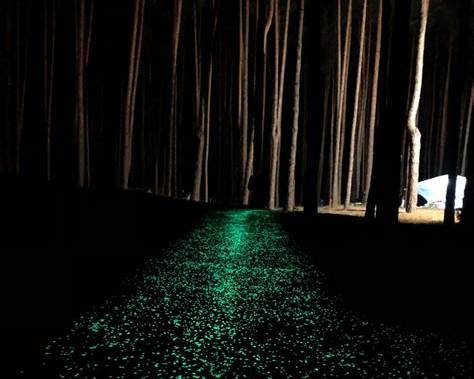
Photoluminescent pavement behaves more like a visible surface treatment.
The pavement itself becomes easier to recognize after dark.
For example:
A solar bollard may illuminate a section of path from the side.
A photoluminescent pathway may show hundreds of glowing points distributed directly across the pavement.
Neither effect is automatically better.
They serve different design purposes.
When Photoluminescent Pavement Makes Sense
Photoluminescent aggregate can be particularly useful when the project already requires a new pavement.
For example, if a concrete pathway is already being constructed, the glow aggregate can be incorporated during the paving process.
Suitable applications may include:
-
parks
-
resorts
-
garden paths
-
landscape trails
-
courtyards
-
scenic routes
-
waterfront areas
-
bike paths
-
decorative plazas
The result is integrated into the architecture rather than added as separate fixtures.
When Solar Path Lights Make Sense
Solar lights can be convenient when an existing pathway is already finished and the owner does not want to rebuild the pavement.
They can also be useful when the project needs visible point lighting in specific locations.
For example:
-
entrances
-
steps
-
garden edges
-
small residential paths
-
temporary landscape upgrades
Installation can often be simpler because the pavement itself does not need to be modified.
Installation: New Pavement and Retrofit Projects
Photoluminescent Pavement
Installation normally needs to be coordinated with the paving work.
Depending on the substrate, the aggregate may be:
-
surface-seeded
-
embedded
-
rolled into asphalt
-
exposed after concrete finishing
-
incorporated into resin systems
This means planning should happen before or during pavement construction.
Solar Path Lights
Solar lights are normally installed after the landscape or path is complete.
Installation may involve:
-
placing stakes
-
fixing bases
-
positioning solar panels
-
spacing fixtures
-
replacing or maintaining individual units
This can make solar lights easier for retrofit projects.
Maintenance: Pavement Care vs. Light Fixtures
Photoluminescent pavement has no individual batteries or electronic components inside the glow aggregate.
However, the pavement still needs normal maintenance.
This may include:
-
cleaning
-
removing leaves and dirt
-
repairing cracks
-
maintaining sealers if used
-
keeping the luminous aggregate exposed
Solar lights have different maintenance needs.
Depending on the system, maintenance may include:
-
cleaning solar panels
-
replacing batteries
-
replacing damaged fixtures
-
checking water ingress
-
repositioning tilted lights
-
replacing failed LEDs or electronics
For large projects, the number of individual fixtures can become an important maintenance consideration.
Dirt Affects Both Systems
Both technologies depend on receiving light during the day.
If a solar panel becomes heavily covered with dust or leaves, charging performance may decrease.
If photoluminescent aggregate becomes covered by dirt, soil or debris, less luminous surface remains exposed.
So neither system should be treated as completely maintenance-free.
Site conditions matter.
A clean open plaza and a forest path under dense trees will have very different maintenance requirements.
How Shade Affects Both Systems
Shaded areas are important to evaluate.
Photoluminescent aggregate still needs sufficient light exposure.
Solar panels also need enough light to recharge.
If the pathway sits under dense tree cover for most of the day, both systems may perform differently than they would in an open location.
This is why site testing is important.
Do not select either system only from product photos.
Look at the actual daytime light conditions first.
Nighttime Appearance
This is where the two systems feel very different.
Photoluminescent Pavement
The effect can look:
-
subtle
-
atmospheric
-
integrated
-
star-like
-
continuous across the path
This is often attractive in landscape design.
Solar Lights
The effect is usually:
-
brighter at individual points
-
more directional
-
easier to recognize as lighting fixtures
-
more concentrated
For resorts, parks and decorative landscapes, the preferred choice depends heavily on the desired visual style.
Which One Looks More Natural?
Photoluminescent aggregate is usually less visually intrusive during the day because the luminous particles can blend into the pavement.
Solar lights remain visible as physical fixtures.
For projects where landscape designers want fewer visible objects along the path, integrated glow aggregate can be attractive.
For projects where visible fixtures are acceptable or even desirable, solar lighting may work well.
Which One Provides More Light?
Solar LED lights can generally provide stronger illumination than photoluminescent aggregate.
This is an important distinction.
Glow aggregate provides an afterglow.
It should not be treated as the same thing as a powered lighting fixture.
Where strong illumination is required, electrical or solar lighting may still be necessary.
Photoluminescent pavement is better understood as:
passive nighttime visibility and decorative guidance
rather than full-area lighting.
Can the Two Systems Be Used Together?
Yes.
In fact, combining them can sometimes make more sense than choosing only one.
For example:
Solar lights may be installed at:
-
intersections
-
steps
-
entrances
-
important safety points
while photoluminescent aggregate is used along:
-
pathway surfaces
-
edges
-
decorative bands
-
landscape sections
This creates a layered nighttime design.
The lights provide stronger illumination where needed.
The glow aggregate creates a continuous visual identity across the pavement.
Comparing Total Installation and Maintenance Costs
Comparing only the price of one glow stone and one solar lamp is not useful.
A real project should compare total system cost.
For photoluminescent pavement, consider:
-
aggregate
-
paving
-
installation labor
-
sample testing
-
surface finishing
-
maintenance
For solar lighting, consider:
-
fixtures
-
poles or stakes
-
batteries
-
installation
-
replacement parts
-
maintenance
-
future unit replacement
The cheapest product price does not necessarily mean the lowest long-term project cost.
New Construction vs. Existing Pathway
This is one of the easiest ways to narrow the choice.
New Pathway
If a new concrete or asphalt path is already being constructed, photoluminescent aggregate can be incorporated as part of the paving work.
This may make the system easier to integrate visually.
Existing Pathway
If the pavement is already finished, installing solar path lights may require less modification.
Adding photoluminescent aggregate to an existing surface usually requires an additional compatible overlay, coating or resurfacing system.
So project timing matters.
Public Projects Need More Careful Planning
For public trails, parks and municipal spaces, the decision should not be based only on visual appearance.
Designers should also consider:
-
local lighting requirements
-
pedestrian safety
-
accessibility
-
expected traffic
-
vandalism risk
-
maintenance access
-
climate
-
drainage
-
surrounding vegetation
Photoluminescent material should complement applicable lighting and safety requirements rather than automatically replace them.
What About Bike Paths?
Bike paths are an interesting application because users move faster than pedestrians.
A few isolated glowing points may be less useful than a clear continuous pattern.
Photoluminescent aggregate can be arranged as:
-
edge bands
-
repeated patterns
-
continuous scattered surfaces
-
selected guidance zones
Solar lights can be positioned at specific intervals.
The final choice depends on:
-
riding speed
-
viewing distance
-
path geometry
-
surrounding darkness
-
required illumination
A test section is especially useful.
Which System Is Better in a Dark-Sky Area?
Projects that aim to reduce excessive artificial lighting may find passive luminous materials interesting.
Photoluminescent pavement does not project strong light upward like conventional fixtures.
Its visual effect remains concentrated near the surface.
However, any project in a protected dark-sky environment should still follow the site's specific lighting and environmental requirements.
The advantage is mainly that glow aggregate can provide a softer surface-level visual feature.
Which One Is Easier to Replace?
Solar lights are individual components.
If one fails, that fixture can often be replaced separately.
Photoluminescent aggregate is integrated into the pavement.
If the pavement becomes damaged, repair may require local surface reconstruction.
So repair strategy is another difference:
solar lighting = replaceable components
photoluminescent paving = integrated pavement system
Both have advantages depending on the project.
A Practical Way to Choose
Before deciding, ask five questions.
Is this a new pavement or an existing path?
Do we need real illumination or mainly visual guidance?
How much daylight does the site receive?
What maintenance resources are available?
What nighttime appearance does the designer want?
These answers usually make the decision much easier.
Example: Resort Garden Path
Imagine a resort is building a new concrete path through landscaped gardens.
The goal is not to brightly illuminate the entire area.
The designer wants a soft, premium nighttime effect.
In this case, photoluminescent aggregate may fit the design well.
Solar lights could still be used at:
-
stairs
-
entrances
-
intersections
This combination creates both visual atmosphere and functional lighting.
Example: Existing Residential Walkway
Now imagine a homeowner already has a finished concrete path.
They simply want some nighttime visibility.
Rebuilding the surface may not make economic sense.
Installing a few solar lights may be the simpler option.
This is why the answer depends on the project rather than the technology alone.
Frequently Asked Questions
Are glow stones brighter than solar lights?
No. Solar LED fixtures can provide stronger illumination. Glow stones provide a softer passive afterglow.
Do photoluminescent pathways need electricity?
The luminous aggregate itself does not need an electrical connection. It absorbs available light and releases it after dark.
Do solar lights work in shade?
Performance depends on how much light reaches the solar panel. Heavily shaded locations may reduce charging performance.
Can glow pavement replace required safety lighting?
It should not automatically be treated as a replacement for lighting required by local standards or safety requirements.
Which requires less maintenance?
The answer depends on the site and system. Glow pavement avoids individual electronic fixtures, while solar lights can require battery, panel or fixture maintenance.
Can I combine glow stones and solar lights?
Yes. Using both can provide stronger illumination at key locations while maintaining a continuous decorative glow along the pathway.
A Useful Project Design Principle
The choice does not need to be:
photoluminescent pavement OR solar lights.
Sometimes the better question is:
Where should each technology be used?
Use stronger powered light where people genuinely need illumination.
Use photoluminescent aggregate where the project needs:
-
surface guidance
-
decorative atmosphere
-
continuous visual identity
-
passive nighttime effects
This can produce a more balanced landscape design than forcing one system to do everything.
Final Thoughts
Photoluminescent pavement and solar path lights solve different problems.
Solar lights are better when the project needs concentrated illumination from individual fixtures.
Photoluminescent aggregate is useful when the design calls for an integrated glowing pavement surface with no individual electrical connection to each luminous point.
For new pathways, parks, resorts and landscape projects, the best solution may even combine both.
Before deciding, evaluate:
site lighting + pavement type + maintenance + visual goal + project budget.
Then build a small test section if possible.
A real nighttime test is far more useful than comparing two product photos online.