

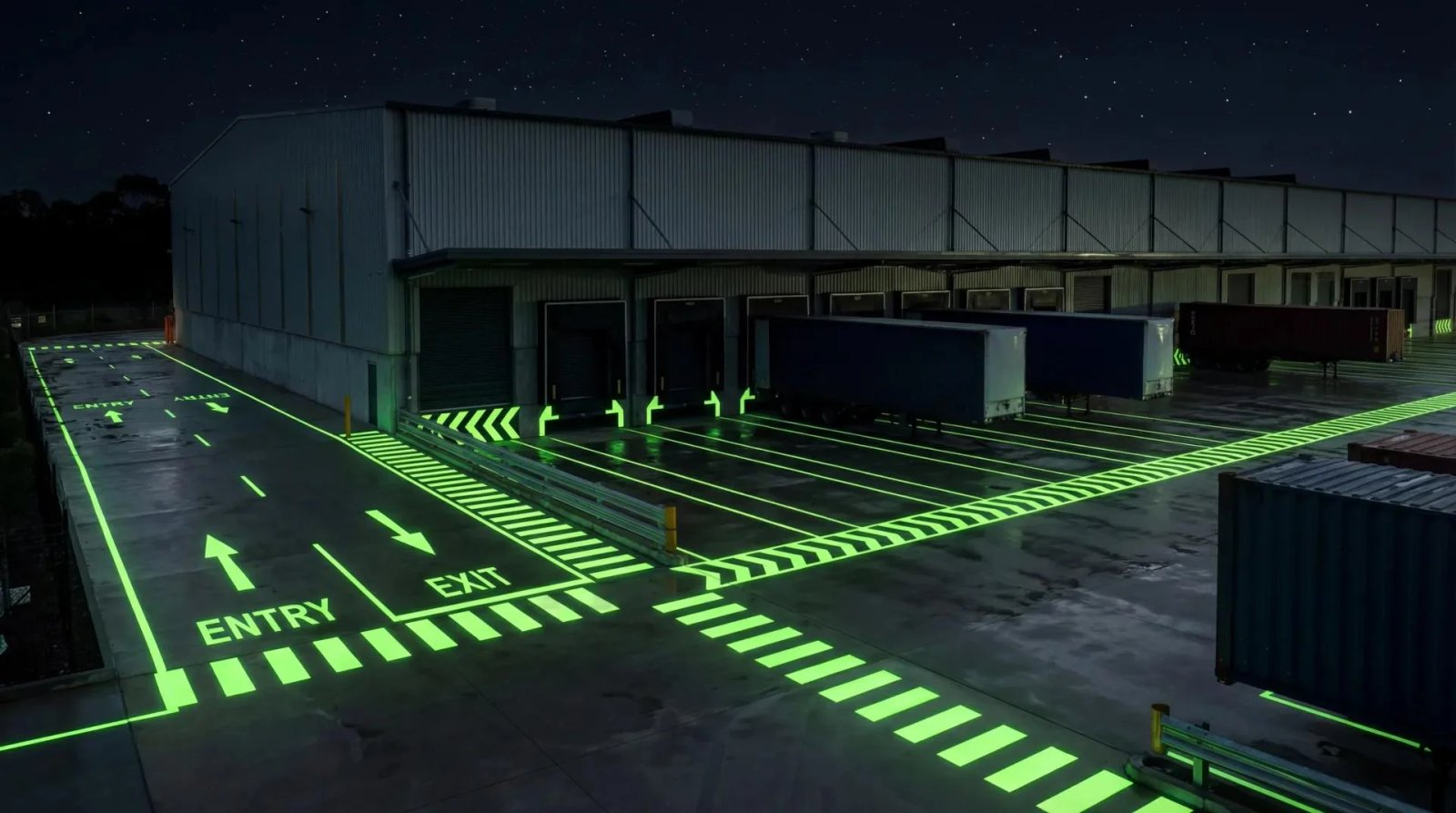
Photoluminescent fire lane markings can add supplementary nighttime visibility to emergency access routes. Selected boundary lines, text and arrows absorb daylight or suitable artificial light, then release a visible afterglow as the surroundings become darker.
Fire lanes must remain clear for fire trucks, ambulances and other emergency vehicles. A luminous marking can make a route easier to recognize in low light, but it does not replace required fire lane markings, signs, lighting or emergency-access requirements.
How the markings work
The light-storing material in the pavement marking absorbs and stores energy, then releases it gradually as visible afterglow:
Charge with Light → Store Energy → Glow in Darkness → Recharge
Unlike LED systems, the marking needs no electrical power for the afterglow itself. It normally looks brightest shortly after the environment becomes dark, then its brightness decreases. This fading is normal and should not be compared directly with continuously powered lighting.
Afterglow duration depends on pigment quality, charging time, light intensity, material concentration, ambient darkness and surface condition.
Use lines, text and arrows to identify the route
Standard painted markings are usually easy to identify in daylight, but their nighttime visibility may depend on streetlights, building lights or headlights. Keeping selected lines and symbols visible for a period after darkness begins can add guidance without changing the basic road layout.
Boundary lines
Options include continuous luminous edge lines, luminous borders beside standard colored markings, photoluminescent warning segments and glow direction indicators along a designated emergency route.
Pavement text
Examples include FIRE LANE, NO PARKING, EMERGENCY ACCESS and KEEP CLEAR. Text should remain large, simple and easy to understand.
These markings may be useful near building entrances, fire department connections, loading areas, emergency gates and parking-lot access points. Their use must fit the local requirements discussed below.
Directional arrows
On large properties, arrows can help indicate fire-truck direction, emergency-vehicle entry, exit routes, turning areas and access to building sides. They can combine with boundary lines to form a continuous guidance system.
Match the application to the property
Clear identification is particularly important at large commercial properties, industrial parks, warehouses, residential communities, shopping centers, hotels, hospitals, parking areas, underground garages and public facilities.
Parking lots and commercial properties
Consider selected markings around building perimeters, main entrances, emergency exits, fire access roads, loading zones and no-parking areas. They can help distinguish emergency access from ordinary parking spaces, including access around shopping centers and office buildings.
Underground garages
Limited daylight means suitable artificial lighting becomes the main charging source. Potential applications include fire access routes, emergency-vehicle lanes, no-parking zones, exit arrows and fire-equipment areas. Test the actual glow performance under the existing garage lighting.
Warehouses and industrial facilities
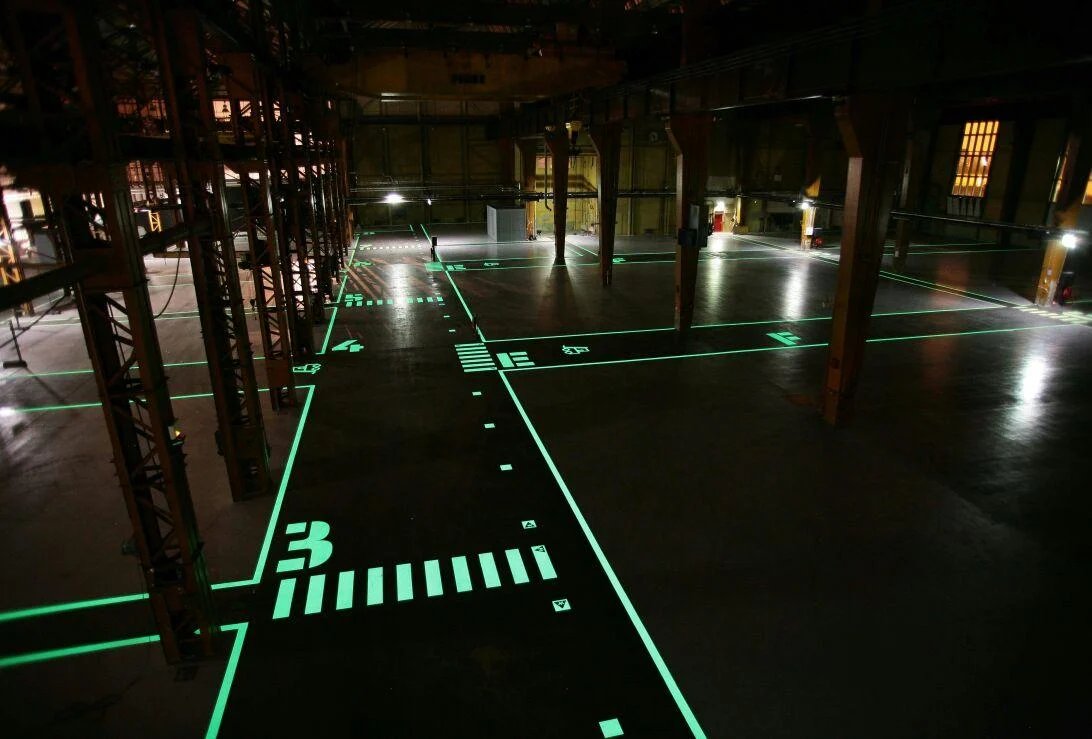
Large paved areas at industrial sites must retain clear emergency access. Possible marking locations include warehouse entrances, loading docks, factory buildings, emergency gates, fire-equipment zones and restricted parking areas.
These environments may experience heavy vehicle traffic, making durability especially important. Markings can help identify fire-truck routes around loading areas and industrial buildings.
Residential communities
Internal fire access roads and parking areas may run along building fronts, apartment entrances, courtyards, access roads and emergency gates. Photoluminescent markings can add nighttime visibility without introducing electrical components into the pavement marking itself.
Hotels and resorts
Hotels and resorts combine vehicle access, landscaping, pedestrian routes and parking. Luminous markings may help distinguish fire access around hotel entrances, service roads, fire access zones, parking areas and internal resort roads while maintaining a clean nighttime appearance. The design should remain clearly functional rather than decorative.
Check surface color and contrast
- Dark asphalt: green or blue-green markings can create strong nighttime contrast.
- Light concrete: a dark daytime outline combined with luminous material may improve recognition.
- Colored pavement: the luminous color should remain visually distinct from the surrounding surface.
Assess a sample before full installation.
Choose the substrate, binder and layer arrangement
Depending on the coating system, markings may be applied to asphalt, concrete, epoxy-coated surfaces, resin pavement or industrial flooring. Select the primer and binder according to the substrate.
Photoluminescent material often performs better over a light-colored base. A white layer can help reflect more light through the luminous material. A typical arrangement may include:
- Pavement
- Primer
- White base coat
- Photoluminescent layer
- Protective topcoat
Prepare for traffic, wear and skid resistance
Before application, the surface should normally be clean, dry, stable, free from oil and loose material, and free from excessive dust. Poor preparation can reduce adhesion and shorten service life.
Fire lanes may encounter cars, delivery vehicles, fire trucks, service vehicles and turning movements. Heavy traffic can cause abrasion, so select the system for the expected traffic level. A decorative glow coating designed for pedestrian areas may not suit vehicle routes.
Markings should not create slippery pavement, particularly at curves, entrances, ramps, wet areas and loading zones. Anti-slip aggregate may be incorporated where necessary. Balance:
Visibility + Adhesion + Wear Resistance + Skid Resistance
Evaluate weather and charging conditions
Outdoor markings face sunlight, UV radiation, rain, temperature changes, dust and vehicle contamination. The binder and protective coating should be suitable for outdoor use.
Outdoor routes generally receive daylight, while indoor or covered areas depend more on artificial light. Glow performance is affected by light intensity, exposure time, lamp type, pigment quality, coating thickness and surface cleanliness. A shaded fire lane may charge less effectively than one receiving direct daylight.
Compare reflective, photoluminescent and LED guidance
Reflective markings reflect headlights or another external light source. Photoluminescent markings absorb light beforehand and release afterglow later. Some projects combine both technologies for reflection under headlights and passive glow when direct illumination is limited.
Photoluminescent marking
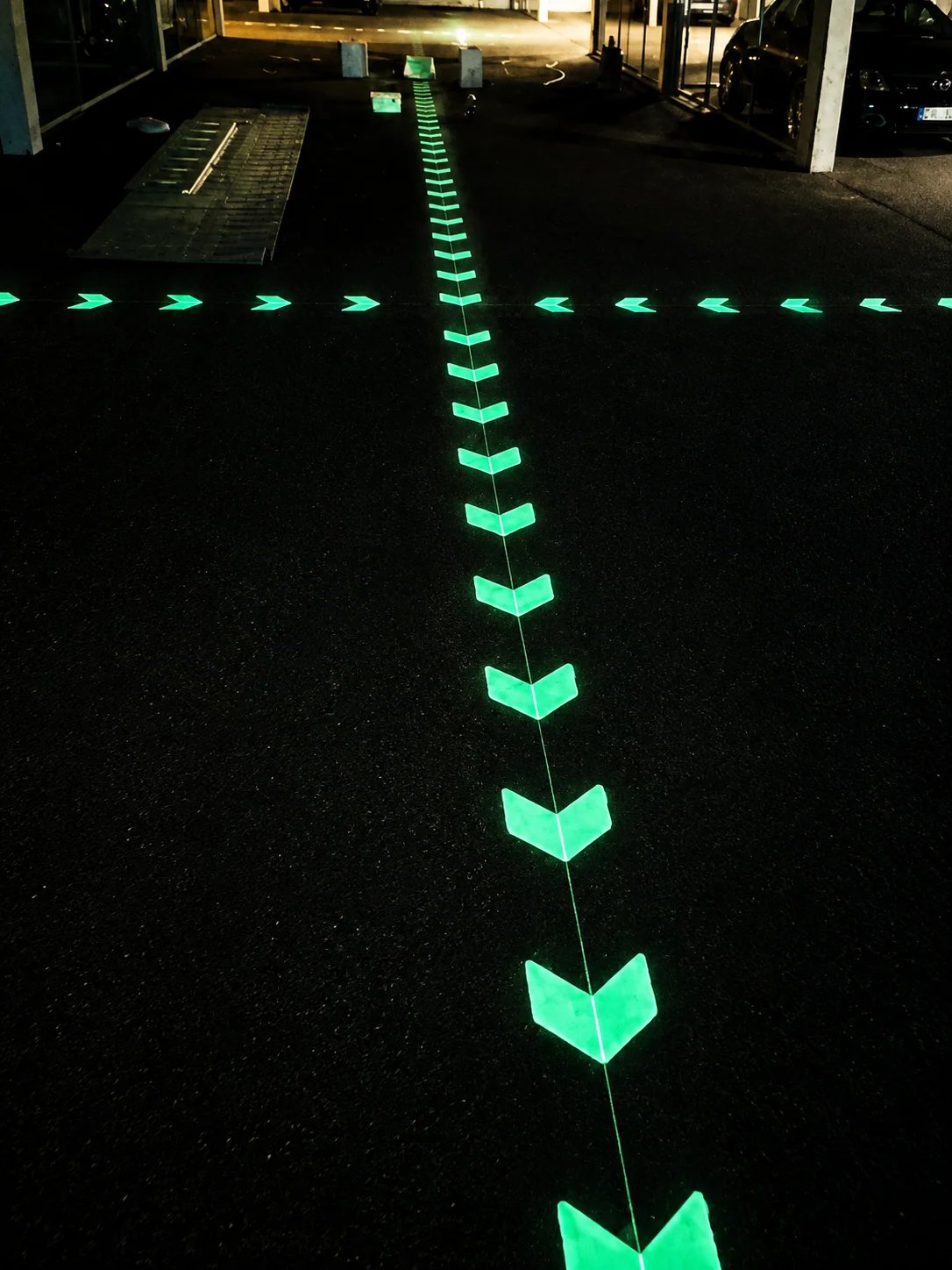
- No wiring needed for the afterglow
- Integrated into the pavement
- Passive operation
- Gradually fading brightness
LED guidance
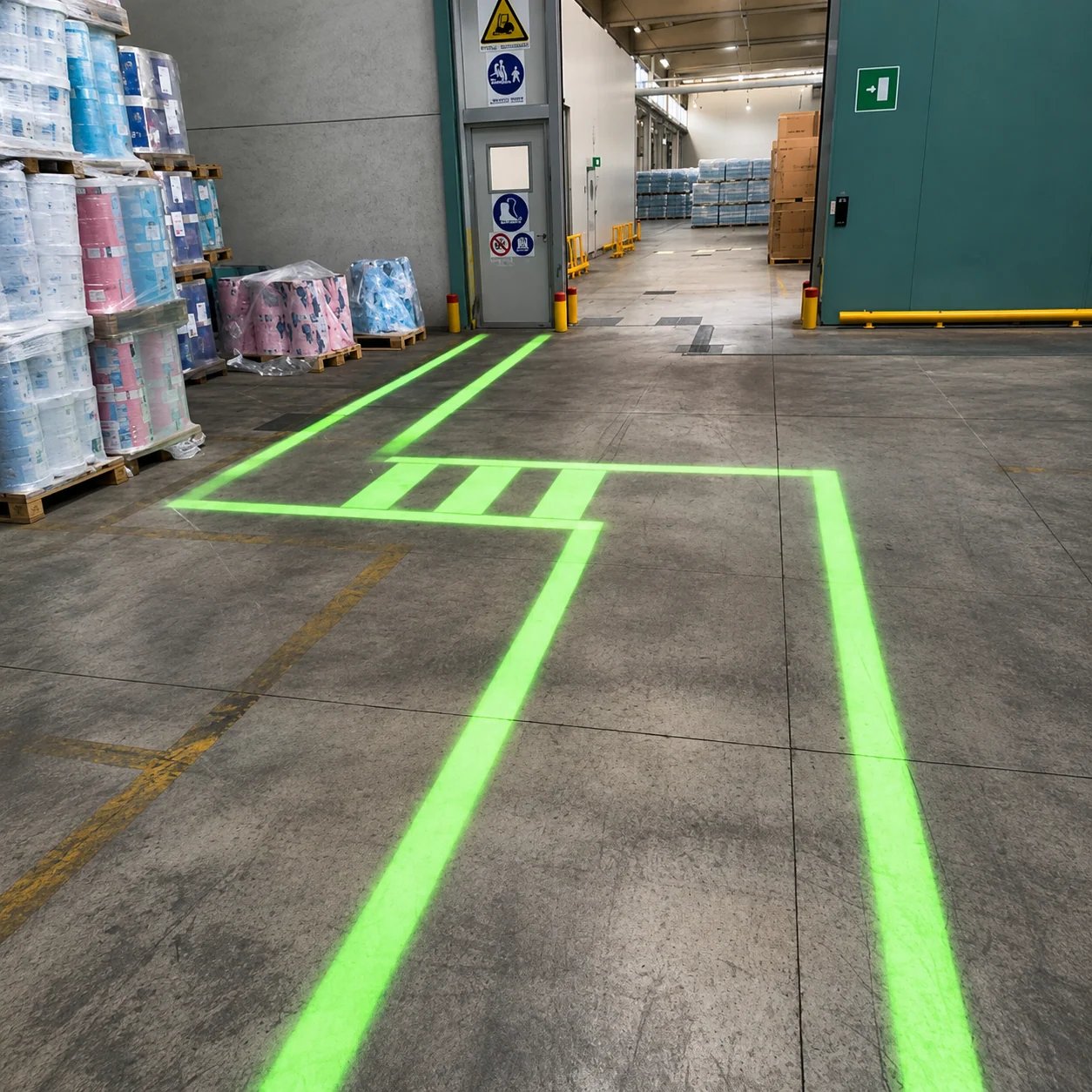
- Requires electrical or solar power
- Produces stronger active illumination
- Involves more complex installation
- Can maintain consistent brightness
The appropriate option depends on the project environment.
Keep required fire lane markings and emergency lighting
Photoluminescent materials do not automatically replace standard fire lane markings. Local requirements may cover color, text, line width, placement, no-parking zones, emergency access and fire codes. Use these materials only where they are compatible with applicable regulations. In many projects, they are best used as a supplementary element alongside the required marking.
They cannot replace emergency lighting. Pavement markings improve route visibility but do not illuminate the surroundings. They cannot replace the lighting needed to see vehicles, pedestrians, obstacles, building entrances or fire equipment.
Test before installing across a large site
Make a test section using the actual pavement, primer, base coat, photoluminescent material and protective layer. Evaluate daytime appearance, nighttime glow, adhesion, skid resistance, vehicle wear and charging conditions to help determine whether the system suits the site.
Clean and inspect the markings
Dust, mud, tire residue, oil and leaves can block light and reduce charging. Routine cleaning keeps the luminous surface exposed and can improve nighttime performance. Regularly inspect for surface wear, peeling, loss of adhesion and reduced visibility.
The complete system depends on surface preparation, charging conditions, a suitable binder, skid resistance, wear resistance and regular maintenance. Photoluminescent markings should support the fire lane markings, signs, lighting and emergency-access requirements specified by local regulations.
Discuss your emergency-access marking project
FUXIN supplies Photoluminescent Pigments, Luminous Road Marking Materials, Glow-in-the-Dark Traffic Marking Materials, and Pavement Coating Systems for parking areas, fire access routes, industrial facilities, pedestrian routes and low-light applications.
Contact us for samples, quotations or project material recommendations.