


Photoluminescent aggregate can be used near the surface of suitable asphalt paving systems to create visible glowing points after dark. For bike paths, pedestrian trails and landscape roads, the aim is to keep enough aggregate securely anchored while leaving enough luminous surface exposed.
Asphalt has a different binder and construction process from concrete, so the installation method needs careful evaluation. Mixing glow stones throughout the full asphalt layer is usually inefficient. Review surface application, construction conditions, particle size and site lighting, then test the actual aggregate and asphalt system before a larger installation.
Why Asphalt Is Interesting for Photoluminescent Pavement

Asphalt is widely used for outdoor paths because it can create a continuous, relatively smooth pavement surface.
Typical applications include:
-
bicycle paths
-
pedestrian trails
-
parks
-
greenways
-
resort roads
-
landscape paths
-
recreational areas
These are also environments where passive nighttime visual effects can be useful.
Photoluminescent aggregate can add small glowing points to the pavement without requiring each luminous particle to be connected to electricity.
For decorative paths and low-light landscape projects, this can create a distinctive nighttime appearance.
Keep luminous aggregate near the asphalt surface
This is one of the most important design principles.
If photoluminescent aggregate is mixed throughout the entire asphalt thickness, a large percentage of the material may become completely hidden.
Those buried particles cannot contribute much to the visible nighttime effect.
They may still be physically inside the pavement, but they are not exposed to enough light and cannot be seen from the surface.
That means part of the material cost is effectively wasted.
For a luminous pavement, it is generally more efficient to concentrate the glow aggregate near the upper surface.
The same principle applies to concrete:
What matters is not only how many kilograms of glow aggregate are used, but how much luminous surface remains visible.
Surface Seeding Can Make Better Use of the Material
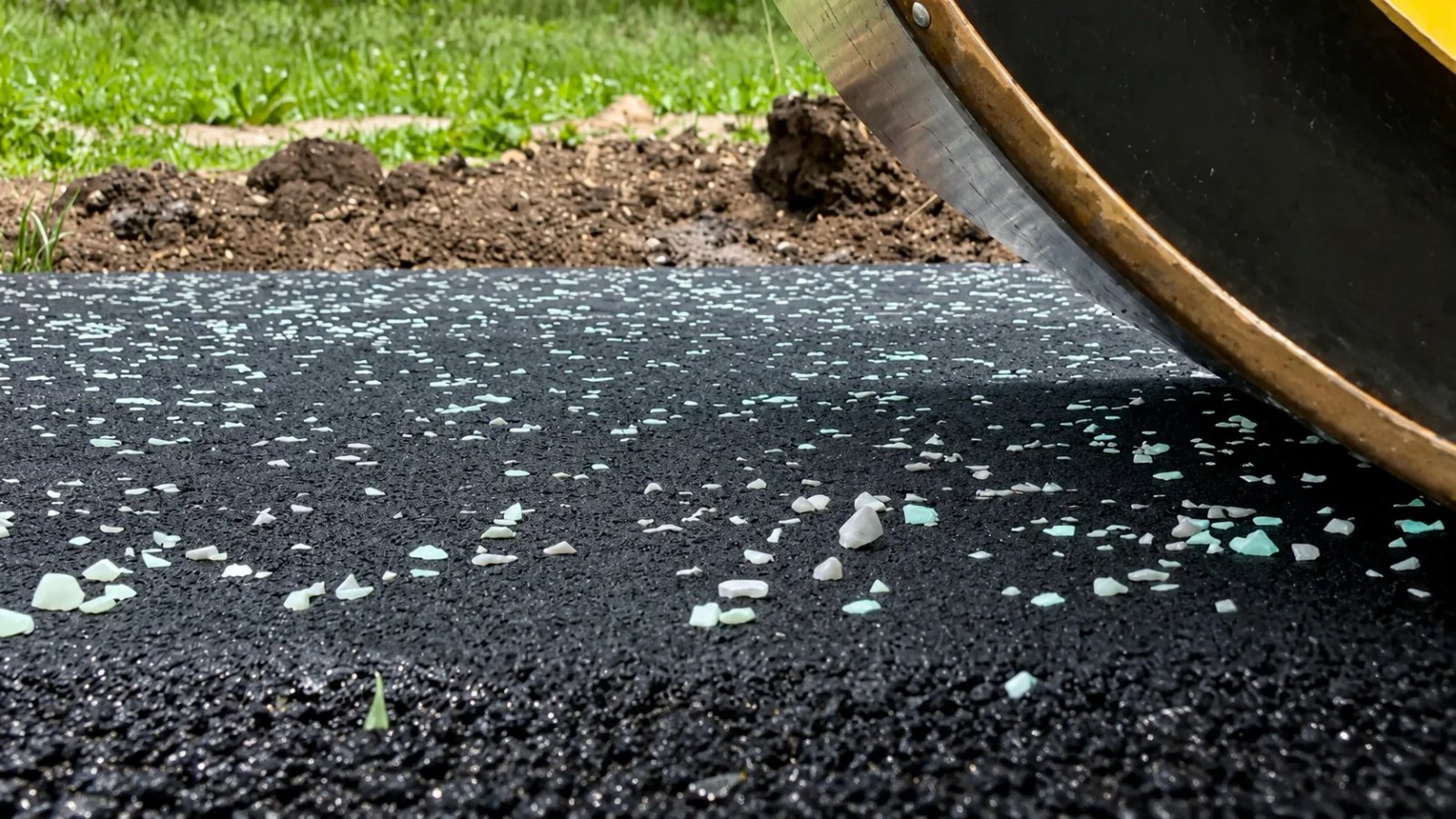
One approach for asphalt applications is to distribute suitable glow aggregate over the upper surface while the paving layer can still accept and hold the particles.
The aggregate is then embedded into the surface using an appropriate construction method.
The aim is to achieve two things at the same time:
Strong enough embedment for durability
and
Enough exposure for charging and nighttime visibility
If the stones remain too loose, they may detach.
If they are pushed too deeply into the asphalt, the luminous effect may become weaker.
This balance should be confirmed with a test section before full-scale installation.
Check compatibility with asphalt construction temperatures
Unlike many decorative concrete applications, asphalt installation involves elevated material temperatures.
This makes material compatibility particularly important.
Before using photoluminescent aggregate in a hot asphalt process, the supplier and contractor should confirm that the luminous material is suitable for the intended installation conditions.
Do not assume that every type of decorative glow stone can tolerate every asphalt process.
Factors such as the aggregate composition, binder system and construction sequence all matter.
For this reason, we recommend evaluating the actual glow aggregate together with the intended asphalt system rather than choosing the material only from photographs.
Particle Size Changes the Finished Effect
The three particle ranges you are already using — 1–5mm, 5–10mm and 10–20mm — can create noticeably different asphalt surfaces.
1–5mm
Small particles create many fine luminous points.
They may be useful when the design requires a dense, subtle glow pattern rather than large visible stones.
They can work well for decorative paths and finer surface treatments.
5–10mm
Medium-sized aggregate creates clearer individual glowing points while still allowing relatively even distribution.
For many pedestrian and landscape paths, this size can provide a practical balance between visibility and surface appearance.
10–20mm
Larger particles create stronger individual visual features.
However, large particles need to be integrated carefully into the pavement because surface texture and embedment become more noticeable.
They are often more suitable for decorative feature areas than for surfaces where a smoother finish is required.
Choose the Color for the Site, Not Just the Sample
Blue, blue-green and yellow-green can all create different effects on dark asphalt.
Because asphalt is usually dark, luminous particles can produce strong nighttime contrast.
Blue creates a cooler, modern effect.
Blue-green offers a balance between decorative appearance and visibility.
Yellow-green often appears more noticeable in darker environments and can work well where nighttime recognition is important.
But color should always be evaluated at the actual project site.
Nearby street lights, landscape lighting and vehicle headlights can change how each color appears.
Dark Asphalt Can Create Strong Visual Contrast
One advantage of black or dark-gray asphalt is the nighttime contrast it can create around luminous particles.
During the day, the light-colored photoluminescent aggregate may appear as decorative speckles.
After dark, the same particles become more visually dominant.
This day-to-night transformation is one reason glow aggregate works particularly well in landscape trails and recreational paths.
However, camera photos can exaggerate the effect.
Real projects should always be evaluated with the human eye under normal site lighting.
Where Can Glow Asphalt Be Used?
Photoluminescent aggregate can be considered for a range of decorative and landscape-oriented asphalt applications.
A bike path may use luminous particles throughout the surface or concentrate them near edges.
A park trail may use them to create scattered nighttime points.
A resort may use glow aggregate as part of a decorative route connecting landscape features.
A dark-sky or scenic area may benefit visually because lower ambient lighting creates stronger contrast.
The best layout depends on whether the project goal is decoration, guidance or a stronger luminous feature.
Consider selective coverage for the intended effect
One misconception is that the entire asphalt surface needs to glow.
Often, a more controlled design looks better and uses material more efficiently.
Glow aggregate can be concentrated in:
path edges, curves, entrances, decorative bands, intersections or selected landscape zones.
This can create a clearer visual hierarchy than randomly spreading a small amount across a very large area.
For commercial projects, concentrated design zones can also make it easier to control consumption.
Test the Aggregate Before the Full Asphalt Project
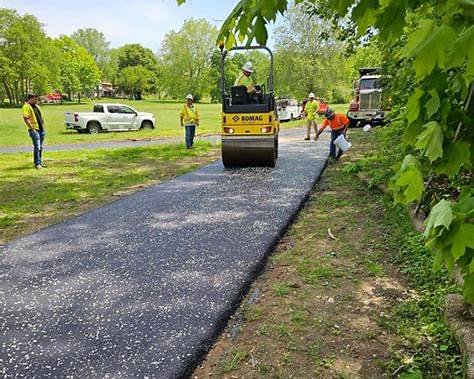
A small test section is especially important with asphalt.
The contractor can evaluate several things before committing to the full project:
aggregate bonding, embedment depth, surface texture, particle distribution, daytime appearance, nighttime visibility and compatibility with the asphalt process.
The test area should then be allowed to experience normal outdoor conditions.
Inspect it after traffic, cleaning and weather exposure if the project schedule allows.
A successful sample panel provides much more useful information than loose glow stones alone.
Check the Path During Both Day and Night
Photoluminescent asphalt needs to work visually in two completely different environments.
During the day, check whether the aggregate distribution looks natural and whether the surface texture is acceptable.
At night, check whether:
the luminous points are evenly distributed, enough aggregate remains exposed, the selected color is visible under surrounding lighting, and the effect can be recognized from the expected viewing distance.
A surface that looks impressive from 50 centimeters away may be much less noticeable from 10 meters.
That matters for bike paths and longer trails.
Don't Treat Glow Aggregate as a Replacement for Required Lighting
Photoluminescent aggregate produces an afterglow, not the continuous illumination of an electric lighting system.
It can provide passive visual features and decorative nighttime guidance, but it should not automatically be considered a replacement for lighting required by local safety standards.
For public roads, transportation facilities or regulated pedestrian areas, applicable local requirements should still determine the lighting and marking system.
Glow aggregate works best as part of the overall pavement and landscape design.
A Common Mistake: Adding More Material Instead of Improving Exposure
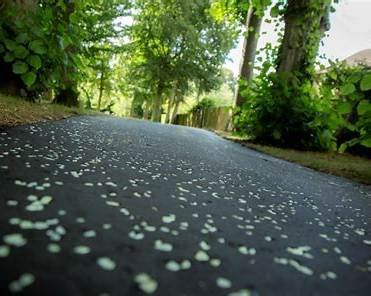
Suppose a test asphalt surface looks weaker than expected.
The immediate reaction may be:
“Use twice as much glow aggregate.”
That may increase the number of luminous particles, but it does not necessarily solve the real problem.
The issue could instead be:
poor surface exposure, excessive embedment, weak charging conditions, strong surrounding lighting, or unsuitable particle distribution.
If those factors are not corrected, adding more aggregate can increase cost without producing a proportional improvement in visible glow.
This is why installation quality matters just as much as material quantity.
Confirm the paving method before material quantity
Before calculating the final quantity, start with the project conditions.
Identify the pavement type, traffic level, installation method, expected daytime exposure and nighttime lighting.
Then choose the glow color and particle size.
After that, make a small sample section using the actual paving method.
Only after evaluating that surface during both daytime and nighttime conditions should the contractor finalize the consumption rate.
This sequence reduces guesswork and makes the material recommendation much more project-specific.
Frequently Asked Questions
Can glow stones be mixed directly into asphalt?
They can be incorporated into asphalt systems, but material buried deep in the pavement contributes little to the visible glow. For luminous applications, surface exposure is critical.
What size photoluminescent aggregate is suitable for asphalt?
The best size depends on the surface and design. Smaller particles create denser luminous points, while larger particles create more noticeable individual features.
Can glow aggregate be rolled into asphalt?
Some asphalt systems use surface application followed by controlled embedding or rolling. The specific method should be tested with the actual aggregate and asphalt construction process.
Does black asphalt make glow stones look brighter?
Dark pavement can create stronger visual contrast with luminous aggregate, especially in low ambient light. Actual visibility still depends on charging, particle exposure and surrounding lighting.
Can glow asphalt be used for bike paths?
Photoluminescent aggregate can be used in suitable recreational and landscape path systems, including bicycle and pedestrian applications, provided the overall pavement design and local requirements are satisfied.
Should I make a test area first?
Yes. For an asphalt project, a small test section is one of the best ways to verify bonding, texture, installation method and nighttime appearance before placing a larger order.
Test the real aggregate in the real asphalt system
Using photoluminescent aggregate in asphalt is not simply about adding glowing stones to a black pavement.
The finished effect depends on the complete system:
aggregate quality + particle size + installation method + embedment depth + surface exposure + charging conditions + nighttime environment.
For project buyers and contractors, the most efficient approach is to test the real material in the real asphalt system before large-scale installation.
A correctly designed surface can use the luminous aggregate much more efficiently than a pavement where expensive material is buried out of sight.