

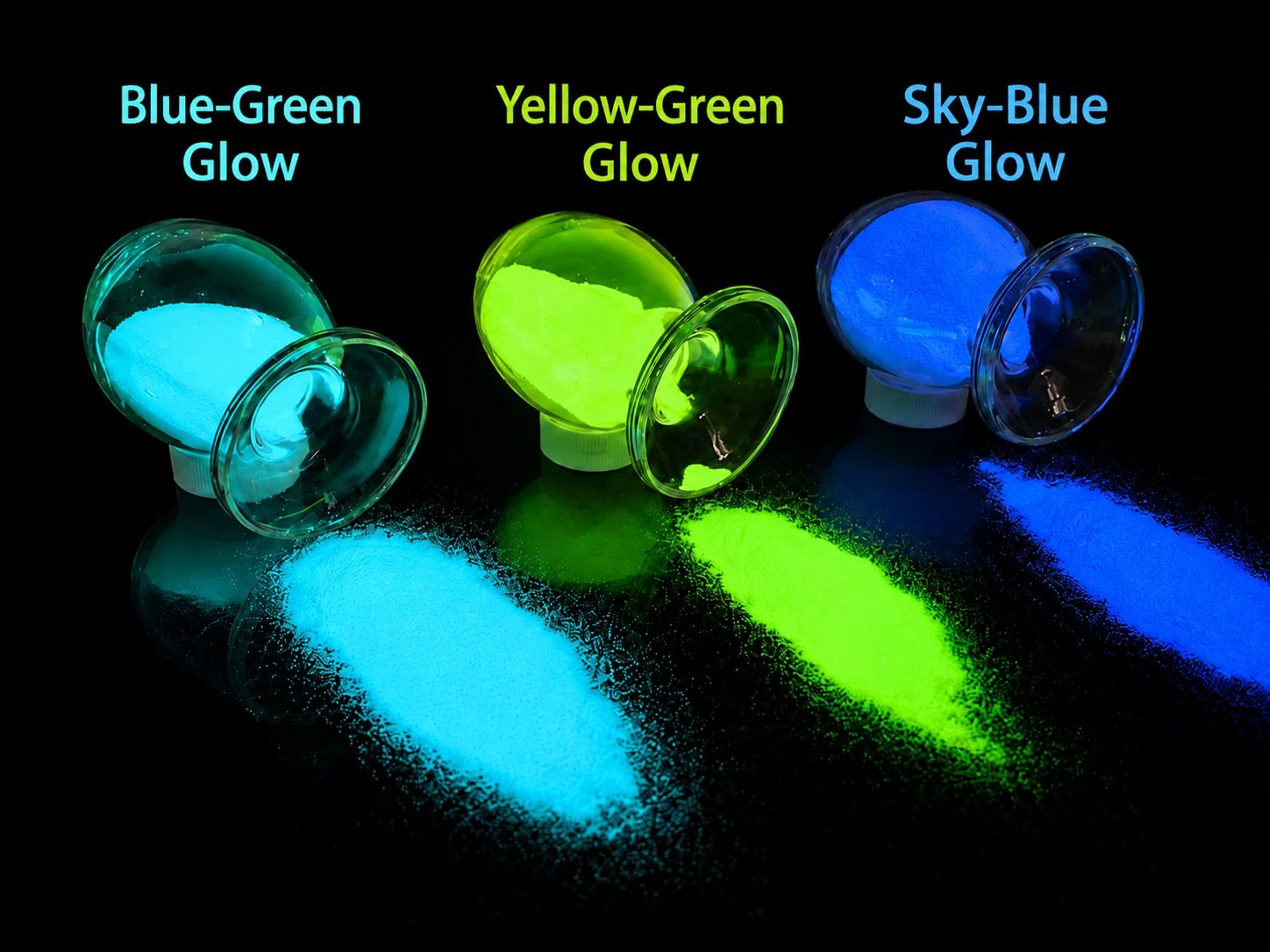
Long afterglow pigment for pavement is used in photoluminescent pavement, glow-in-the-dark pathways, luminous road markings, decorative concrete and resin-bound landscape surfaces. Unlike ordinary fluorescent pigments, it can absorb energy from sunlight or suitable artificial light and gradually release stored energy as the surroundings darken.
Initial brightness alone can be misleading. Particle size, glow colour, binder compatibility, pigment concentration, outdoor exposure, coating structure and charging conditions can all affect the finished result. Evaluate the pigment as part of the complete pavement system.
What Is Long Afterglow Pigment?
Long afterglow pigment is a photoluminescent material capable of storing light energy and releasing it gradually after the charging source is removed.
The basic cycle is:
Light Exposure → Energy Absorption → Energy Storage → Afterglow → Recharge
The material can repeat this process whenever it receives suitable light again. For pavement projects, the pigment is normally incorporated into a compatible coating, resin, or other surface system.
Long Afterglow vs. Fluorescent Pigment
These two materials should not be confused.
Fluorescent Pigment
Fluorescent materials appear especially bright while they are being illuminated. When the light source disappears, the visible effect generally disappears as well.
Long Afterglow Pigment
Photoluminescent pigment stores energy and continues producing visible afterglow after the charging light is removed. This makes it more suitable for glow-in-the-dark applications.
Match pigment to pavement coatings and applications
In pavement-related projects, the material can be used for:
- Photoluminescent road markings
- Glow pavement coatings
- Garden pathways
- Bicycle paths
- Parking guidance
- Decorative concrete
- Resin-bound pavement
- Industrial floor markings
- Landscape pavement
The formulation should be adjusted according to the application.
Photoluminescent Pavement Coatings
One common application is mixing the pigment into a transparent or translucent pavement coating.
A typical coating system may include:
Prepared Pavement
↓
Primer
↓
White Base Coat
↓
Long Afterglow Coating
↓
Transparent Protective Layer
Each layer can influence the final luminous performance.
Why the White Base Matters
Dark pavement can absorb a significant amount of light. This is particularly relevant when applying luminous coatings over black asphalt. A white or light-colored base can reflect more light back through the photoluminescent layer. For many systems, this can improve the apparent nighttime glow.
Before a large project, compare:
Dark Pavement + Glow Coating
with
White Base + Glow Coating
under identical charging conditions.
Choose the glow colour
Common long afterglow colours include yellow-green and blue-green.
Yellow-Green
Often selected when stronger apparent brightness is preferred.
Potential applications include:
- Road marking
- Safety guidance
- Path edges
- Industrial markings
Blue-Green
Provides a cooler visual appearance.
It is often attractive for:
- Parks
- Resorts
- Landscape paths
- Decorative pavement
Colour selection should consider both appearance and performance.
Evaluate afterglow beyond initial brightness
When comparing pigments, buyers often look at the first few seconds after the lights are switched off. That does not provide the complete picture.
A pigment may have:
- Strong initial brightness but faster decay
or
- Moderate initial brightness with longer visible afterglow
For pavement applications, the brightness decay over time should also be evaluated.
Test Afterglow at Different Times
A simple comparison can record appearance at:
- Immediately after charging
- 10 minutes
- 30 minutes
- 60 minutes
- Later intervals if required
All samples should be charged under the same conditions. This provides a much more useful comparison than a single photograph.
Match particle size to the application method
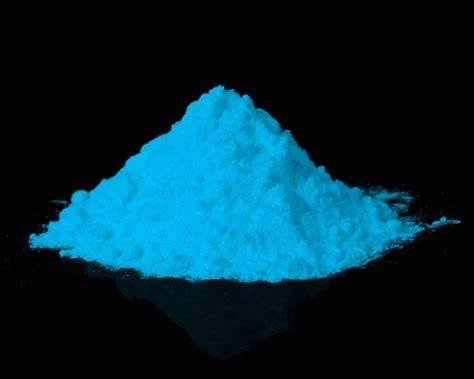
Particle size can affect both luminous performance and processing.
Larger particles may create strong visible luminous points but can influence:
- Surface smoothness
- Sprayability
- Sedimentation
- Coating texture
Finer particles can create a smoother finish but may behave differently in the coating. The appropriate size depends on the application method.
Pigment for Spray Application
If the material will be sprayed, particle size and coating viscosity become particularly important.
Particles that are too large may create:
- Nozzle problems
- Uneven spraying
- Rough surfaces
A trial should be carried out using the actual spray equipment.
Pigment for Roller Application
Roller-applied pavement coatings can often accommodate a wider range of particle sizes. However, the material still needs to remain evenly distributed. The coating should be mixed regularly to reduce pigment settlement.
Pigment Concentration
More pigment does not always produce a better pavement coating. Too little pigment may create weak glow.
Too much pigment can affect:
- Binder strength
- Flow
- Adhesion
- Curing
- Surface texture
- Material cost
The correct concentration should be determined through formulation testing.
Select a transparent binder and compatible formulation
The binder surrounding the pigment should allow light to enter and leave the coating. An overly opaque binder can reduce charging efficiency.
A suitable binder should combine:
Transparency + Adhesion + Water Resistance + Wear Resistance + Weather Resistance
For outdoor projects, UV resistance is also important.
Clear Resin Systems
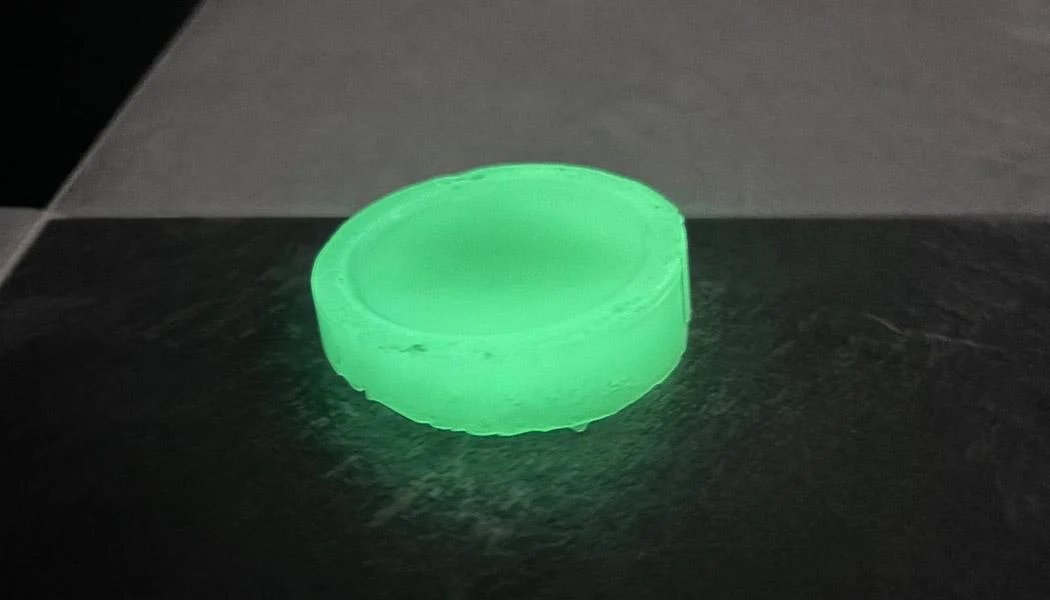
Long afterglow pigment can also be used with compatible transparent resin.
Applications may include:
- Resin-bound pathways
- Decorative pavement
- Landscape inserts
- Luminous patterns
The resin should remain sufficiently transparent after curing.
Avoid Highly Opaque Fillers
Opaque pigments and fillers can block light. If too much opaque material surrounds the photoluminescent particles, the luminous effect may become weaker. This is why simply adding glow powder to any conventional pavement paint does not guarantee good performance.
Evaluate exposure and charging conditions
Long afterglow pigment used outdoors may be exposed to:
- UV radiation
- Rain
- Heat
- Cold
- Humidity
- Dirt
The pigment must therefore be considered together with the binder and protective system.
Outdoor durability is a property of the complete system, not the pigment alone.
Indoor Applications
Indoor pavement applications include:
- Underground parking
- Warehouses
- Industrial floors
- Corridors
These environments usually rely on artificial lighting for charging. Lamp intensity and exposure time should be tested before installation.
Sunlight Charging
Outdoor pavement can benefit from natural daylight. Open areas typically receive better charging than heavily shaded areas.
However, the final effect still depends on:
- Weather
- Shade
- Surface orientation
- Material formulation
A real-site sample provides the best indication.
Artificial-Light Charging
Artificial-light charging depends on:
- Lamp type
- Light intensity
- Distance
- Exposure duration
This is particularly important in underground garages and factories. Do not evaluate an indoor project using only a powerful laboratory charging lamp.
Consider concrete, resin-bound and marking applications
Long afterglow pigment can be used in concrete-related systems, but placement matters. Concrete itself is opaque. Pigment buried deep inside the concrete receives little light and contributes little visible glow.
For many applications, it is more efficient to concentrate luminous material:
- Near the surface
- In a surface coating
- In exposed aggregate
- In transparent resin inserts
Glow Pigment for Resin-Bound Pavement

Transparent resin systems are particularly useful because they allow light to reach luminous materials.
Long afterglow pigment can be combined with:
- Natural aggregate
- Glow aggregate
- Decorative stones
This can create luminous landscape pavement with a more natural appearance.
Road Marking Applications
Long afterglow pigment may be incorporated into compatible road-marking systems for selected applications such as:
- Path edges
- Parking lines
- Bicycle guidance
- Pedestrian routes
- Low-level safety markings
For regulated public roads, applicable traffic-marking requirements should always be checked.
Plan skid resistance and a transparent protective topcoat
A luminous pavement coating still needs to provide safe surface traction.
Anti-slip aggregate may be required for:
- Bicycle paths
- Pedestrian routes
- Ramps
- Parking areas
However, excessive aggregate can partially cover the luminous layer. The system needs to balance glow and traction.
Protective Topcoat
A transparent protective coating may help improve:
- Wear resistance
- Water resistance
- Cleaning resistance
But the topcoat should remain sufficiently transparent. A thick, cloudy, or yellowed topcoat can reduce both charging and visible afterglow.
Mix consistently and keep the surface clean
Photoluminescent pigment can settle in liquid coatings. Good mixing is therefore important.
For larger batches:
- Use suitable mechanical mixing
- Keep mixing consistent
- Avoid excessive air entrainment
- Follow the binder manufacturer's working time
Uneven pigment distribution can create uneven glow.
Surface Cleanliness
Even a high-quality pigment can appear weak if the finished pavement becomes dirty. Dust, oil, mud, and tire residue can block incoming light. Regular cleaning helps keep the luminous material exposed.
Compare samples in a complete pavement system
When comparing several pigments, keep the test conditions identical.
Use the same:
- Pigment quantity
- Binder
- Base colour
- Coating thickness
- Charging source
- Charging duration
- Observation time
Otherwise, the comparison may not be meaningful.
Do Not Compare Supplier Photos Alone
Photographs of luminous materials are highly sensitive to camera settings. Exposure time, ISO, aperture, and image processing can dramatically change apparent brightness. A physical sample test is more reliable for B2B purchasing.
Create a Small Pavement Sample
For a real project, prepare sample panels or a small pavement section.
Test:
- Daytime colour
- Initial glow
- Afterglow
- Adhesion
- Surface texture
- Water resistance
- Skid resistance
For outdoor applications, expose the sample to real weather.
Avoid price, binder and appearance selection mistakes
Photoluminescent pigment prices can vary. But comparing price per kilogram without considering performance can be misleading.
A lower-cost pigment may require:
- Higher dosage
- Thicker coating
- More maintenance
For project buyers, it is better to evaluate the complete material consumption and final performance.
Common Mistake: Using the Wrong Binder
A pigment may perform well in one resin and poorly in another.
The binder can affect:
- Transparency
- Pigment dispersion
- Adhesion
- Weather resistance
Compatibility testing is important before bulk production.
Common Mistake: Expecting Constant Brightness
Long afterglow does not mean constant brightness. Photoluminescent materials normally become gradually dimmer after the charging source is removed. This is a normal characteristic of passive afterglow technology.
Common Mistake: Ignoring Daytime Appearance
The pavement must also look acceptable during the day.
Depending on the formulation, luminous coatings may appear:
- Pale yellow-green
- Pale green
- Off-white
- Blue-green
Daytime colour should be evaluated before full installation.
Evaluate the supplier and prepare project information
For B2B purchasing, consider:
- Available glow colours
- Particle size options
- Batch consistency
- Sample availability
- Technical information
- Packaging
- OEM capability
- Export experience
The supplier should also understand the intended application.
Information to Provide Before Ordering
Before requesting a recommendation, provide:
- Intended application
- Indoor or outdoor use
- Asphalt, concrete, or resin system
- Application method
- Required glow colour
- Project area
- Traffic conditions
This makes material matching more accurate.
Best Pavement Applications

Long afterglow pigment is particularly useful for:
Landscape Pavement
Decorative nighttime effects.
Garden Paths
Glow stones and luminous coatings.
Bicycle Paths
Selected route and edge guidance.
Parking Areas
Low-level lines and pedestrian guidance.
Industrial Floors
Safety and route markings.
Resin-Bound Pavement
Decorative luminous aggregate systems.
Choose pigment for the complete pavement system
Long afterglow pigment is one of the core materials behind photoluminescent pavement systems, but pigment brightness alone does not determine project performance.
A successful system depends on:
Pigment Quality + Particle Size + Correct Concentration + Transparent Binder + Light-Colored Base + Charging Conditions + Surface Protection
For contractors, coating manufacturers, distributors, and landscape companies, the best approach is to test the pigment in the actual binder and pavement system before placing a large order.
FUXIN supplies Long Afterglow Pigments, Photoluminescent Pigments, Glow Powder for Pavement, Glow Aggregates, Glow Stones, and Luminous Pavement Materials for road marking, concrete, resin-bound pathways, landscape pavement, parking areas, and industrial applications.
For pigment samples, technical specifications, bulk quotations, or formulation matching, please contact us.