

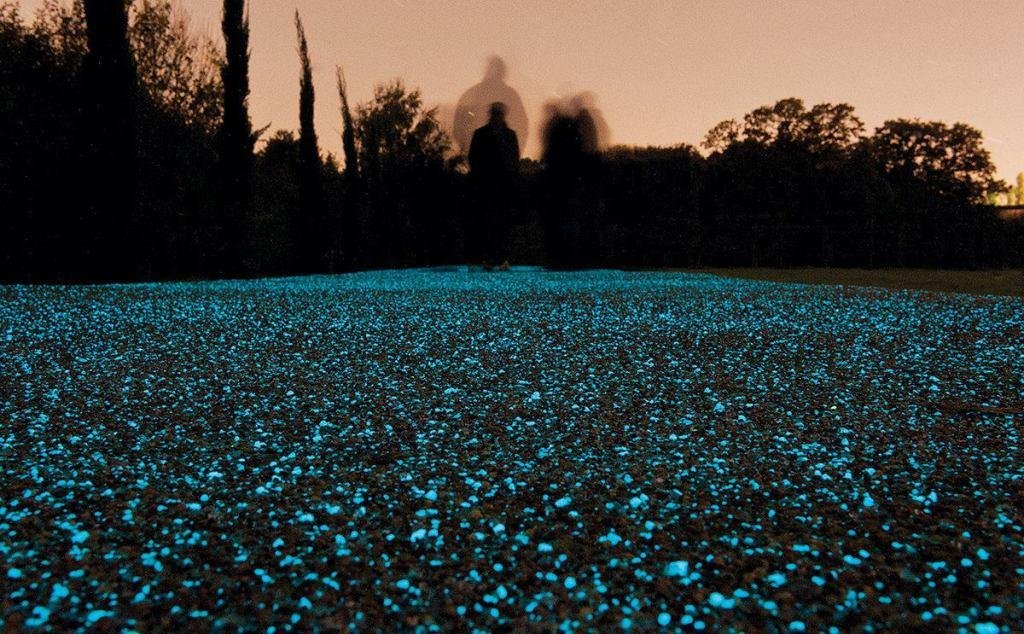
How much glow stone do you need per square meter? There is no single quantity for every pathway or pavement project. Consumption depends on stone size, the desired nighttime effect, installation method, surface area, distribution density, and whether glow stones are used alone or mixed with natural aggregate.
Estimating consumption before ordering helps contractors, landscape designers and material buyers control both the visual effect and the project budget. Use the examples below to plan glow stone coverage, then assess it in a sample.
Quick Answer: Glow Stone Consumption per Square Meter
For a relatively dense luminous pavement effect, a practical reference consumption is:
| Glow Stone Size | Approximate Consumption |
|---|---|
| Around 5 mm | ≈ 5 kg/m² |
| Around 10 mm | ≈ 8 kg/m² |
These figures are reference values rather than universal specifications.
Actual consumption can vary depending on:
- Stone shape
- Particle-size distribution
- Installation method
- Surface texture
- Desired glow density
- Natural aggregate ratio
For a large project, always create a small sample area before calculating the final order quantity.
Understand how stone size affects consumption
A 5 mm glow stone and a 10 mm glow stone do not create the same surface appearance. Smaller particles can be distributed more evenly across the pavement. Larger stones create more obvious individual luminous points but generally require more material by weight to achieve dense surface coverage. That is why particle size should be selected before calculating total material requirements.
5 mm Glow Stones
Around 5 mm is a practical size for creating relatively uniform luminous pavement.
Typical applications include:
- Garden pathways
- Landscape pavement
- Resin-bound surfaces
- Decorative concrete
- Park walkways
For dense coverage, approximately:
5 kg/m²
can be used as an initial estimating reference.
Example
For a 100 m² pathway:
100 m² × 5 kg/m² = 500 kg
Estimated glow stone requirement:
≈ 500 kg
A waste allowance may also be considered depending on the installation method.
10 mm Glow Stones
Larger stones create stronger individual glowing points and a more obvious aggregate appearance.
They can be suitable for:
- Landscape paths
- Decorative concrete
- Resort pavement
- Garden designs
- Resin-bound surfaces
For dense coverage, approximately:
8 kg/m²
can be used as an initial reference.
Example
For a 100 m² project:
100 m² × 8 kg/m² = 800 kg
Estimated requirement:
≈ 800 kg
Choose light, medium or dense distribution
This is important. Not every luminous pathway needs 5–8 kg of glow stone on every square meter. There are several different design approaches.
Light Decorative Distribution
Glow stones are scattered across the pavement as decorative points. The objective is to create a subtle star-like effect rather than a strongly luminous surface.
This approach is suitable for:
- Private gardens
- Courtyards
- Decorative paths
- Residential landscaping
Material consumption can be significantly lower than dense coverage.
Medium Glow Distribution
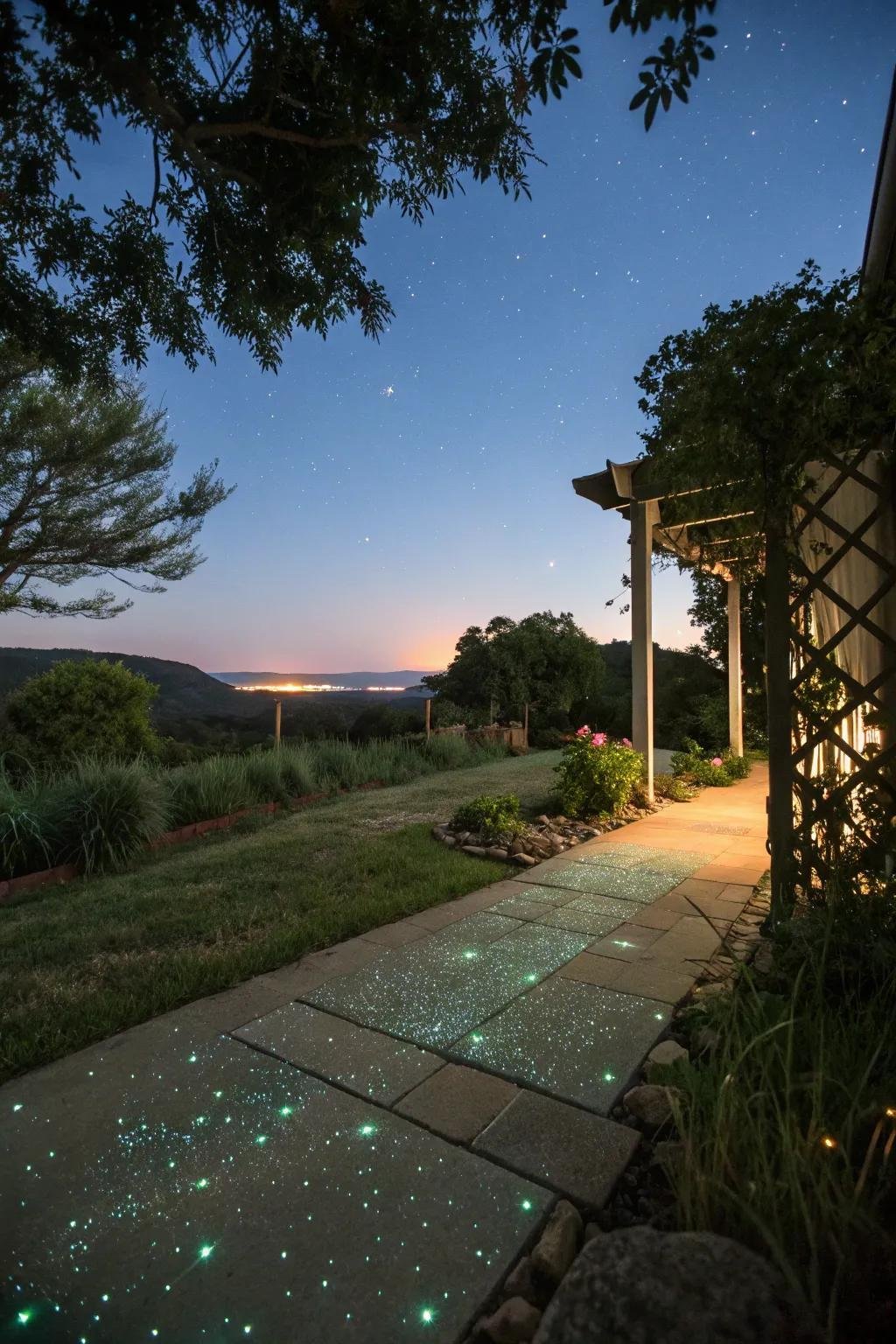
A moderate concentration provides more visible nighttime effects while allowing the normal aggregate or pavement to remain visible.
This approach works well for:
- Parks
- Resorts
- Residential communities
- Commercial landscapes
It can provide a good balance between appearance and material cost.
Dense Glow Distribution
A higher concentration creates a much stronger luminous surface.
This is suitable for:
- Feature pathways
- Resort attractions
- Scenic routes
- High-impact landscape projects
For this type of design, the 5 kg/m² and 8 kg/m² reference values become more relevant.
Glow Stone Density Changes the Final Appearance
Think of the surface in three levels:
Low Density → Scattered Stars
Medium Density → Visible Luminous Path
High Density → Strong Glow Surface
There is no reason to use high-density coverage if the client only wants decorative luminous points. This is why visual requirements should be confirmed before calculating material quantity.
Calculate quantities using the project examples
A simple formula is:
Project Area × Consumption per m² = Total Glow Stone Quantity
For example:
A pathway is:
2 meters wide × 50 meters long
Total area:
2 × 50 = 100 m²
Using 5 mm glow stones at approximately 5 kg/m²:
100 × 5 = 500 kg
Using 10 mm glow stones at approximately 8 kg/m²:
100 × 8 = 800 kg
Example: 500 m² Project
For 5 mm stones:
500 × 5 kg = 2,500 kg
Approximately:
2.5 metric tons
For 10 mm stones:
500 × 8 kg = 4,000 kg
Approximately:
4 metric tons
This difference becomes important when calculating material and freight costs.
Example: 1,000 m² Project
For a large 1,000 m² project:
5 mm Glow Stones
1,000 × 5 kg = 5,000 kg
Approximately:
5 metric tons
10 mm Glow Stones
1,000 × 8 kg = 8,000 kg
Approximately:
8 metric tons
For export projects, this quantity difference can significantly affect shipping and total project cost.
What If Glow Stones Are Mixed with Natural Aggregate?
This is where material consumption can be reduced significantly.
Instead of using glow stones across the entire surface, they can be combined with:
- Quartz
- Natural stone
- Decorative aggregate
- Resin-bound stone
For example, the surface might contain:
Natural Aggregate + Selected Percentage of Glow Stones
This creates luminous points throughout the pavement without requiring a full glow-stone surface.
Resin-Bound Glow Stone Pavement
Resin-bound pavement is particularly suitable for mixed aggregate designs.
A typical concept is:
Natural Aggregate + Glow Stones + Transparent Resin Binder
The glow stones should remain sufficiently exposed at the surface so they can absorb light. If they are buried under natural aggregate or covered excessively by resin, the visible glow may decrease.
Calculate by Glow Stone Ratio
For resin-bound systems, another way to estimate material is by percentage.
For example, assume a pavement design uses a total aggregate quantity of:
10 kg/m²
If glow stones represent 20% of the aggregate:
10 kg × 20% = 2 kg glow stones/m²
For 100 m²:
2 × 100 = 200 kg glow stones
This method allows the designer to adjust the glow effect without using luminous aggregate throughout the entire surface. The actual resin-bound mix ratio should be established according to the selected aggregate and binder system.
Plan edge-only coverage

Another effective way to reduce consumption is using glow stones only along the edges.
For example:
Glow Strip | Normal Pathway | Glow Strip
Instead of calculating the entire pathway area, calculate only the luminous strips.
Suppose a pathway is:
- 100 m long
- 2 m wide
And you create two luminous edge strips, each 0.1 m wide.
Total glow area:
100 × 0.1 × 2 = 20 m²
Using 5 mm stones at 5 kg/m²:
20 × 5 = 100 kg
Compared with full-surface coverage:
100 × 2 × 5 = 1,000 kg
This demonstrates how pathway design can dramatically change material consumption.
Full Surface vs. Edge Design
For the same 200 m² pathway:
Full-Surface Glow
At 5 kg/m²:
200 × 5 = 1,000 kg
20 m² Glow Edge Area
At 5 kg/m²:
20 × 5 = 100 kg
The edge design uses approximately one-tenth of the glow stone quantity in this example. For large landscape projects, this can make a major difference to the budget.
Decorative Pattern Design
Glow stones can also be concentrated into:
- Waves
- Curves
- Stars
- Arrows
- Logos
- Direction lines
Only the actual luminous area needs to be included in the consumption calculation. This allows designers to create high-impact nighttime effects without covering the entire pavement.
How Much Should You Order?
Once the theoretical quantity has been calculated, consider whether additional material is needed for:
- Installation loss
- Sample sections
- Repairs
- Uneven substrate
- Pattern adjustment
- Future maintenance
For large projects, it is generally better to calculate based on a confirmed test section rather than ordering solely from theoretical figures.
Create and compare 1 m² samples
One of the most practical methods is to create a 1 m² test panel.
For example, prepare three samples:
Sample A
2 kg/m²
Subtle luminous distribution.
Sample B
5 kg/m²
Higher-density luminous surface.
Sample C
8 kg/m²
Very dense luminous aggregate effect.
Charge all three under the same lighting conditions and compare them after dark. The project owner can then select the preferred appearance.
Compare Samples Under the Same Conditions
To make the comparison meaningful, keep the following consistent:
- Charging light
- Charging duration
- Background pavement
- Glow stone color
- Observation time
- Ambient darkness
Otherwise, one sample may appear brighter simply because it received more charging light.
Yellow-Green vs. Blue-Green Glow Stones
Color can also influence perceived brightness.
Yellow-Green
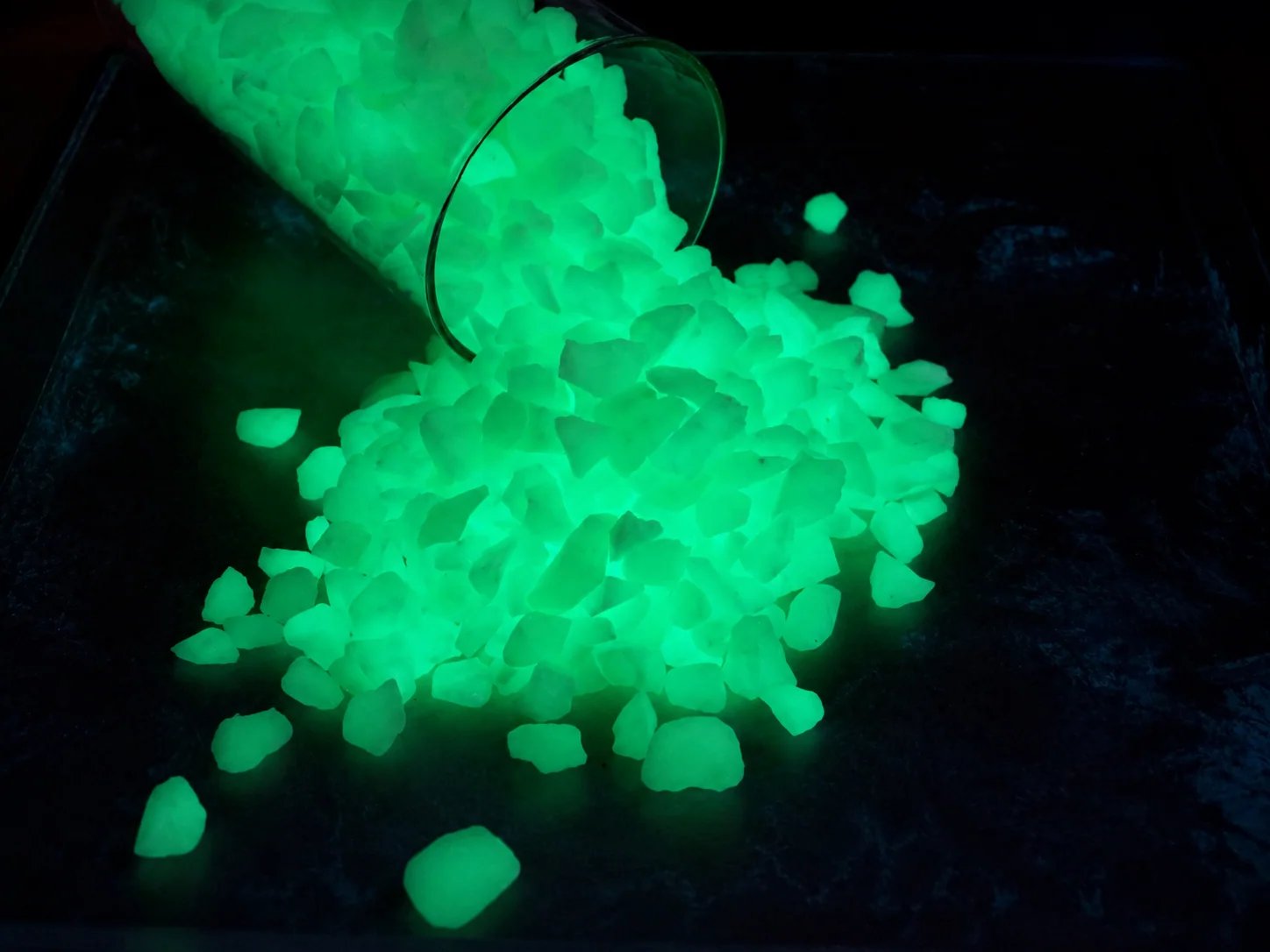
Often appears brighter to the human eye and is suitable for strong visual guidance.
Blue-Green
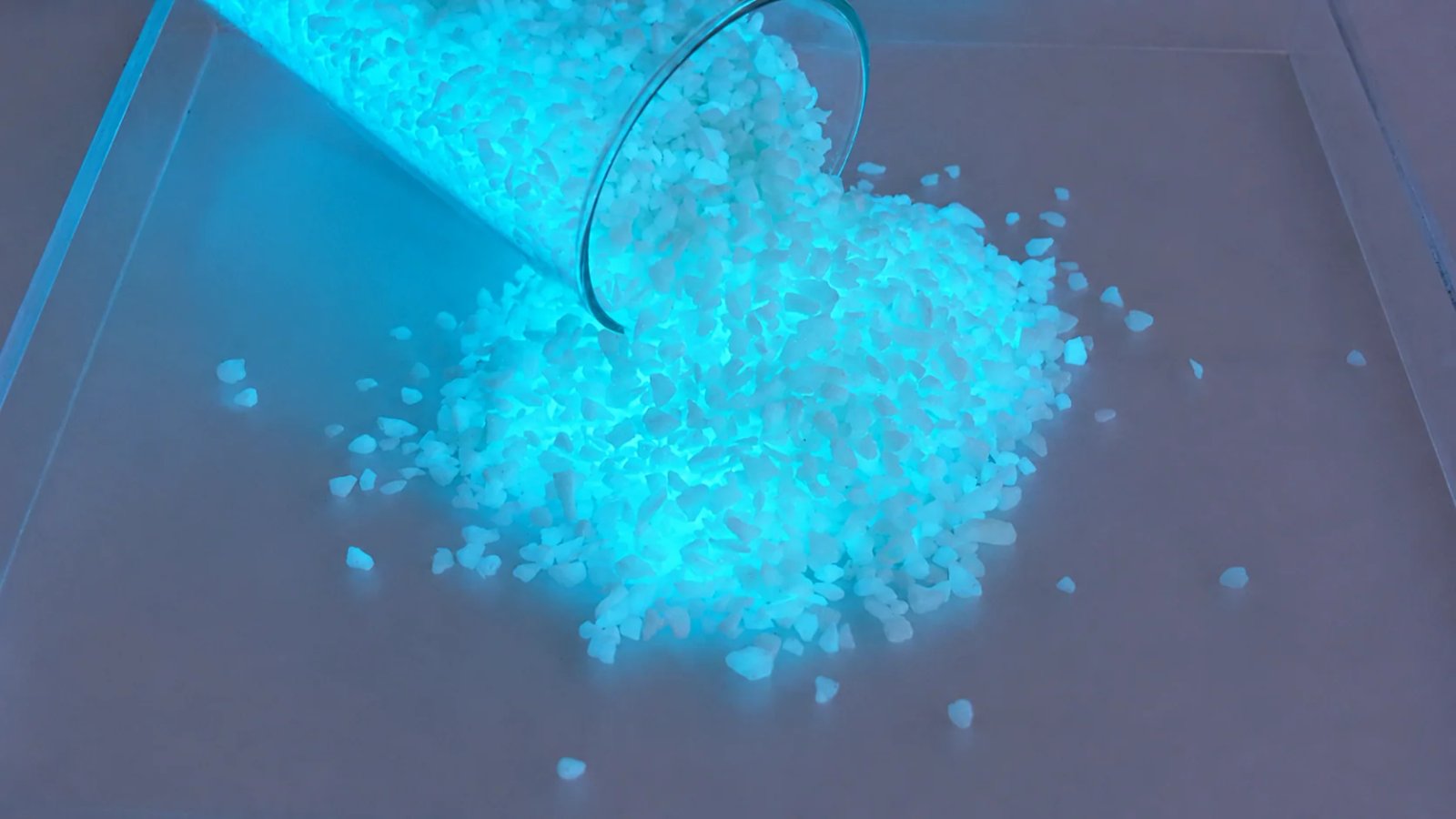
Provides a cooler appearance and is popular for:
- Gardens
- Resorts
- Landscape paths
- Waterfront areas
Do not automatically increase material consumption simply because one color appears less bright. Test the actual material first.
Does More Glow Stone Always Mean Better Performance?
No. Adding more luminous aggregate can create a stronger visual effect, but eventually other factors become more important.
Excessive material may:
- Increase project cost
- Change surface texture
- Affect aggregate grading
- Make resin-bound installation more difficult
The best quantity is the amount required to achieve the desired visual effect and pavement performance.
Match the estimate to the installation method
Consumption also depends on how the glow stones are installed.
Surface Broadcasting
Glow stones are distributed over the upper surface. This can concentrate the luminous material where it receives the most light.
Embedded Concrete
Glow stones are pressed into fresh concrete. Only the exposed portion contributes strongly to the visible effect.
Resin-Bound Mixing
Glow stones are mixed with natural aggregate and transparent resin. Consumption depends on the luminous aggregate ratio.
Decorative Inserts
Glow stones are concentrated into selected strips or patterns. This can substantially reduce total consumption.
Keep glow stones exposed and the surface clean
Photoluminescent material needs light. A glow stone buried below an opaque surface contributes very little to nighttime appearance.
For better material efficiency, keep the luminous material:
- At the surface
- Partially exposed
- Free from opaque coverings
This helps get more visible effect from each kilogram of material.
Surface Color Matters
Dark and light pavement backgrounds create different visual effects. A dark background can create strong contrast with individual glowing stones. A lighter background may help some luminous systems appear brighter. The best combination depends on the design. Again, sample testing is more useful than guessing.
Cleaning Affects Glow Performance
A dirty pathway may appear weaker even when the glow stones are still functioning normally. Dust, mud, leaves, and other contaminants can block charging light.
Regular cleaning helps maintain:
- Light absorption
- Visible afterglow
- Decorative appearance
How Much Glow Stone for a Garden Path?
For a small decorative garden path, full dense coverage may not be necessary. A scattered or medium-density design can often provide an attractive result while reducing material consumption. For example, instead of starting at 5 kg/m², test several lower densities first. Choose the lowest consumption that produces the desired nighttime appearance.
How Much for a Resort or Commercial Project?
Commercial landscape projects often need a stronger visual effect.
For these applications, consider:
- Medium-density distribution
- Dense feature areas
- Edge guidance
- Decorative patterns
A combination can be more cost-effective than using maximum coverage everywhere.
How Much for Resin-Bound Pavement?
For resin-bound systems, calculate based on:
- Total pavement area
- Total aggregate consumption
- Desired glow-stone percentage
- Resin system requirements
Do not simply apply the full-surface 5 kg/m² or 8 kg/m² reference without considering the complete mix design.
Gather project details before calculating the order
Before requesting a quotation, prepare:
- Total pavement area
- Glow stone size
- Glow color
- Full coverage or decorative distribution
- Concrete or resin-bound installation
- Required nighttime effect
- Project location
- Expected traffic
With this information, material quantity can be estimated much more accurately.
Quick Calculation Table
| Project Area | 5 mm at 5 kg/m² | 10 mm at 8 kg/m² |
|---|---|---|
| 10 m² | 50 kg | 80 kg |
| 50 m² | 250 kg | 400 kg |
| 100 m² | 500 kg | 800 kg |
| 500 m² | 2,500 kg | 4,000 kg |
| 1,000 m² | 5,000 kg | 8,000 kg |
These figures represent dense-coverage reference calculations. Actual project consumption should be confirmed through testing.
Estimate coverage and confirm it with a sample
So, how much glow stone do you need per square meter?
For dense luminous pavement, a useful starting reference is:
Around 5 mm glow stones → approximately 5 kg/m²
Around 10 mm glow stones → approximately 8 kg/m²
But the most economical design is not always full coverage.
Using:
Natural Aggregate Mixing + Edge Strips + Decorative Patterns + Controlled Glow Stone Density
can significantly reduce material consumption while still creating a strong nighttime effect.
For contractors, landscape designers, distributors, and project owners, the best approach is to prepare a 1 m² sample first, confirm the desired glow density, and then calculate the total order quantity.
FUXIN supplies Glow Stones, Photoluminescent Aggregate, Resin-Bound Glow Stones, Long Afterglow Pigments, and Luminous Pavement Materials in different particle sizes and glow colors for garden paths, parks, resorts, residential communities, and landscape pavement projects.
For project quantity calculations, samples, or bulk quotations, please contact us.