

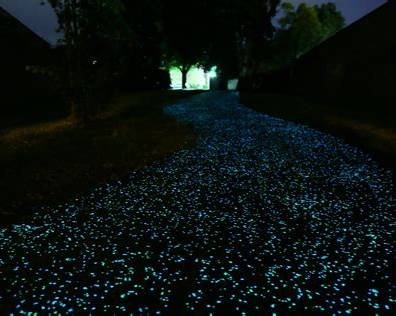
Glow stones are usually better for decorative pathways, exposed aggregate concrete, resin-bound pavement, gardens and landscape projects. Glow powder is generally more suitable for coatings, markings, symbols and continuous luminous surfaces. Both absorb light and release visible afterglow after dark, but they create different surface effects and require different installation methods.
Neither material is universally better for pavement. Compare appearance, installation, durability, material consumption, maintenance and project type before choosing. The guide below also explains where a combination of glow stones and glow powder can be useful.
Glow stones vs. glow powder: quick pavement comparison
| Factor | Glow Stones | Glow Powder |
|---|---|---|
| Material Form | Luminous aggregate/stone | Fine photoluminescent pigment |
| Appearance | Individual glowing points | Continuous luminous effect |
| Typical Installation | Concrete or resin-bound pavement | Mixed into compatible coating/binder |
| Best For | Paths, gardens, landscapes | Coatings, lines, arrows, markings |
| Surface Texture | Aggregate texture | Depends on coating |
| Design Style | Natural/decorative | Uniform/functional |
| Repair | Local aggregate/resin repair | Recoating |
| Main Requirement | Surface exposure | Transparent compatible binder |
Neither option is universally better.
The correct choice depends on the pavement you want to create.
What Are Glow Stones?
Glow stones are photoluminescent aggregates designed to absorb light and become visible after dark.
They are available in different particle sizes, such as:
-
1–3 mm
-
Around 5 mm
-
Around 10 mm
-
Larger decorative sizes
They can be installed in:
-
Concrete
-
Resin-bound pavement
-
Garden paths
-
Decorative aggregate surfaces
The individual stones remain visible, producing a scattered luminous effect.
What Is Glow Powder?
Glow powder is a fine photoluminescent pigment.
Instead of being installed as individual stones, the powder is normally incorporated into a compatible transparent or translucent binder.
It can be used for:
-
Glow pavement paint
-
Photoluminescent coatings
-
Road markings
-
Direction arrows
-
Floor markings
-
Decorative patterns
Glow powder is generally better when a project requires a more continuous luminous layer.
Surface appearance: individual points vs. continuous glow
The easiest way to understand the difference is visual.
Glow stones: individual luminous points
Create individual luminous points.
Think of:
Stars scattered across a dark surface.
Glow powder: a continuous luminous effect
Creates a more continuous luminous area.
Think of:
A glowing line, arrow, or coated surface.
This difference alone can determine which material is more suitable for a project.
Which Is Better for Garden Paths?
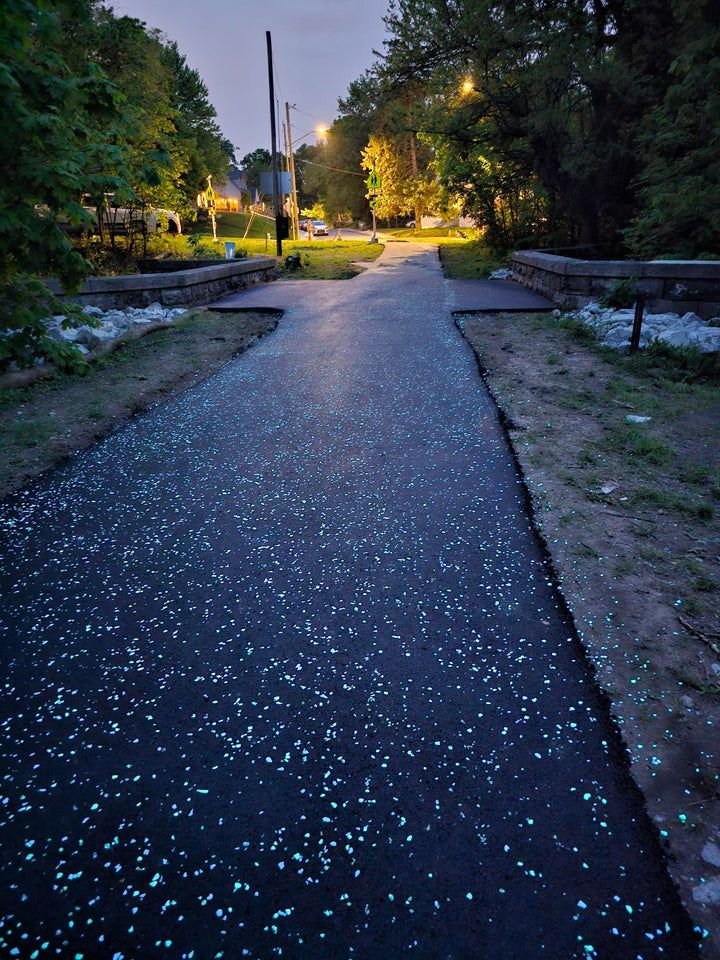
For most garden pathways, glow stones are usually the more natural-looking option.
They can be scattered into:
-
Concrete
-
Gravel designs
-
Resin-bound surfaces
-
Path edges
During the day, they look like decorative aggregate.
At night, the luminous particles become visible.
This works particularly well in gardens because the surface does not need to look like painted pavement.
Which Is Better for Landscape Projects?
Glow stones also work well for:
-
Parks
-
Resorts
-
Hotels
-
Residential communities
-
Scenic areas
-
Waterfront paths
They can be mixed with natural aggregate to create a subtle glow rather than a fully luminous surface.
For landscape designers, this provides more control over the visual effect.
Which Is Better for Road Markings?

Glow Powder = Continuous Luminous Coating
Glow powder is generally more practical for creating:
-
Lines
-
Arrows
-
Symbols
-
Parking markings
-
Selected safety markings
Because the pigment is incorporated into a coating, it can create clearly defined shapes.
Glow stones are less suitable for producing precise thin lines or detailed symbols.
Which Is Better for Concrete?
Both can be used with concrete, but in different ways.
Glow Stones in Concrete
Glow stones can be placed near the concrete surface.
This works well for:
-
Exposed aggregate concrete
-
Garden paths
-
Decorative sidewalks
-
Landscape pavement
Glow Powder with Concrete
Simply mixing glow powder throughout an entire concrete slab is usually inefficient because concrete is opaque.
Pigment buried deep inside the concrete receives little charging light.
A better approach is often to use glow powder in a surface treatment or compatible coating.
Which Is Better for Resin-Bound Pavement?
Glow stones are particularly suitable for resin-bound pavement.
A typical system can contain:
Natural Aggregate + Glow Stones + Transparent Resin
This creates a stable decorative pathway with visible luminous particles.
Glow powder can also be incorporated into compatible resin, but excessive pigment loading can affect transparency, viscosity, and other properties.
For natural-looking resin-bound pathways, glow stones are usually the more straightforward option.
Which material creates a stronger glow? Test the system
This cannot be answered only by comparing material form.
Glow performance depends on:
-
Photoluminescent material quality
-
Charging intensity
-
Charging duration
-
Glow color
-
Material concentration
-
Surface exposure
-
Ambient darkness
A high-quality glow stone can outperform a poor-quality glow powder, and vice versa.
The complete system should be tested.
Which Produces More Uniform Glow?
Glow powder usually has the advantage when a continuous luminous appearance is required.
Because fine pigment can be distributed throughout a coating, the surface can appear more uniform.
Glow stones create separate points of light.
Therefore:
Uniform Glow → Glow Powder
Decorative Point Glow → Glow Stones
Which Looks Better During the Day?
This depends on the project.
Glow stones can blend naturally with:
-
Quartz
-
Gravel
-
Decorative stone
-
Exposed aggregate concrete
This makes them attractive for landscape applications.
Glow powder coatings may have a pale daytime color such as:
-
Off-white
-
Pale green
-
Yellow-green
-
Blue-green
For architectural landscape projects, daytime appearance should be considered alongside nighttime glow.
Which is easier to install: glow stones or glow powder?
The answer depends on the existing pavement.
Installing glow stones
Common methods include:
-
Broadcasting onto fresh concrete
-
Embedding into the surface
-
Mixing into resin-bound aggregate
Applying glow powder in a coating
Usually requires:
-
Compatible binder
-
Proper mixing
-
Controlled coating thickness
-
Primer/base system
For existing pavement that only needs a luminous line or symbol, glow powder coating may be easier.
For new decorative pathways, glow stones may integrate more naturally into construction.
Glow stone consumption: size and distribution density
Glow stone consumption depends on particle size and desired density.
For relatively dense coverage, practical starting references can be:
Around 5 mm → approximately 5 kg/m²
Around 10 mm → approximately 8 kg/m²
These are not universal specifications.
Decorative or edge-only designs can require much less material.
Glow powder consumption: formulation and coating thickness
Glow powder should not be calculated using the same kg/m² method as loose aggregate.
Consumption depends on:
-
Pigment-to-binder ratio
-
Coating thickness
-
Binder density
-
Number of coats
-
Required luminous performance
For this reason, the complete coating formulation needs to be established before calculating project consumption.
Which material is more cost-effective per finished square meter?
It depends on the design.
If you want an entire pathway densely covered with glow stones, material consumption can become significant.
However, glow stones can be used selectively:
Normal Aggregate + 10–20% Glow Stones
or
Glow Edges + Normal Center Surface
This can significantly reduce consumption.
Glow powder may be more economical for thin lines, symbols, and selected coating areas.
Cost should therefore be compared by finished square meter, not simply by kilogram.
Which Is Better for Large Areas?
For large landscape surfaces, mixing glow stones with natural aggregate can be practical.
Instead of making the entire pavement luminous, designers can create:
-
Scattered glow
-
Edge strips
-
Decorative patterns
-
Feature zones
For large continuous luminous markings, a glow powder coating may be more appropriate.
Which Is Better for Detailed Patterns?
Glow powder usually wins here.
It is easier to create:
-
Letters
-
Arrows
-
Thin lines
-
Logos
-
Geometric patterns
Glow stones are better for larger decorative effects.
Which Is Better for Path Edges?
Both can work.
Glow Stones
Create a decorative aggregate edge.
Glow Powder
Creates a cleaner continuous line.
For a garden or resort, glow stones may look more natural.
For functional route guidance, a continuous coating may be easier to recognize.
Which Is Better for Outdoor Use?
Both can work outdoors when incorporated into a suitable system.
The key issue is not simply whether the material is stone or powder.
Outdoor performance depends on:
-
UV resistance
-
Water resistance
-
Binder durability
-
Surface adhesion
-
Traffic
-
Cleaning
The complete system should be designed for exterior use.
Compare binder transparency requirements
Glow powder relies heavily on binder transparency.
If the pigment is surrounded by an opaque coating, charging performance can decrease.
Glow stones also benefit from transparent resin, but a significant portion of the luminous surface can remain exposed.
For both systems:
Light must reach the photoluminescent material.
White base coats for glow powder systems
A white or light-colored base is especially useful for coating systems.
A typical glow powder pavement system may be:
Pavement
↓
Primer
↓
White Base
↓
Photoluminescent Coating
↓
Transparent Protection
The white background can improve the apparent glow.
Natural aggregate combinations for glow stones
Glow stones work particularly well when combined with normal decorative stone.
For example:
Natural Beige Aggregate + Blue-Green Glow Stones
or
Grey Aggregate + Yellow-Green Glow Stones
This creates an attractive daytime surface and a different nighttime appearance.
Which Is Better for Skid Resistance?
Neither material automatically guarantees skid resistance.
The complete pavement system determines traction.
For glow powder coatings, compatible anti-slip aggregate may need to be added.
For glow-stone pavement, surface texture depends on:
-
Stone size
-
Resin quantity
-
Installation method
Always evaluate the finished surface rather than the luminous material alone.
Which Is Easier to Clean?
A smoother glow-powder coating can be easier to clean, depending on its surface texture.
Coarse glow-stone pavement may retain more:
-
Dirt
-
Dust
-
Organic residue
However, a well-designed resin-bound surface can still be relatively easy to maintain.
Cleaning matters because contamination can reduce charging performance.
Which Is Easier to Repair?
Repairing a glow powder coating
Worn areas can often be cleaned, prepared, and recoated.
Repairing glow stone pavement
Damaged areas may require local resin and aggregate repair.
The repair method should be considered during project planning.
Vehicle traffic: assess wear, adhesion and skid resistance
Vehicle traffic creates much greater mechanical wear.
Neither decorative glow stones nor a basic glow coating should automatically be assumed suitable for heavy traffic.
For vehicle areas, evaluate:
-
Abrasion resistance
-
Tire shear
-
Adhesion
-
Surface strength
-
Skid resistance
A system suitable for a garden path may not be suitable for a road.
Glow Stones vs. Glow Powder for Parks
For parks, glow stones are often attractive because they integrate naturally into landscape pavement.
Good applications include:
-
Walking paths
-
Scenic routes
-
Rest areas
-
Decorative surfaces
Glow powder can be used where clear route lines or arrows are required.
Using both is also possible.
Glow Stones vs. Glow Powder for Resorts
Resorts often prioritize visual design.
Glow stones can create:
-
Star-like paths
-
Blue-green landscape surfaces
-
Decorative borders
Glow powder can create:
-
Luminous patterns
-
Logos
-
Direction lines
A combination can produce a more customized nighttime design.
Can Glow Stones and Glow Powder Be Used Together?
Yes.
For example, a landscape project could use:
Resin-Bound Glow Stones for the Path Surface
plus
Glow Powder Coating for Direction Arrows
This allows each material to perform the function it handles best.
Selection checklist: glow stones, glow powder or both
Choose Glow Stones if you want:
-
Natural aggregate appearance
-
Garden or landscape paths
-
Resin-bound pavement
-
Decorative concrete
-
Individual luminous points
Choose Glow Powder if you want:
-
Continuous glow
-
Lines and arrows
-
Symbols
-
Surface coatings
-
Detailed designs
Choose Both if the project requires decorative pavement plus functional luminous markings.
Test both pavement systems before ordering
Before choosing either material for a large project, create samples.
For glow stones, test:
-
Particle size
-
Distribution density
-
Natural aggregate ratio
For glow powder, test:
-
Pigment concentration
-
Binder compatibility
-
Coating thickness
-
Base color
Charge all samples under the same conditions before comparing them.
Compare afterglow over time and finished-surface performance
Evaluate samples:
-
Immediately after charging
-
After 10 minutes
-
After 30 minutes
-
After 60 minutes
Also evaluate:
-
Daytime appearance
-
Surface texture
-
Wet conditions
-
Cleaning
-
Adhesion
This provides a much more realistic comparison.
Choose the material that fits the pavement design
So, which is better for pavement: glow stones or glow powder?
There is no single winner.
Glow Stones are generally better for:
Landscape Paths + Resin-Bound Pavement + Decorative Concrete + Natural Glow Effects
Glow Powder is generally better for:
Pavement Coatings + Lines + Arrows + Symbols + Continuous Luminous Surfaces
For many projects, the best solution may actually combine both materials.
The right choice depends on:
Application + Surface Type + Desired Appearance + Installation Method + Traffic + Budget
For contractors, landscape designers, coating manufacturers, and distributors, testing the actual material system before bulk purchasing remains the most reliable approach.
FUXIN supplies Glow Stones, Photoluminescent Aggregate, Glow Powder, Long Afterglow Pigments, Transparent Resin Binders, and Luminous Pavement Materials for gardens, parks, resorts, concrete pathways, resin-bound pavement, parking areas, and landscape projects.
For samples, material comparisons, technical recommendations, or bulk quotations, please contact us.