

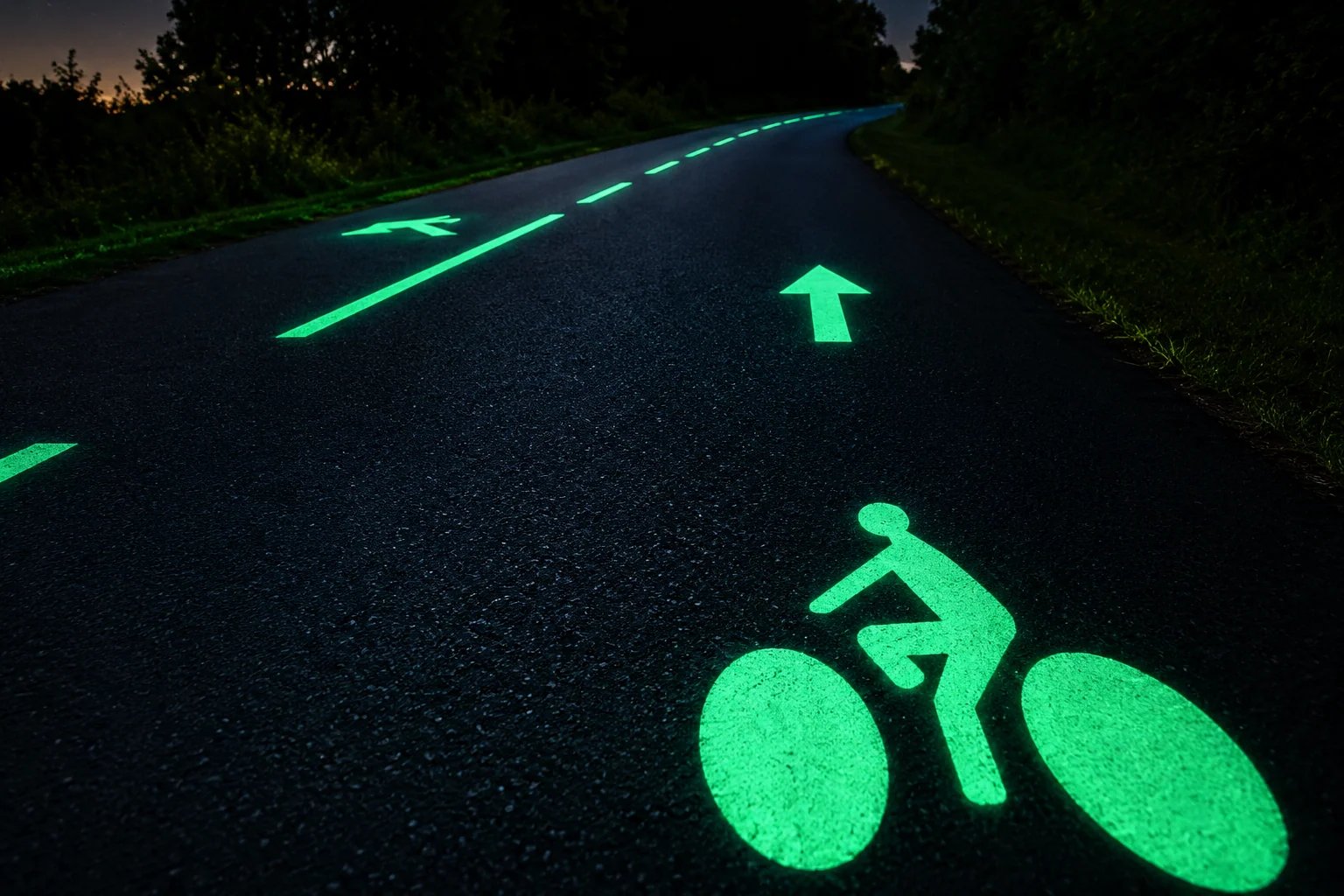
Road markings are traditionally designed to organize traffic, define lanes, and improve road visibility. Most conventional markings rely on color contrast, reflective glass beads, streetlights, or vehicle headlights to remain visible at night.
Glow-in-the-dark road marking introduces another possibility.
By incorporating photoluminescent pigment into a compatible marking or coating system, selected pavement markings can absorb light during the day and gradually release that stored energy after dark.
The result is a marking that can produce a visible afterglow without requiring electricity.
But how does glow-in-the-dark road marking actually work, and where is it most suitable?
What Is Glow-in-the-Dark Road Marking?
Glow-in-the-dark road marking is a pavement marking system that contains photoluminescent material.
During daylight or exposure to suitable artificial light, the luminous material absorbs energy.
When the surrounding environment becomes dark, the stored energy is gradually released as visible light.
The basic process is:
Absorb Light → Store Energy → Glow in Darkness → Recharge
Unlike LED road studs or electrically illuminated pavement, photoluminescent markings do not require electrical wiring to create their afterglow.
This makes them particularly interesting for decorative, landscape, pedestrian, cycling, and supplementary visibility applications.
What Material Makes Road Markings Glow?
The main luminous component is usually photoluminescent pigment.
This fine powder can be incorporated into compatible transparent or light-transmitting binders and coatings.
The pigment needs sufficient exposure to light, so the complete coating system is important.
If the luminous particles are covered by a highly opaque layer, their ability to absorb light can be reduced.
A typical glow marking system may involve:
-
Prepared pavement surface
-
Suitable primer if required
-
Compatible luminous coating
-
Photoluminescent pigment
-
Optional protective transparent layer
The exact system depends on the pavement, traffic conditions, binder chemistry, and intended application.
How Does Glow-in-the-Dark Road Marking Work at Night?
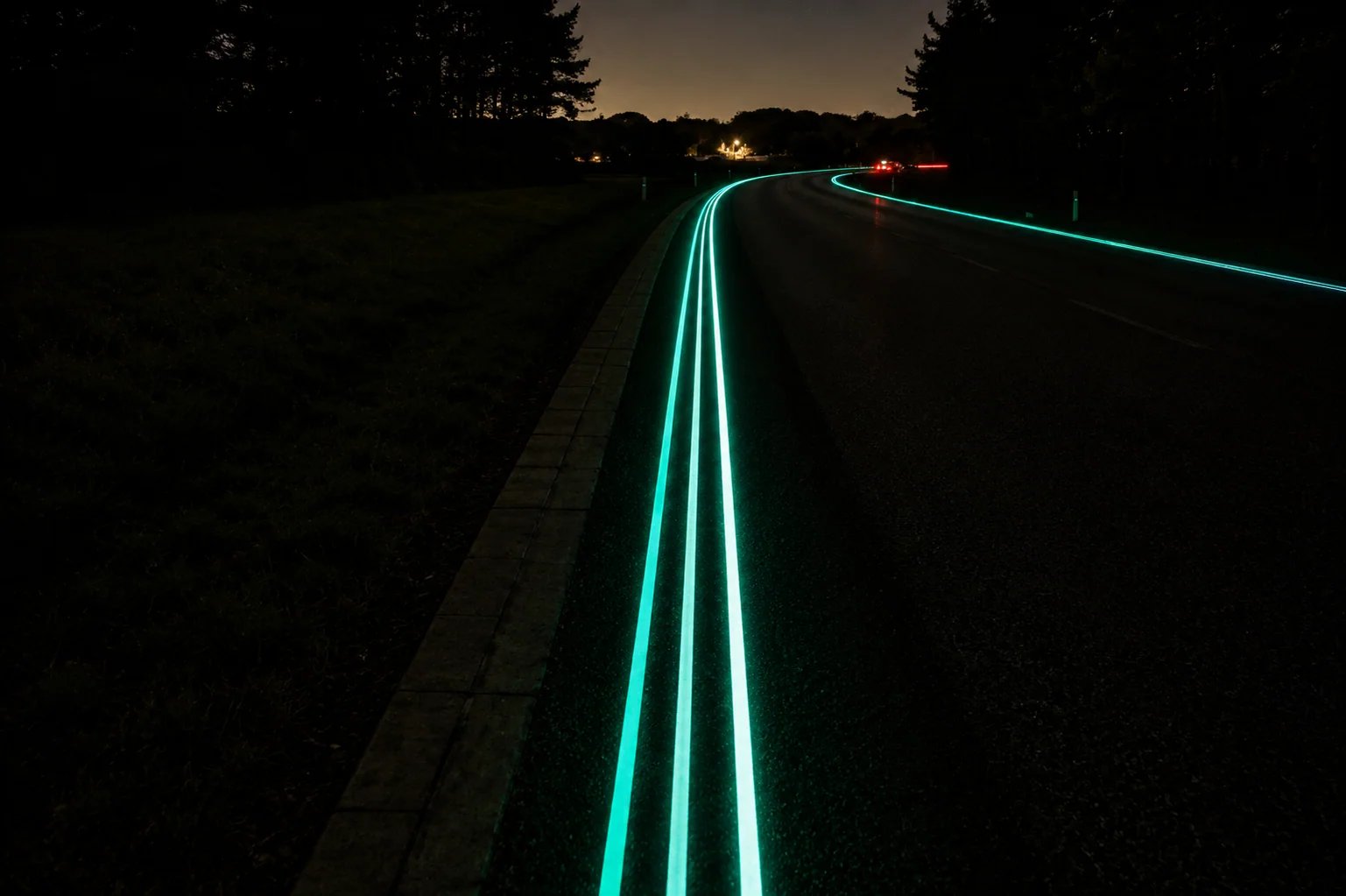
During the day, the marking absorbs available light.
Sunlight is an effective charging source for outdoor applications.
After sunset, the photoluminescent material begins releasing the stored energy.
The marking is usually brightest shortly after the surrounding environment becomes dark.
Its brightness then gradually decreases over time.
This is normal for photoluminescent materials.
Glow-in-the-dark marking should therefore not be expected to behave like an LED lamp that produces the same brightness continuously throughout the night.
Glow-in-the-Dark Marking vs. Reflective Road Marking
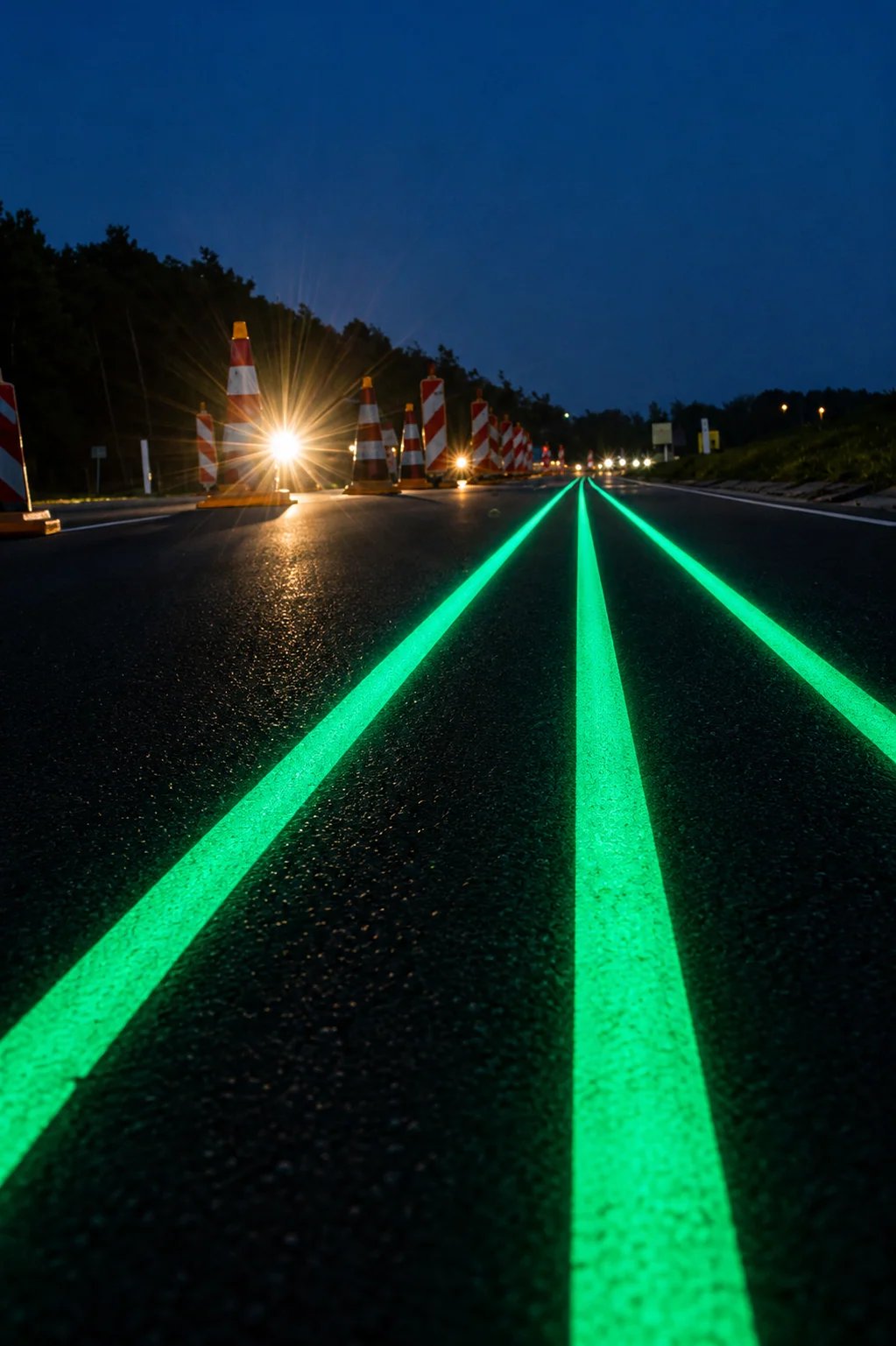
Glow and reflection are not the same thing.
Reflective Road Marking
Reflective markings rely on an external light source.
Vehicle headlights strike reflective materials such as glass beads, and part of that light is returned toward the driver.
Without an external light source, conventional reflective markings do not produce their own visible glow.
Glow-in-the-Dark Road Marking
Photoluminescent markings absorb light before darkness and then gradually release it.
They can therefore remain visible for a period even without direct vehicle headlights.
The two technologies can serve different purposes.
In some applications, reflective and photoluminescent features may even be combined as part of a broader pavement visibility design.
Where Can Glow-in-the-Dark Road Marking Be Used?
Glow markings are especially interesting in areas where nighttime visual guidance and decorative pavement design are important.
Bicycle Paths
Bicycle paths are one of the most suitable applications.
Photoluminescent materials can be used for:
-
Bicycle symbols
-
Pathway edge lines
-
Directional arrows
-
Decorative center lines
-
Selected route markings
In darker park or landscape environments, luminous markings can create a distinctive visual effect after sunset.
For routes requiring regulated illumination or traffic-control performance, glow markings should be used together with appropriate conventional systems.
Pedestrian Walkways
Glow-in-the-dark markings can also be incorporated into pedestrian areas.
Possible uses include:
-
Walking route lines
-
Direction arrows
-
Decorative borders
-
Pedestrian symbols
-
Landscape patterns
This can be particularly attractive in parks, resorts, campuses, scenic areas, and commercial landscapes.
Parks and Scenic Areas
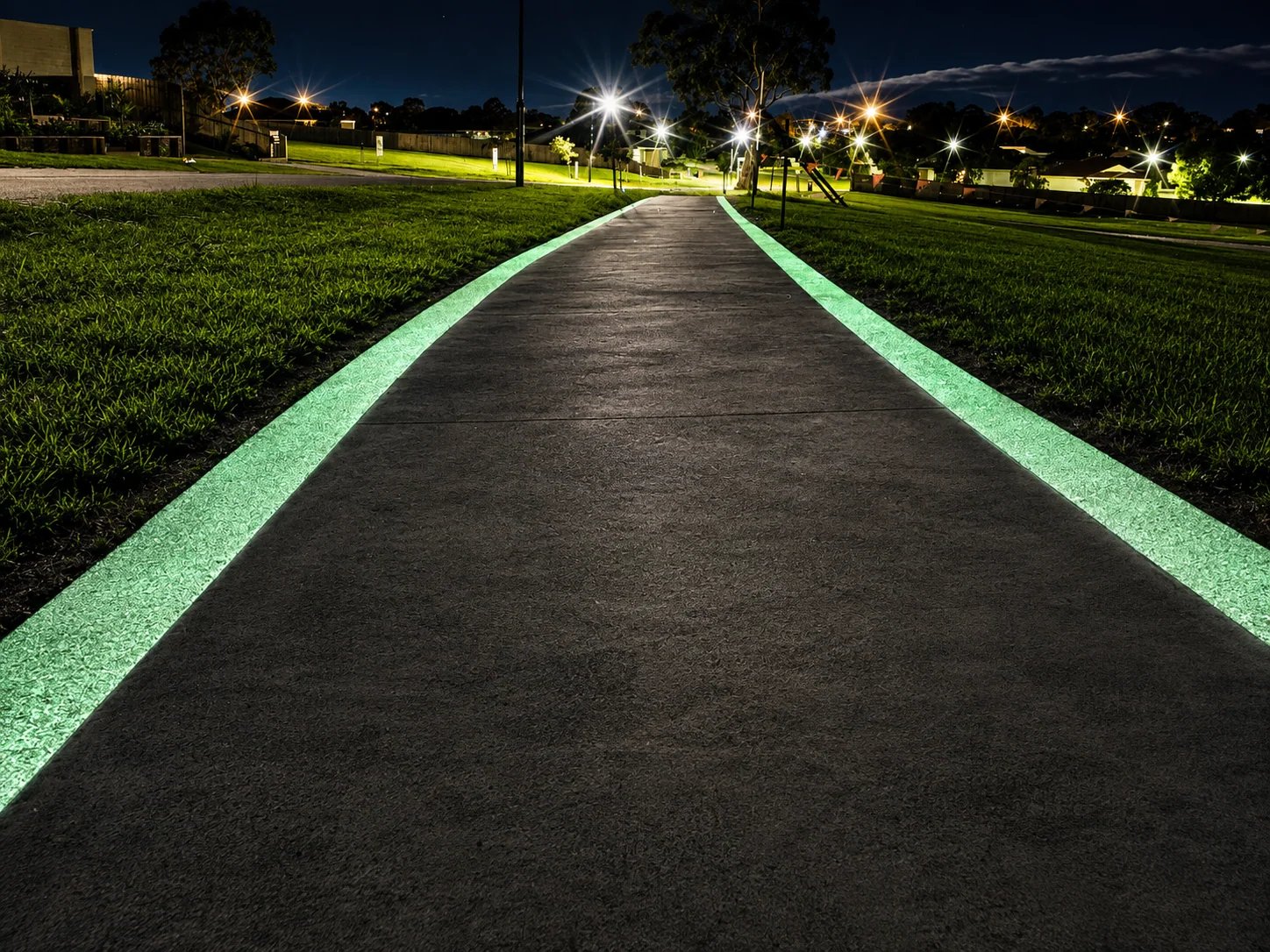
Parks often contain areas where strong lighting is not desirable everywhere.
Photoluminescent pavement markings can become part of the landscape design by creating soft nighttime guidance without placing electrical fixtures directly into every section of the pavement.
They can be used around:
-
Garden paths
-
Recreational routes
-
Viewing areas
-
Landscape walkways
-
Public leisure spaces
Resorts and Hotels
Hotels and resorts frequently use nighttime pavement design as part of the guest experience.
Glow markings can be incorporated into:
-
Resort paths
-
Villa walkways
-
Poolside routes
-
Garden paths
-
Courtyard pavement
-
Directional graphics
In these environments, the goal is often visual atmosphere rather than strong functional illumination.
Campgrounds and Outdoor Recreation Areas
Photoluminescent markings can also be useful as decorative route indicators in darker outdoor environments.
For example, they may be used to identify:
-
Walking routes
-
Cabin paths
-
Campsite boundaries
-
Recreational areas
-
Decorative pavement features
Because surrounding artificial light may be limited, the luminous effect can appear more noticeable.
What Can Be Created With Glow Road Marking?
Glow-in-the-dark material does not have to be limited to conventional straight road lines.
Depending on the application, it can be used to create:
Edge Lines
Luminous lines can highlight the edges of selected paths.
Arrows
Directional arrows can provide visible route information while also creating a distinctive nighttime design.
Bicycle Symbols
Cycling symbols are well suited to dedicated bike paths and recreational routes.
Pedestrian Symbols
Selected pedestrian graphics can be incorporated into landscape paving.
Decorative Patterns
Curves, stars, waves, geometric shapes, and customized graphics can create more creative pavement environments.
Warning or Guidance Areas
Photoluminescent materials may also be considered as a supplementary visual feature in selected low-light areas, subject to the requirements of the project.
What Affects the Glow Performance?
Several factors determine how the marking will look after dark.
Light Exposure
The material needs light in order to charge.
Markings installed in open outdoor areas generally receive more daylight than those located under permanent shade.
Pigment Quality
The quality of photoluminescent pigment can affect:
-
Initial brightness
-
Afterglow
-
Color consistency
-
Charging behavior
Pigment Concentration
Using too little luminous material may create a weak effect.
However, adding more pigment is not always the only solution because binder performance and coating structure must also be considered.
Binder Transparency
The luminous material needs access to light.
A suitable transparent or light-transmitting binder can help the pigment absorb and release light effectively.
Surface Cleanliness
Dust, mud, oil, and other contamination can cover the luminous surface and reduce light exposure.
Surrounding Lighting
Glow markings are usually more noticeable in darker environments.
Strong streetlights can reduce visual contrast.
Choosing the Right Glow Color
Photoluminescent materials can produce different luminous colors.
Green and blue-green tones are commonly associated with glow applications because they create a strong visual effect in darkness.
Color selection should consider:
-
Pavement color
-
Surrounding lighting
-
Landscape design
-
Daytime appearance
-
Project purpose
For decorative projects, nighttime color can become an important part of the overall visual identity.
Basic Application Process
The exact process varies by coating system, but a typical application involves several basic stages.
Surface Preparation
The pavement should be:
-
Clean
-
Dry
-
Stable
-
Free from oil
-
Free from loose materials
Cracks or damaged areas should be repaired before applying the luminous coating.
Material Preparation
Photoluminescent pigment is mixed with the compatible coating or binder according to the selected formulation.
Uniform dispersion is important for consistent appearance.
Marking Application
The material can be applied to create lines, arrows, symbols, or customized patterns.
The coating thickness should be kept consistent.
Curing
The marking should be allowed to cure according to the binder manufacturer's requirements.
Light Charging
After curing, the marking needs sufficient exposure to light.
Nighttime Inspection
The finished marking should be inspected after dark to evaluate:
-
Brightness
-
Uniformity
-
Pattern visibility
-
Distribution
-
Contrast with surrounding pavement
For large projects, testing a sample area first is recommended.
Maintenance of Glow Road Markings
Like other pavement coatings, glow markings require maintenance.
The surface should be kept reasonably clean so that light can reach the photoluminescent material.
Typical maintenance may include:
-
Removing dust
-
Washing away mud
-
Removing leaves
-
Cleaning surface contamination
-
Inspecting coating wear
-
Repairing damaged sections
Heavy wear may gradually reduce the visible luminous surface.
Traffic conditions should therefore be considered when selecting the application area.
Is Glow-in-the-Dark Road Marking Suitable for Vehicle Roads?
This depends heavily on the project.
Roads carrying regular vehicle traffic have demanding requirements for:
-
Skid resistance
-
Durability
-
Visibility
-
Wear resistance
-
Traffic regulations
-
Marking standards
Photoluminescent markings should not automatically be treated as a replacement for certified conventional road markings.
For many projects, the technology is better suited to:
-
Bicycle paths
-
Pedestrian areas
-
Parks
-
Landscape routes
-
Resorts
-
Recreational spaces
-
Decorative pavement
Where glow materials are considered for public roads, the complete system should meet the relevant local road-marking and safety requirements.
Is Glow Road Marking a Replacement for Street Lighting?
Generally, no.
Glow-in-the-dark markings produce an afterglow, but they do not illuminate a road in the same way as streetlights.
They should normally be considered a:
-
Supplementary visibility feature
-
Decorative pavement element
-
Landscape design tool
-
Passive luminous marking
Where regulated illumination is required, conventional lighting should still be provided.
Why Is Glow-in-the-Dark Road Marking Interesting?
Its main attraction is not simply brightness.
It offers designers another way to integrate nighttime visual effects directly into pavement.
Potential advantages include:
-
No electrical power required for the afterglow itself
-
Recharges through light exposure
-
Can be integrated directly into pavement markings
-
Supports customized patterns and graphics
-
Suitable for landscape and recreational projects
-
Creates a distinctive nighttime appearance
This makes photoluminescent marking particularly interesting for projects that want the pavement itself to become part of the nighttime design.
Glow Road Marking Works Best as Part of a Complete System
A successful project should consider more than the luminous pigment.
The complete system includes:
Pavement Base + Binder + Photoluminescent Pigment + Surface Design + Light Exposure + Maintenance
All of these factors influence the final result.
Choosing a good luminous pigment but ignoring surface preparation or binder compatibility may still lead to poor performance.
Final Thoughts
Glow-in-the-dark road marking offers a different approach to nighttime pavement design.
Instead of relying entirely on electricity or vehicle headlights, photoluminescent materials absorb available light and gradually release it after dark.
This technology can be particularly useful for bicycle paths, pedestrian walkways, parks, resorts, campuses, scenic areas, and other landscape projects.
Its strongest value is usually not as a replacement for conventional lighting or regulated road markings, but as a supplementary and decorative luminous pavement solution.
With the right pigment, compatible coating system, good surface preparation, and appropriate project environment, glow-in-the-dark markings can transform ordinary pavement into a much more distinctive nighttime surface.
For contractors, distributors, landscape companies, and project developers looking for photoluminescent pigment and glow-in-the-dark pavement materials, FUXIN can provide product information, samples, quotations, and material recommendations.
Contact us to discuss your glow-in-the-dark road marking project.