

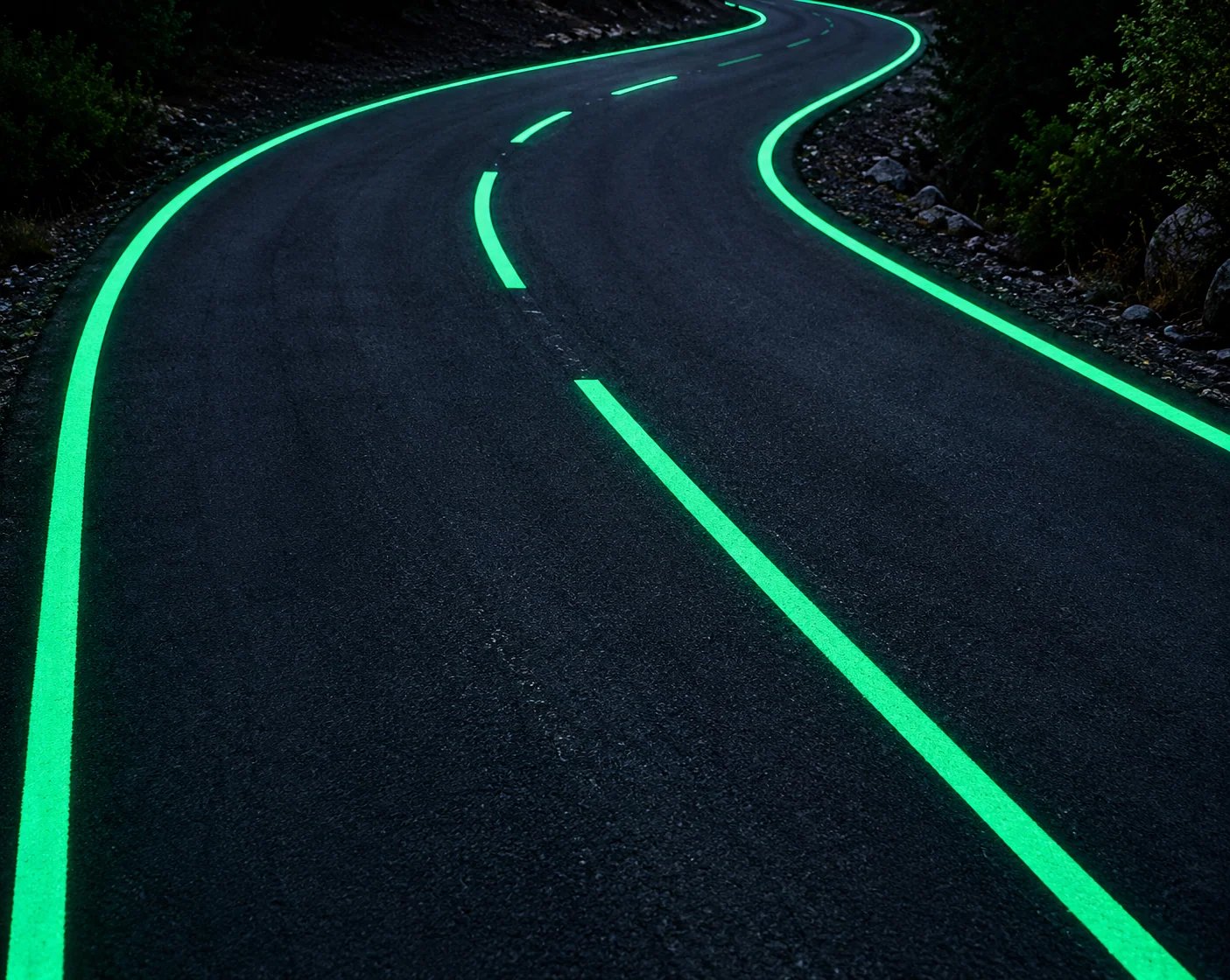
In many road-marking applications, “self-luminous” means photoluminescent: the marking stores light and releases a visible afterglow in darkness. It provides passive nighttime guidance without continuous electrical power, but it still needs daylight or suitable artificial light to recharge.
These markings can help identify selected lane boundaries, directions, parking areas, crossings and safety zones for drivers, cyclists and pedestrians. They supplement visual guidance; they do not replace street lighting or automatically replace standard road markings.
What “self-luminous” means
Commercial descriptions and online searches often use related terms such as self-luminous road marking, photoluminescent road marking, glow-in-the-dark road marking, luminous pavement marking and glow road line.
The term can be misunderstood as continuous light without charging. Photoluminescent markings work differently: light-absorbing particles, commonly supplied as pigments in a compatible pavement coating, store energy and release it gradually.
Absorb Light → Store Energy → Release Afterglow → Recharge
The marking is normally brightest shortly after darkness begins, then its brightness decreases. This is normal behavior. Unlike LED road markers, it does not actively generate powered light.
Choose the marking function
Center lines and edge lines
Selected private roads, scenic roads, park roads, campus roads and low-speed internal roads can use luminous center lines for additional nighttime visual guidance.
Edge lines can define the outer boundary of curved roads, landscape roads, bicycle routes, low-light access roads and internal facility roads. They can make the road's shape easier to follow after dark.
Directional arrows
Straight, left-turn, right-turn, exit and parking-guidance arrows can help organize traffic flow in low-light environments.
Parking areas and underground garages
Parking applications include bay lines, direction arrows, pedestrian routes, entry and exit lanes, and ramp guidance. These provide additional guidance at pavement level.
Underground garages have limited daylight and rely more on artificial light for charging. Possible uses include parking lines, exit routes, walking routes, stair-access lines and arrows. Always test the material under the garage's actual lighting before full installation.
Bicycle and pedestrian routes
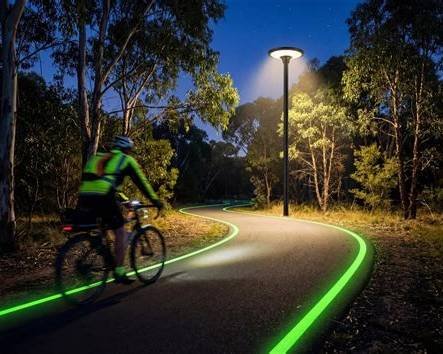
On bicycle paths, luminous markings can highlight center lines, edges, curves, intersections and direction arrows. Outdoor routes can recharge naturally during the day, making parks, campuses, scenic routes and waterfront areas potential settings.
Pedestrian uses include walkway borders, crossings, park paths, residential routes and campus walkways. A continuous luminous line can make walking routes easier to identify after dark.
Match the design to the location
Potential projects include parking lots, scenic roads, bicycle paths, pedestrian routes, residential communities, campuses, industrial parks, underground garages, internal roads, resorts and hotels.
For example, scenic roads may use markings on low-light landscape and internal routes; campuses may combine pedestrian and internal-traffic guidance; industrial parks may use them on internal roads and safety routes. Check local road-marking standards before installing on public roads.
Select green or blue-green against the pavement
Green and blue-green are common luminous colors. Green normally offers a strong glow and high visual recognition. Blue-green gives a cooler appearance and is often used in landscape or decorative pavement projects.
Dark asphalt usually creates strong contrast with either color. Choose according to the background pavement, lighting conditions, required contrast, pigment performance and project design.
Specify a compatible substrate and layer system
Depending on the coating system, self-luminous markings may be used on asphalt, concrete, resin pavement, epoxy surfaces or colored pavement. Choose the primer and binder for the substrate.
Photoluminescent coatings often perform better over a light-colored base, which can reflect more light through the luminous layer and improve visible brightness. A typical arrangement may include:
- Road surface
- Primer
- White base coat
- Photoluminescent layer
- Protective topcoat
Prepare the surface before application
The pavement should generally be clean, dry, stable, free from oil and dust, and free from loose material. Poor preparation may cause peeling, cracking or early wear.
Balance glow, adhesion, durability and skid resistance
Road markings should not create a slippery surface. Pay particular attention to curves, ramps, crossings, bicycle lanes and parking entrances. Anti-slip aggregate may be added where needed.
Glow Performance + Durability + Adhesion + Skid Resistance
Vehicle tires cause abrasion and turning forces, so traffic levels have a major effect on durability. A low-traffic area may perform very differently from a busy parking entrance, turning zone, heavy-vehicle route or industrial road. Select the coating system for actual traffic conditions.
Design for outdoor exposure and routine maintenance
Outdoor markings must withstand UV exposure, rain, temperature changes, dust, water and tire contamination. The binder and protective layer should be suitable for long-term outdoor use.
Photoluminescent markings need light to recharge. Dust and contamination can reduce performance. Routine care may include sweeping, washing, removing oil, cleaning tire marks and inspecting worn sections. A clean surface helps maintain more consistent glow performance.
Understand the difference from reflective and LED markings
Conventional road markings are generally recognizable during the day. At night, their visibility often depends on street lighting or vehicle headlights.
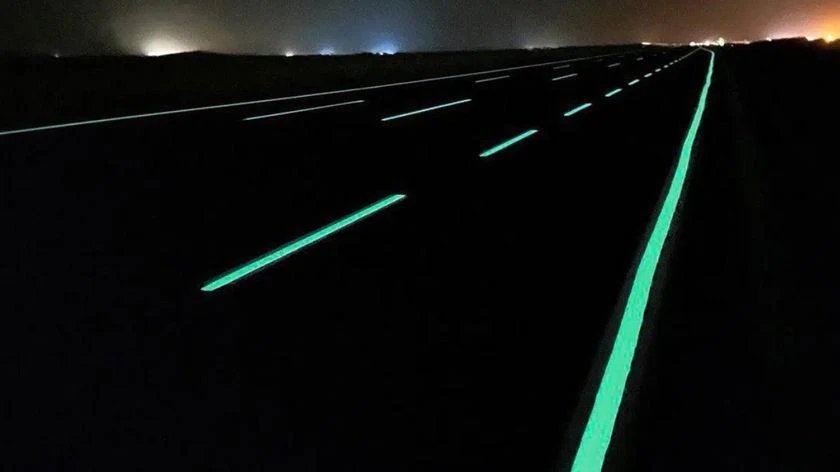
Reflective road markings need an external light source, such as headlights. Self-luminous photoluminescent markings store light beforehand and release afterglow in darkness. Some applications combine both technologies to provide headlight reflection and passive afterglow.
- Photoluminescent marking: no wiring for the afterglow, passive operation, integration into the pavement and gradually fading brightness.
- LED road marking: electrical or solar power, stronger illumination, more complex installation and the ability to maintain consistent brightness.
Each system suits different project conditions.
Retain street lighting and compliant road markings
Self-luminous markings cannot replace street lighting. They can improve the visibility of pavement lines but do not illuminate the complete road environment. They cannot replace the light needed to see vehicles, pedestrians, obstacles, curbs or road hazards.
They do not automatically replace standard road markings either. Public-road requirements may cover color, reflectivity, line width, placement, skid resistance and traffic regulations. Use self-luminous materials only where they are compatible with applicable standards.
Test the complete system before large-scale installation
Create a sample section using the actual pavement, primer, base coat, luminous material and protective topcoat. Assess daytime appearance, nighttime glow, adhesion, skid resistance, wear resistance and charging conditions. This helps establish whether the system fits the project.
Good results depend on surface preparation, suitable luminous material, proper charging, skid resistance, wear resistance and regular maintenance. For many low-speed roads, parking areas, scenic routes, campuses, industrial sites and pedestrian environments, self-luminous markings can add nighttime guidance while reducing the need for powered pavement lighting. Required street lighting and standard markings still remain separate requirements.
Discuss your road-marking project
FUXIN supplies Photoluminescent Pigments, Self-Luminous Road Marking Materials, Glow-in-the-Dark Pavement Materials, and Luminous Traffic Marking Systems for roads, parking areas, bicycle paths, pedestrian routes and industrial applications.
Contact us for samples, quotations or project recommendations.