

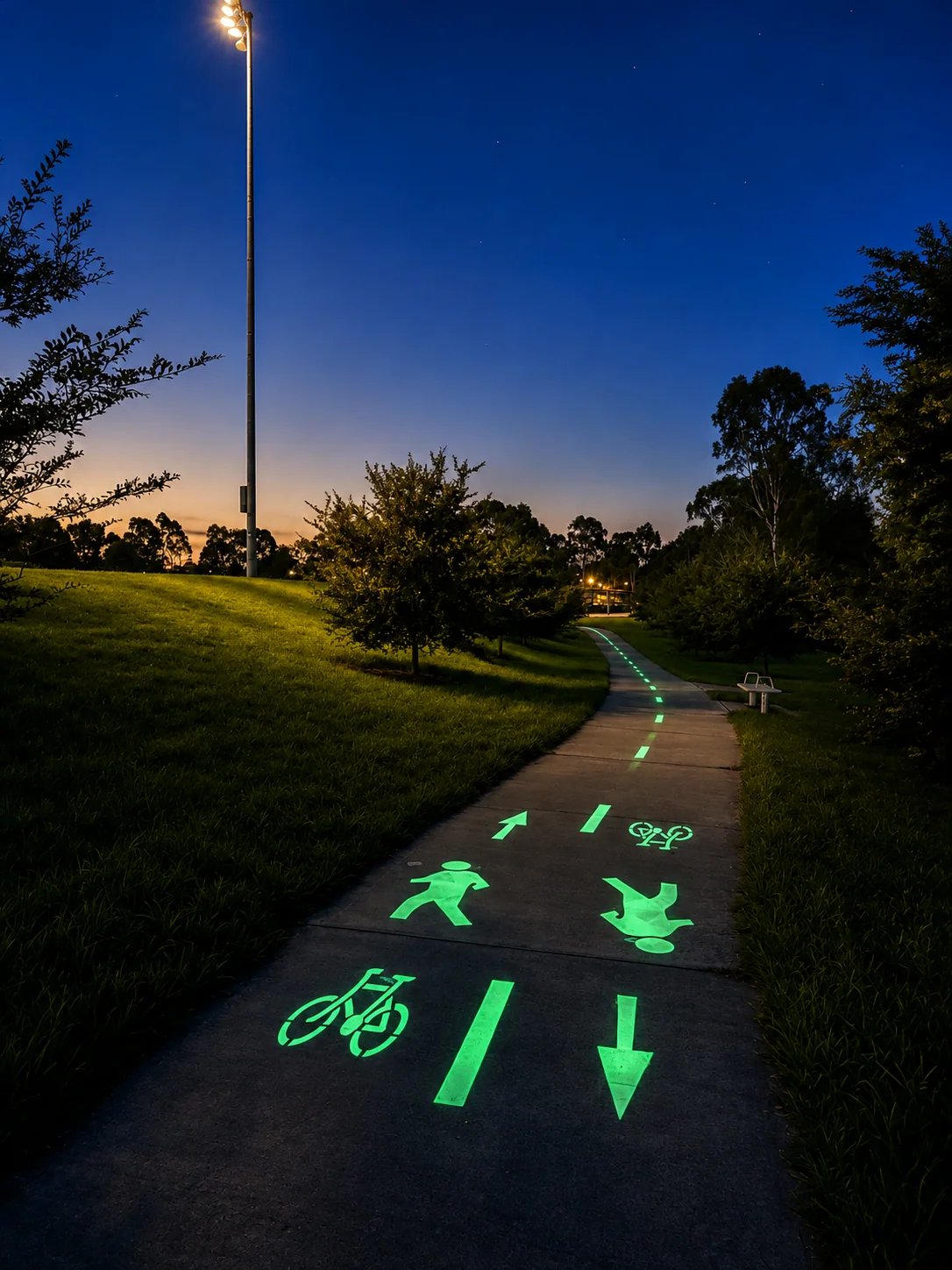
Photoluminescent pavement marking is attracting increasing attention in parks, bicycle routes, pedestrian walkways, resorts, campuses, scenic areas, and other outdoor spaces where nighttime pavement design is important.
Unlike conventional markings that rely mainly on vehicle headlights or street lighting, photoluminescent markings contain materials that absorb light and gradually release the stored energy after dark.
This creates a visible glow directly on the pavement surface without requiring electrical power for the afterglow itself.
However, successful photoluminescent pavement marking depends on much more than simply adding luminous pigment to a coating.
The pavement condition, binder, pigment concentration, surface texture, light exposure, surrounding lighting, traffic level, and maintenance all influence the final result.
What Is Photoluminescent Pavement Marking?
Photoluminescent pavement marking is a marking or coating system containing light-storing pigment.
During daylight or exposure to suitable artificial light, the material absorbs energy.
When the environment becomes darker, the stored energy is gradually released as visible light.
The basic cycle is:
Absorb Light → Store Energy → Release Afterglow → Recharge
This process can repeat whenever the material is exposed to light again.
Unlike an LED system, the pavement marking does not actively generate continuous illumination.
Instead, it creates a gradually fading afterglow.
What Makes the Pavement Marking Glow?
The key material is usually photoluminescent pigment.
The pigment is incorporated into a compatible transparent or light-transmitting binder.
Its nighttime performance can be influenced by:
-
Pigment quality
-
Pigment concentration
-
Charging time
-
Light intensity
-
Binder transparency
-
Coating thickness
-
Surface cleanliness
-
Surrounding darkness
The luminous pigment is only one part of the system.
A good project requires the pigment, binder, pavement, and installation method to work together.
What Can Photoluminescent Pavement Marking Look Like?
One advantage of photoluminescent pavement marking is design flexibility.
It can be used to create different types of pavement graphics.
Edge Lines
Continuous luminous lines can be installed along pathway edges.
They are suitable for:
-
Bicycle routes
-
Pedestrian paths
-
Greenways
-
Park walkways
-
Resort paths
At night, the lines can create a clear visual outline of the route.
Dashed Lines
Dashed luminous lines can be used as center markings or decorative guidance.
They generally create a lighter visual effect than a continuous line.
Arrows
Directional arrows are useful at route changes, intersections, and entrances.
They can be incorporated into parks, campuses, resorts, and recreational areas.
Bicycle Symbols
Photoluminescent bicycle symbols can help identify dedicated cycling routes while adding a distinctive nighttime appearance.
Pedestrian Symbols
Walking symbols can be used on pedestrian-only paths or shared recreational routes.
Decorative Patterns
Photoluminescent coating can also create:
-
Curves
-
Waves
-
Stars
-
Geometric patterns
-
Landscape graphics
-
Customized designs
This makes the technology particularly suitable for projects where pavement is part of the overall landscape design.
Where Can Photoluminescent Pavement Marking Be Used?
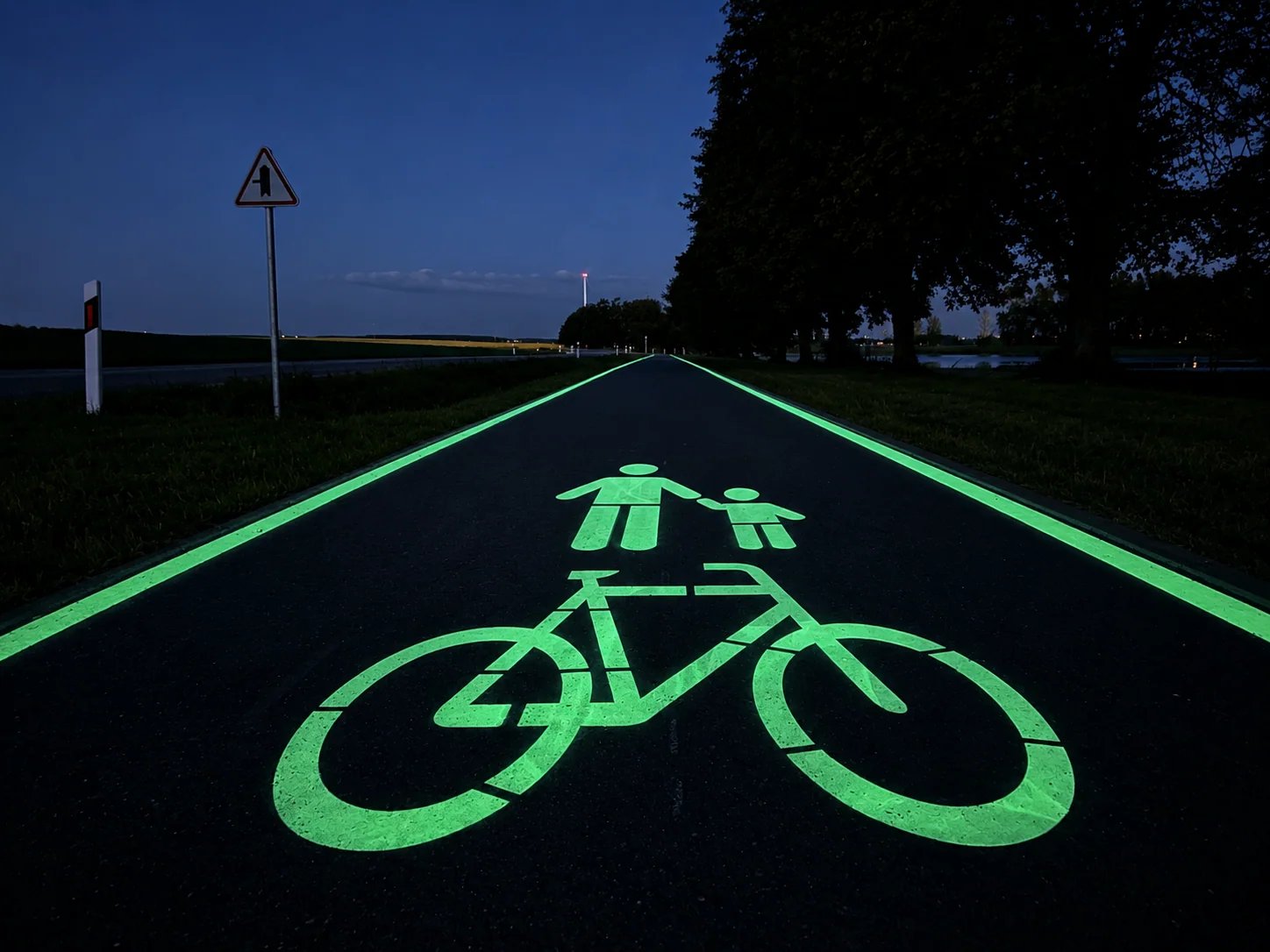
Bicycle Paths
Dedicated bicycle paths are one of the most interesting applications.
Possible designs include:
-
Edge lines
-
Center lines
-
Bicycle symbols
-
Direction arrows
-
Intersection markings
Photoluminescent markings can be particularly noticeable on darker routes with limited surrounding lighting.
Pedestrian Walkways
Walking routes can use luminous markings to highlight edges, directions, or decorative patterns.
Suitable environments include:
-
Parks
-
Residential communities
-
Resorts
-
Campuses
-
Scenic areas
-
Waterfront paths
The goal is often to combine visual guidance with nighttime atmosphere.
Parks and Greenways
Photoluminescent pavement marking can be integrated into recreational landscapes without adding electrical fixtures directly to every section of the pavement.
It may be used around:
-
Walking routes
-
Cycling routes
-
Intersections
-
Seating areas
-
Scenic paths
Hotels and Resorts
Hotels and resorts often use pavement design to create a more distinctive nighttime environment.
Luminous marking can be incorporated around:
-
Villas
-
Gardens
-
Pools
-
Courtyards
-
Outdoor leisure areas
-
Walking routes
Here, the marking may be used more for atmosphere and visual identity than for high-intensity illumination.
Campgrounds and Scenic Routes
Locations with relatively low surrounding artificial light can make photoluminescent effects more noticeable.
Possible applications include:
-
Cabin paths
-
Campsite routes
-
Scenic walking trails
-
Recreational zones
-
Directional pavement graphics
Parking and Landscape Areas
Selected symbols, pedestrian routes, or directional markings may also be used in parking and commercial landscape areas.
Where vehicles are involved, however, durability, skid resistance, and local marking requirements should be evaluated carefully.
Photoluminescent Marking vs. Reflective Marking
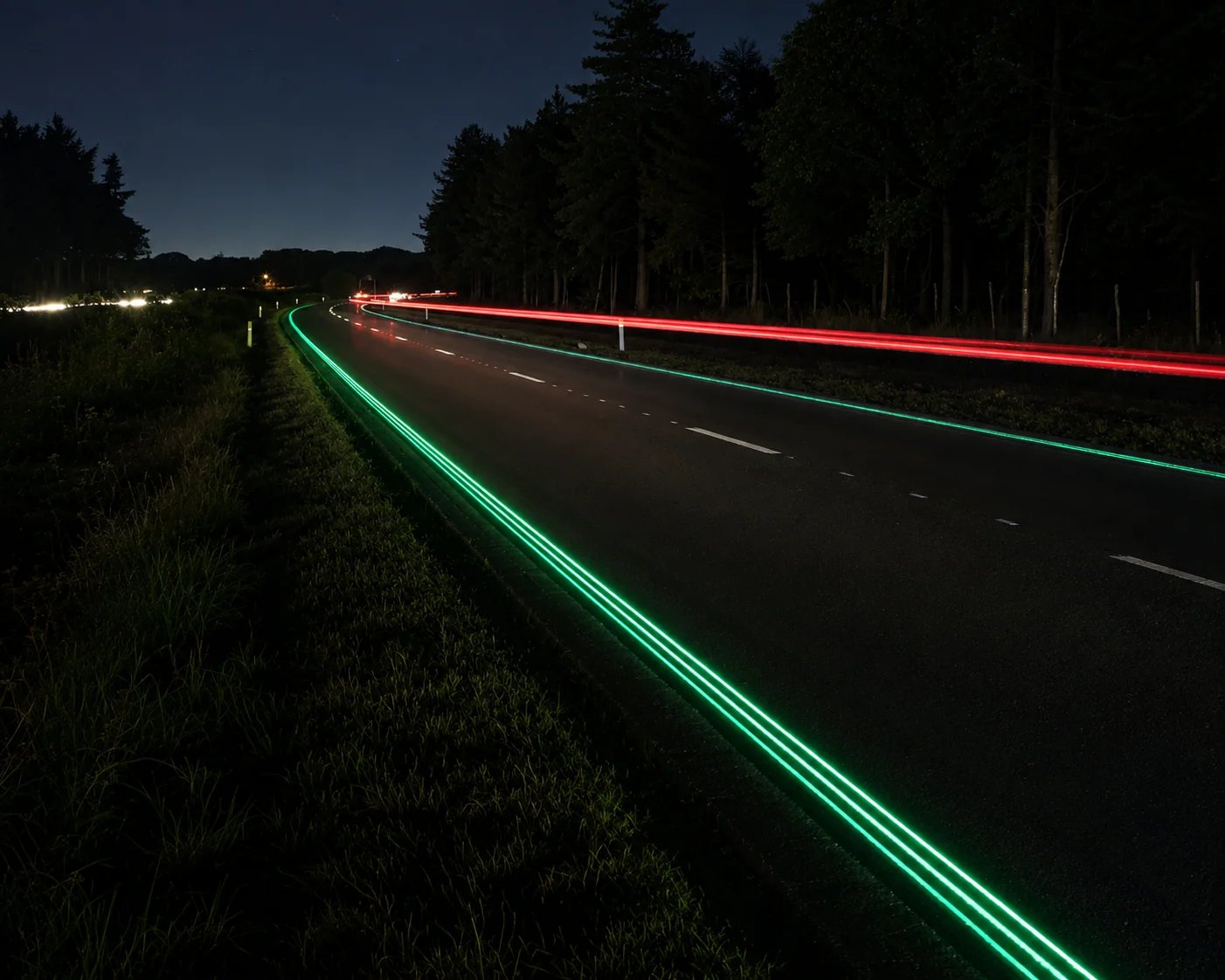
Photoluminescent and reflective markings work in different ways.
Reflective Markings
Reflective road markings rely on an external light source.
Vehicle headlights strike reflective elements such as glass beads, which return part of the light toward the viewer.
Without headlights or another light source, the marking does not create its own afterglow.
Photoluminescent Markings
Photoluminescent materials absorb light before darkness.
They then gradually release that stored energy.
This allows the marking to remain visibly luminous for a period without direct headlights.
For conventional roads, reflective marking remains extremely important.
Photoluminescent marking is generally better considered an additional or specialized pavement solution.
Photoluminescent Marking vs. LED Pavement Guidance
LED systems actively produce light.
Photoluminescent materials store and release light.
This creates different characteristics.
Photoluminescent Pavement Marking
-
No electricity needed for the afterglow
-
Integrated directly into the pavement
-
Produces softer visual guidance
-
Gradually fades after dark
-
Suitable for landscape and recreational applications
LED Guidance
-
Requires power, batteries, or solar systems
-
Produces stronger illumination
-
Can maintain a more consistent brightness
-
Requires additional electrical infrastructure
In some projects, both can be used together.
LED systems can provide functional lighting while photoluminescent markings add pavement-level guidance and decoration.
Surface Preparation Is Critical
Even a high-quality luminous coating can fail on a poorly prepared surface.
Before installation, the pavement should normally be:
-
Clean
-
Dry
-
Stable
-
Free from loose material
-
Free from dust
-
Free from oil and grease
Existing cracks, peeling coatings, and weak pavement areas should be repaired first.
Poor preparation can lead to:
-
Delamination
-
Peeling
-
Uneven coating
-
Premature wear
-
Poor appearance
Choosing the Right Binder
The binder must be compatible with both the pigment and the pavement.
Important characteristics may include:
-
Adhesion
-
Transparency
-
Weather resistance
-
Outdoor durability
-
Working time
-
Curing performance
-
Wear resistance
Because the luminous pigment needs access to light, excessively opaque materials can reduce charging performance.
Any protective topcoat should also allow sufficient light transmission.
Pigment Concentration
Using too little photoluminescent pigment may create a weak effect.
Using too much may affect coating viscosity, application behavior, or physical performance.
The correct concentration should balance:
Glow performance + Workability + Adhesion + Surface strength
For larger projects, sample testing is usually preferable to guessing the formulation.
Pavement Color Affects the Result
Background pavement color influences visual contrast.
Dark asphalt can create strong contrast with green or blue-green luminous markings.
Light concrete may produce a softer appearance.
The project should therefore be evaluated in both:
Daytime conditions
and
Nighttime conditions
A marking that looks attractive only in complete darkness may not be suitable for the overall pavement design.
Light Exposure Matters
Photoluminescent pavement marking needs light before it can glow.
Open outdoor areas generally receive better charging conditions than permanently shaded locations.
Consider whether the pavement will be located:
-
Under trees
-
Under bridges
-
Between tall buildings
-
Under roof structures
-
In direct daylight
Different parts of a long route may receive different amounts of light, which can produce different nighttime effects.
Surrounding Lighting Matters Too
Photoluminescent markings generally appear more noticeable in darker surroundings.
Strong streetlights, commercial lighting, or building lights can reduce the visible contrast.
This does not necessarily mean the luminous material is not working.
It simply means stronger surrounding light makes the afterglow less visually dominant.
This is why photoluminescent pavement marking can work particularly well in:
-
Parks
-
Greenways
-
Scenic routes
-
Resorts
-
Waterfront paths
-
Recreational spaces
Skid Resistance Should Be Considered
A pavement marking is still part of the walking or riding surface.
For pedestrian and bicycle routes, the coating should not become excessively smooth.
Depending on the system, suitable anti-slip aggregate may be incorporated.
This is especially important for:
-
Bicycle curves
-
Ramps
-
Sloped walkways
-
Pool areas
-
Frequently wet surfaces
Nighttime appearance should never be considered separately from pavement performance.
Basic Installation Process
A typical project may include the following stages.
Prepare the Surface
Clean the pavement and repair weak areas.
Mark the Layout
Determine the position of lines, symbols, arrows, and patterns.
Prepare the Material
Mix the photoluminescent pigment with the compatible binder according to the selected system.
Apply the Coating
Maintain consistent coverage and thickness.
Add Surface Texture if Required
Anti-slip aggregate may be incorporated according to project requirements.
Allow the Material to Cure
Keep pedestrians, bicycles, or vehicles away until the coating has cured sufficiently.
Charge the Marking
Allow the surface to receive adequate daylight or suitable artificial light.
Inspect After Dark
Check:
-
Glow uniformity
-
Line visibility
-
Pattern clarity
-
Surface texture
-
Contrast with surrounding pavement
Why Sample Testing Is Important
Before installing a large area, create a small test section.
This allows the project team to evaluate:
-
Glow color
-
Pigment concentration
-
Binder compatibility
-
Daytime appearance
-
Nighttime visibility
-
Coating thickness
-
Surface texture
-
Skid resistance
Whenever possible, test the sample at the actual project location.
A sample viewed indoors in complete darkness may look very different outdoors under streetlights or landscape lighting.
Maintenance of Photoluminescent Pavement Marking
Luminous markings need to remain exposed to light.
Dust, mud, leaves, moss, and surface contamination can reduce the amount of light reaching the pigment.
Routine maintenance may include:
-
Sweeping
-
Washing
-
Removing mud
-
Removing leaves
-
Inspecting worn areas
-
Repairing damaged sections
Heavy traffic may also gradually wear away the luminous surface.
The expected traffic level should therefore be considered when choosing where to use the system.
Can It Replace Street Lighting?
Generally, photoluminescent pavement marking should not be considered a direct replacement for street lighting.
It makes selected pavement features visible but does not illuminate surrounding objects in the way an electrical light does.
Where required lighting levels apply, conventional lighting should still be provided.
Photoluminescent marking is best used as:
-
Supplementary guidance
-
Decorative pavement design
-
Landscape visual enhancement
-
Passive luminous marking
Can It Replace Conventional Road Markings?
Not automatically.
Public roads can have strict requirements covering:
-
Retroreflectivity
-
Color
-
Line dimensions
-
Durability
-
Skid resistance
-
Visibility
-
Approved materials
Any photoluminescent system used as an official road marking should meet the relevant local standards and project specifications.
For many projects, photoluminescent pavement marking is more naturally suited to:
-
Bicycle paths
-
Pedestrian walkways
-
Parks
-
Greenways
-
Resorts
-
Campuses
-
Recreational routes
What Makes a Successful Project?
A successful photoluminescent pavement marking system requires several elements to work together:
Stable Pavement Base
The surface must be clean and structurally sound.
Compatible Binder
The coating needs good adhesion and suitable light transmission.
Quality Photoluminescent Pigment
The material should provide consistent charging and afterglow performance.
Correct Surface Texture
Skid resistance should match the application.
Good Light Exposure
The marking needs sufficient charging conditions.
Proper Maintenance
Keeping the surface clean helps preserve the visible effect.
Final Thoughts
Photoluminescent pavement marking provides a different approach to nighttime pavement design.
Instead of relying entirely on electricity or headlights, the pavement itself can absorb light and produce a visible afterglow after dark.
This makes the technology particularly interesting for bicycle paths, pedestrian walkways, parks, greenways, resorts, campuses, scenic routes, and other landscape applications.
The best results do not come from focusing only on brightness.
A successful project considers:
Pavement preparation + Photoluminescent pigment + Binder compatibility + Skid resistance + Light exposure + Design + Maintenance
When these elements are properly combined, photoluminescent pavement marking can become both a practical guidance feature and a distinctive part of the nighttime landscape.
FUXIN supplies Photoluminescent Pigment and Glow-in-the-Dark Pavement Materials for photoluminescent pavement marking, luminous road lines, bicycle paths, pedestrian routes, and decorative pavement applications.
Product information, samples, quotations, and material recommendations are available for different project requirements.
Contact us to discuss your photoluminescent pavement marking project.