

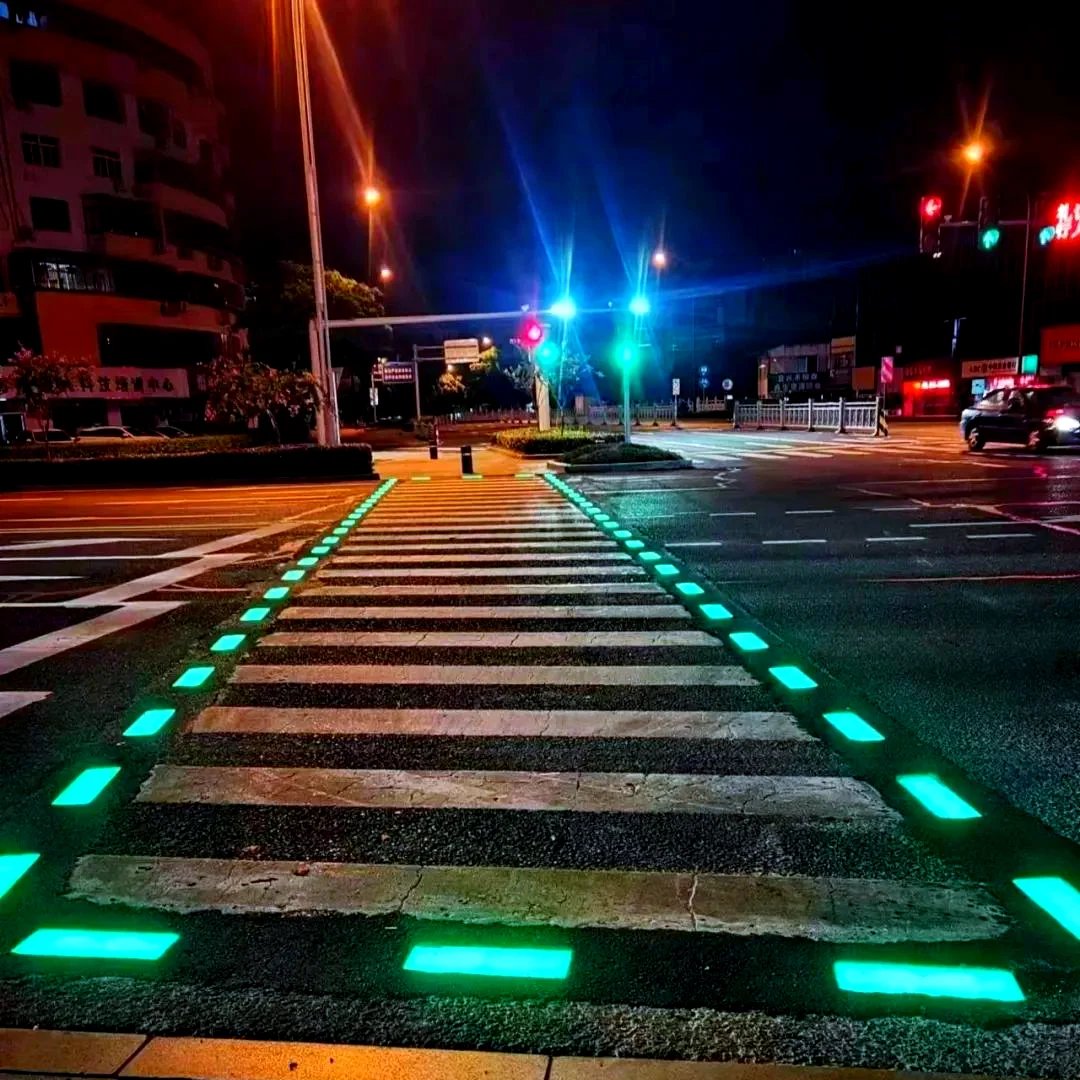
Photoluminescent parking lines absorb light and release visible afterglow as the surroundings darken, adding pavement-level guidance in selected parking lots, underground garages, commercial buildings, industrial facilities, hotels and residential communities.
Drivers need to recognize parking spaces, entrances, exits, ramps, arrows and turning areas; pedestrians need safe routes between vehicles, elevators, stairs and building entrances. Conventional parking lines usually provide enough guidance during the day, while nighttime visibility can depend heavily on overhead lights, streetlights or headlights.
How photoluminescent parking lines work
A photoluminescent parking line is a pavement marking that contains light-storing luminous material. The marking absorbs energy from sunlight or suitable artificial light. After the surrounding light level decreases, the stored energy is gradually released as visible afterglow. The basic process is:
Charge → Store → Glow → Recharge
The marking does not need electrical wiring for the afterglow itself.
Plan lines, routes and boundaries for the parking layout
Parking areas contain many different visual zones. These may include:
- Parking bays
- Drive lanes
- Pedestrian routes
- Entry lanes
- Exit lanes
- Ramp edges
- Direction arrows
- Safety zones
Photoluminescent markings can help reinforce these zones after dark. The technology is particularly interesting in low-speed environments where pavement guidance can remain close to the user’s line of sight.
Parking Bay Lines
Parking bay lines are one of the simplest applications. Luminous lines can define:
- Standard parking spaces
- Visitor parking
- Motorcycle spaces
- Bicycle parking
- Reserved zones
Dark gray concrete or asphalt can create strong visual contrast with luminous green or blue-green lines.
Entry and Exit Guidance
Large parking areas can become confusing at night. Photoluminescent directional lines can help distinguish:
- ENTRY
- EXIT
- One-way routes
- Turning directions
- Internal circulation paths
Arrows can be combined with continuous luminous lines to create a more complete visual guidance system.
Underground Parking Garages
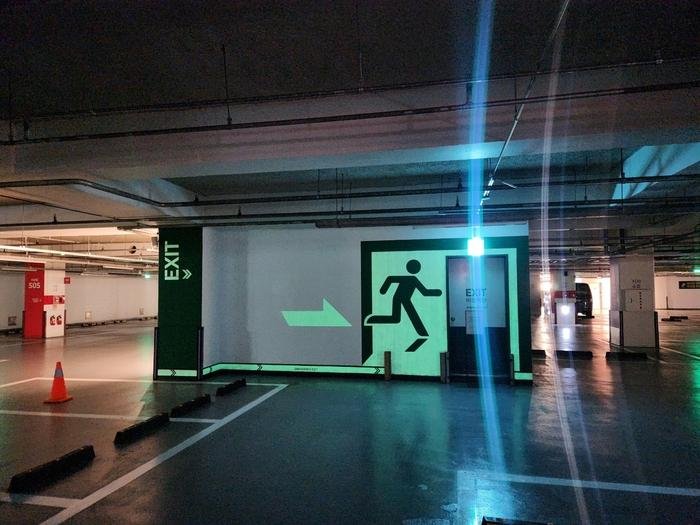
Underground garages are especially suitable for photoluminescent guidance because they already operate under artificial lighting. The existing lights can charge the luminous material during normal operation. Possible applications include:
- Parking bay lines
- Exit arrows
- Stair access routes
- Pedestrian paths
- Ramp edge lines
- Emergency guidance
However, artificial-light charging should always be tested under real site conditions.
Not Every Garage Area Charges Equally
One important design issue is uneven light exposure. A line directly under a ceiling light may charge well. A line may charge less effectively if it is:
- Behind a column
- Under a ramp
- Near a dark corner
- Far from lighting fixtures
For this reason, the garage should be divided into different lighting zones before large-scale installation.
Pedestrian Routes Inside Parking Areas
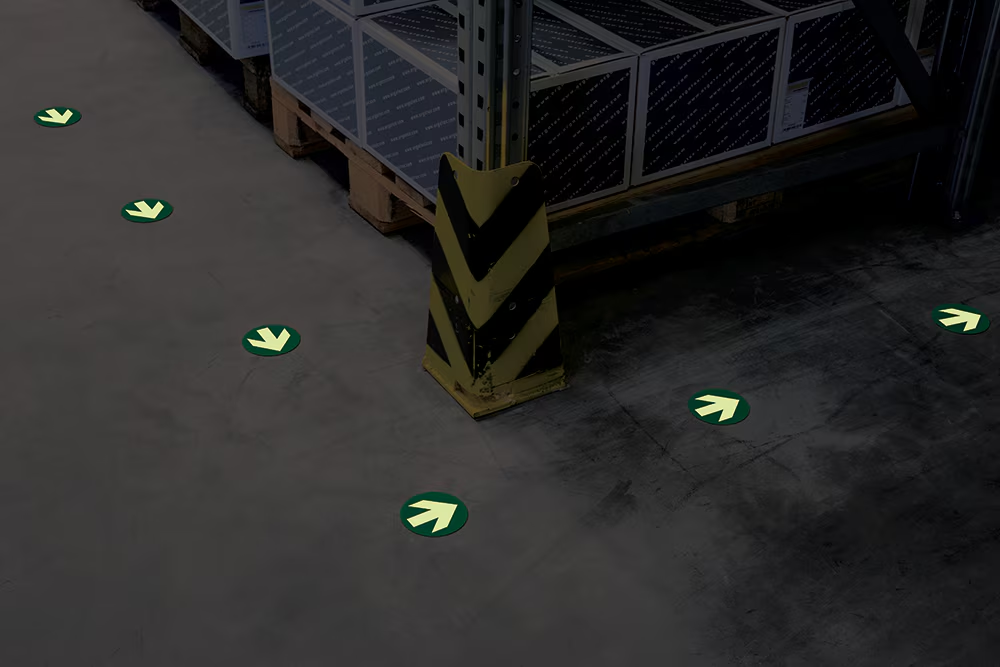
Parking garages are not only vehicle spaces. Pedestrian movement is equally important. Photoluminescent lines can be used to connect:
- Parking zones
- Elevators
- Stairwells
- Building entrances
- Lobbies
- Exit doors
A continuous luminous route can help separate walking paths from vehicle areas.
Ramp Edge Lines
Parking ramps often contain:
- Curves
- Slopes
- Narrow lanes
- Changes in direction
Luminous edge lines can make these boundaries easier to identify after dark. Ramp applications require additional attention to:
- Skid resistance
- Tire wear
- Water
- Surface slope
A more durable coating system may be required.
Columns and Structural Areas
Columns are common in parking garages. Photoluminescent markings can be incorporated around selected columns or near their bases to improve low-level visual recognition. Possible designs include:
- Luminous base strips
- Floor boundary lines
- Direction arrows near columns
These markings should complement conventional high-contrast safety design.
Floor-Level Wayfinding
One advantage of photoluminescent parking markings is that they remain at floor level. This can be useful when drivers or pedestrians need continuous route information. A simple wayfinding system may use:
Green Line → Pedestrian Route
Arrow → Exit
Double Line → Vehicle Lane
Consistency is important.
Too many colors or symbols can make the system difficult to understand.
Choose colors for daytime and nighttime readability
Common photoluminescent colors include:
Yellow-Green
Usually selected when strong visible glow is important.
Blue-Green
Provides a cooler and more modern appearance. For parking projects, color should be selected according to:
- Floor color
- Existing line colors
- Ambient lighting
- Project design
- Required contrast
Combining Daytime and Nighttime Design
Parking markings need to work both during the day and at night. A luminous line should therefore be evaluated in both conditions. During the day, consider:
- Color contrast
- Line width
- Surface appearance
- Compatibility with existing parking markings
At night, consider:
- Glow brightness
- Route continuity
- Direction clarity
- Charging performance
A good system should not sacrifice daytime readability.
Specify the coating layers and line width
Photoluminescent coatings often perform better over a white or light-colored base. A typical structure may include:
Concrete or Asphalt
↓
Primer
↓
White Base Coat
↓
Photoluminescent Layer
↓
Transparent Topcoat
The white layer can improve the visible glow by reflecting more light through the luminous coating.
Parking Line Width
Line width affects both visibility and material consumption. Parking bay lines usually do not need to be excessively wide. The correct width depends on:
- Parking layout
- Existing markings
- Visibility requirements
- Local standards
For luminous markings, consistency is usually more important than oversized lines.
Prepare concrete and asphalt parking surfaces
Parking floors can contain:
- Tire marks
- Oil
- Dust
- Grease
- Water
- Old coatings
Before application, the surface should be properly cleaned and prepared. Poor preparation may result in:
- Peeling
- Edge lifting
- Uneven coating
- Early wear
Concrete Floors
Concrete is common in underground parking garages. Before coating, check for:
- Moisture
- Dust
- Weak laitance
- Existing sealers
- Oil contamination
Grinding or mechanical preparation may be necessary.
Asphalt Parking Lots
Outdoor asphalt parking areas can also use photoluminescent markings. The surface should be:
- Stable
- Dry
- Clean
- Free from loose aggregate
A compatible primer may improve adhesion.
Balance tire-wear resistance and traction
Vehicle tires are one of the biggest durability challenges. High-wear areas include:
- Garage entrances
- Turning zones
- Ramp curves
- Exit lanes
Markings directly under repeated tire turning may wear faster. Where possible, critical luminous guidance can be positioned outside the main wheel path.
Skid Resistance
Parking areas can become wet and slippery. Photoluminescent coatings should not create smooth hazardous surfaces. Anti-slip aggregate may be used on:
- Ramps
- Pedestrian paths
- Garage entrances
- Wet areas
The system should balance:
Glow + Durability + Skid Resistance
Check charging conditions and visible afterglow
Before installation, test the actual ceiling lights. Important factors include:
- Lamp type
- Lamp height
- Light intensity
- Exposure duration
The same luminous paint may perform differently in two garages because the lighting systems are different.
Daylight Charging Outdoors
Outdoor parking lots normally receive natural daylight. This can provide strong charging during the day. However, performance may be lower in areas shaded by:
- Buildings
- Trees
- Canopies
A test section should be placed in both sunny and shaded zones.
How Long Does the Glow Remain Visible?
Photoluminescent markings are usually brightest shortly after darkness begins. Brightness then gradually decreases. The result depends on:
- Pigment quality
- Charging time
- Light intensity
- Coating thickness
- Surface cleanliness
- Ambient darkness
This fading behavior is normal.
Keep the markings clean and inspect for wear
Parking floors collect a lot of contamination. Common examples include:
- Tire dust
- Oil
- Mud
- Exhaust residue
- General dirt
These materials can block incoming light and reduce charging. Regular cleaning helps maintain luminous performance.
Maintenance Planning
A parking marking system should be inspected periodically. Check for:
- Wear
- Peeling
- Reduced glow
- Surface contamination
- Topcoat damage
Small repairs are usually easier and less expensive than replacing a large worn area.
Compare photoluminescent, reflective and LED guidance
Photoluminescent vs. Reflective Parking Lines
These two systems work differently.
Reflective Parking Line
Reflects external light such as headlights.
Photoluminescent Parking Line
Stores light and releases afterglow. In some projects, both technologies can be combined. This can provide:
Headlight Reflection + Passive Glow
Photoluminescent vs. LED Parking Guidance
LED systems actively produce light. Photoluminescent lines provide passive afterglow.
Photoluminescent Parking Line
- No wiring for afterglow
- Integrated into pavement
- Lower system complexity
- Gradually fading brightness
LED Parking Guidance
- Requires electrical or solar power
- Stronger active illumination
- More complex installation
- Can maintain controlled brightness
The correct system depends on the project.
Prioritize a coherent parking guidance design
A parking guidance system does not need every line to be extremely bright. What matters more is whether users can clearly understand:
- Where to drive
- Where to park
- Where to walk
- Where to exit
Simple, continuous, and consistent markings are often more useful than overly bright decorative effects.
Test the complete system at the actual site
Before applying the system throughout the parking area, create a small test zone. Use the actual:
- Floor
- Primer
- Base coat
- Luminous coating
- Topcoat
- Anti-slip treatment
Then evaluate:
- Daytime appearance
- Nighttime glow
- Charging under existing lights
- Tire wear
- Skid resistance
- Cleaning resistance
This is especially important for underground garages.
Parking applications at a glance
Photoluminescent parking lines are particularly suitable for:
Underground Garages
Parking spaces, pedestrian routes, and exit guidance.
Hotels
Nighttime parking and pedestrian organization.
Residential Communities
Internal parking areas and walking routes.
Shopping Centers
Large parking garages and pedestrian guidance.
Industrial Facilities
Employee parking and internal traffic areas.
Resorts
Parking areas integrated with landscape lighting.
Select materials for the parking project
Photoluminescent parking lines can do more than outline a parking space. When properly designed, they can become part of a complete parking guidance system that includes:
- Parking bays
- Direction arrows
- Ramp edges
- Pedestrian routes
- Exit guidance
The best results depend on:
Good Lighting Analysis + Clear Route Design + Proper Surface Preparation + Suitable Luminous Material + Skid Resistance + Regular Maintenance
For underground garages and outdoor parking areas, photoluminescent markings can provide practical passive guidance while complementing existing lighting and conventional parking markings.
FUXIN supplies Photoluminescent Parking Line Materials, Glow Road Marking Materials, Luminous Pavement Coatings, and Photoluminescent Pigments for parking garages, parking lots, pedestrian routes, bicycle paths, and industrial applications.
For samples, quotations, or project material recommendations, please contact us.