

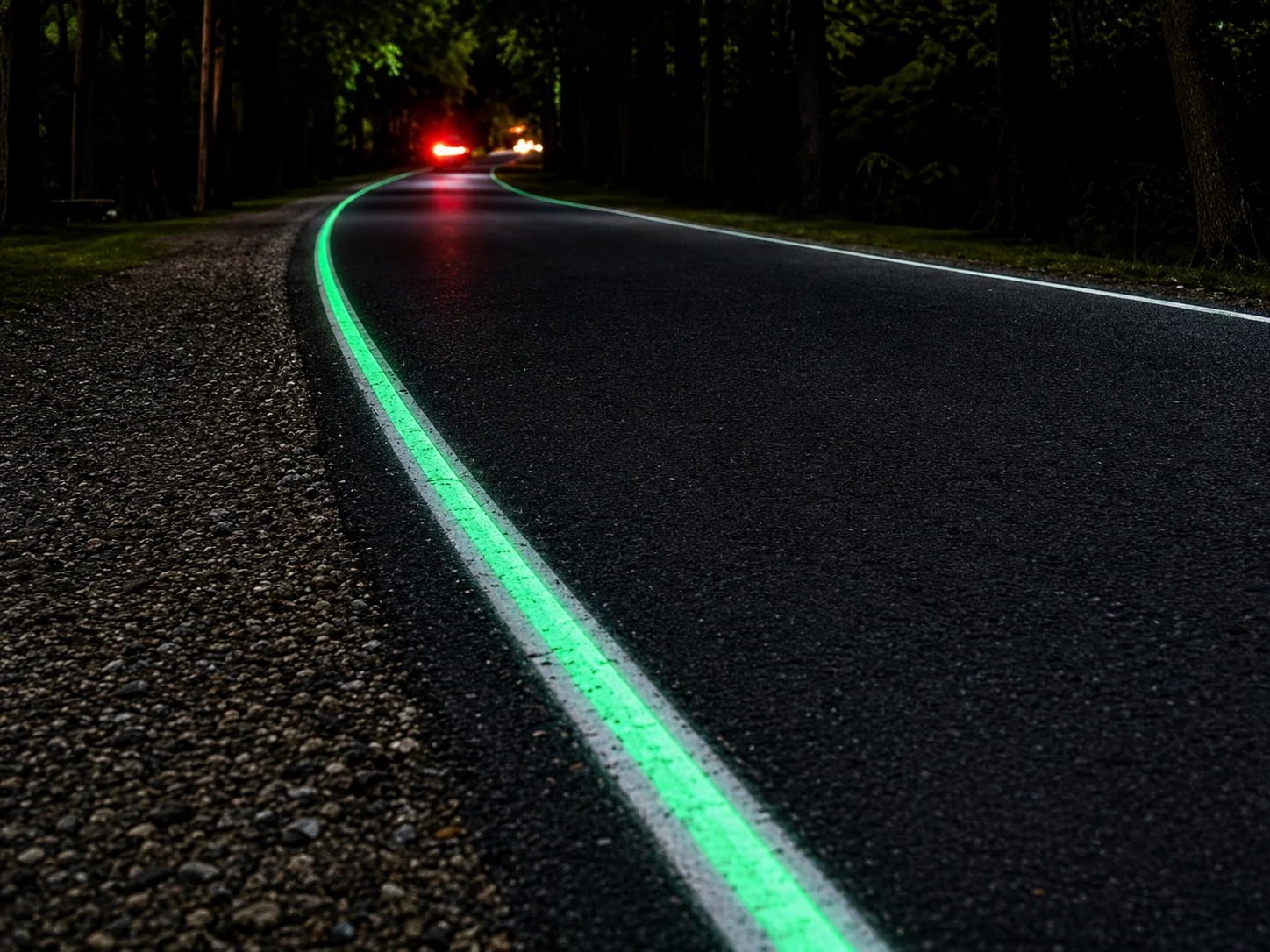
Traffic lines are one of the simplest but most important elements of pavement design.
They separate routes, define boundaries, guide movement, organize parking areas, and help road users understand how a space should be used.
During the day, conventional traffic lines are usually easy to recognize. At night, however, visibility often depends on street lighting, vehicle headlights, or reflective materials.
A luminous traffic line provides another option.
By incorporating photoluminescent material into a compatible pavement marking system, selected traffic lines can absorb light during the day and gradually release that stored energy after dark.
The result is a visible luminous line integrated directly into the pavement.
What Is a Luminous Traffic Line?
A luminous traffic line is a pavement marking line containing photoluminescent material.
During daylight or exposure to suitable artificial light, the material absorbs energy.
When the surrounding environment becomes darker, part of that stored energy is gradually released as visible light.
The process can be summarized as:
Absorb Light → Store Energy → Glow After Dark → Recharge
Unlike electrically illuminated pavement systems, the photoluminescent effect itself does not require wiring, batteries, or a power supply.
However, the line does not maintain constant brightness throughout the night.
The glow is generally stronger shortly after darkness and gradually becomes softer over time.
What Material Creates the Glow?
The luminous effect is usually produced by photoluminescent pigment.
The pigment is incorporated into a compatible binder or pavement coating.
A complete system may include:
-
Pavement primer
-
Base coating
-
Photoluminescent pigment
-
Compatible transparent or light-transmitting binder
-
Anti-slip aggregate
-
Transparent protective layer where appropriate
The exact structure depends on the pavement, expected traffic, environment, and project requirements.
The pigment alone does not determine the final performance.
The binder, coating thickness, installation quality, and light exposure are equally important.
Where Can Luminous Traffic Lines Be Used?
Luminous traffic lines are particularly interesting in areas where route guidance and nighttime pavement design are both important.
Potential applications include:
-
Bicycle paths
-
Pedestrian routes
-
Parking areas
-
Parks
-
Greenways
-
Resorts
-
Campuses
-
Scenic routes
-
Shared-use paths
-
Recreational spaces
-
Selected traffic organization areas
For official public roads, applicable local road-marking standards should always be considered before using photoluminescent materials.
Lane Edge Lines
One of the most straightforward applications is a luminous edge line.
The line can be installed along one or both sides of a route to visually define its boundary.
This approach can be useful on:
-
Bicycle paths
-
Park routes
-
Pedestrian paths
-
Resort roads
-
Recreational routes
-
Waterfront paths
A continuous luminous edge line can be particularly noticeable against dark asphalt.
Center Lines
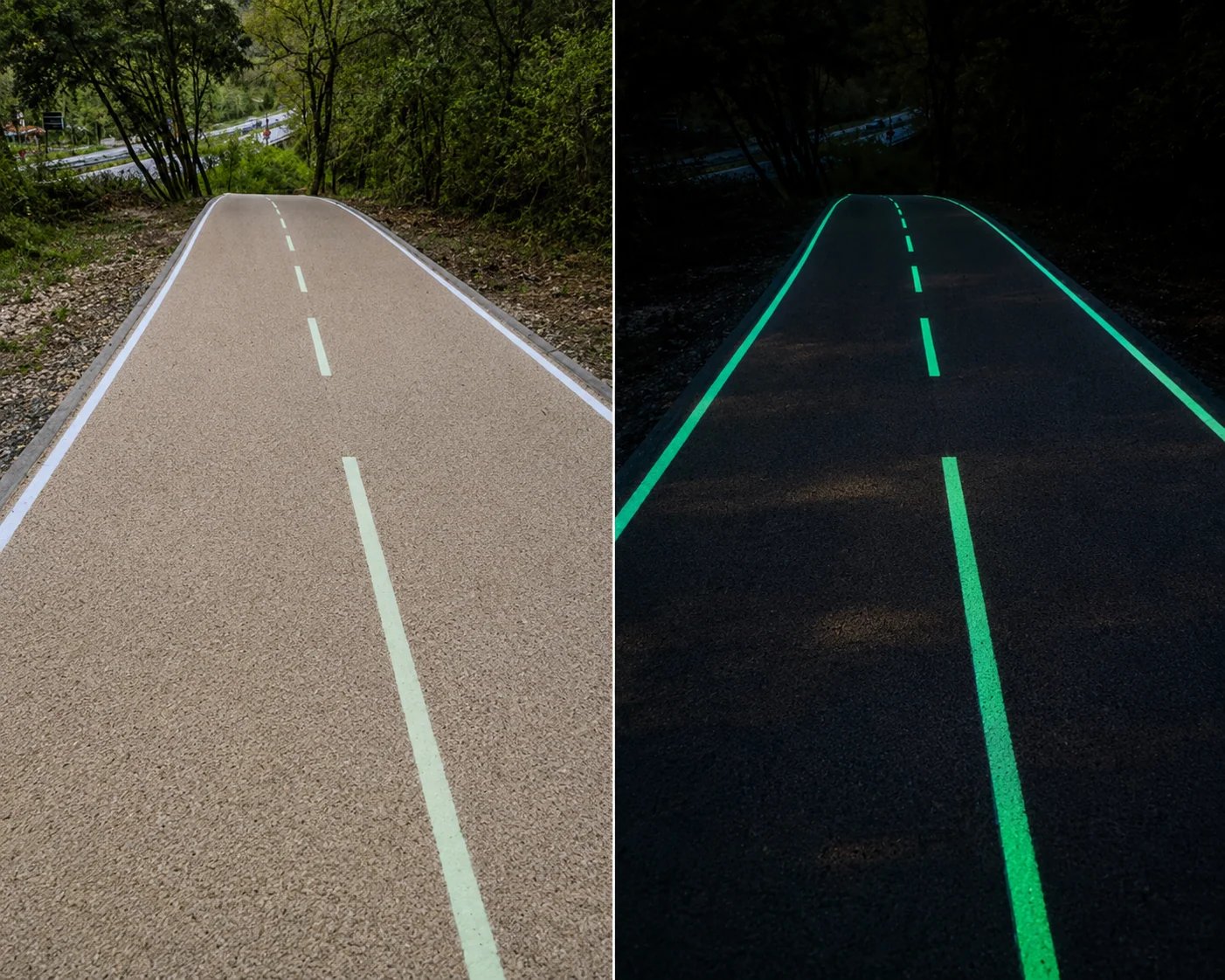
A luminous center line can help visually separate two directions of movement on selected paths.
For example, it may be used on:
-
Two-way bicycle paths
-
Shared-use routes
-
Recreational greenways
-
Campus paths
The line can be continuous or dashed depending on the design.
For official traffic applications, line dimensions and layout should follow relevant project requirements.
Dashed Traffic Lines
Dashed luminous lines can be used where a continuous line would be visually too strong.
Possible applications include:
-
Route division
-
Transition areas
-
Bicycle lanes
-
Shared paths
-
Decorative guidance zones
Consistent spacing is important.
Uneven line length or spacing can make the pavement look poorly organized both during the day and at night.
Intersection Guidance
Intersections are often areas where pavement information becomes more important.
Luminous traffic lines can be combined with:
-
Arrows
-
Direction lines
-
Bicycle symbols
-
Pedestrian symbols
-
Route borders
This can help make selected junctions easier to interpret in nighttime landscape environments.
A clear layout should always be planned before installation.
Parking Areas
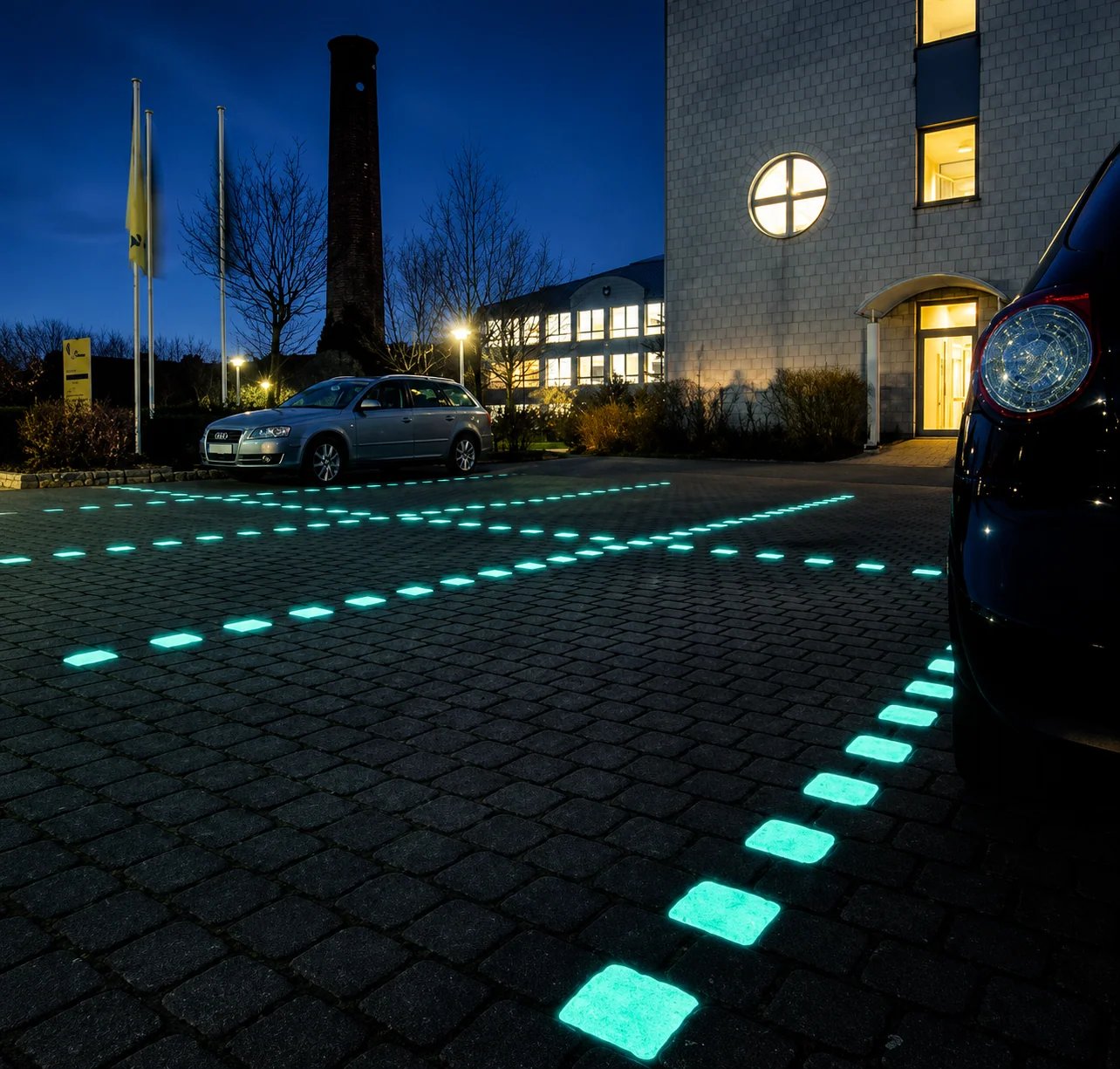
Parking areas contain many different pavement markings.
Luminous materials may be considered for selected features such as:
-
Pedestrian routes
-
Direction arrows
-
Parking entrance guidance
-
Decorative boundary lines
-
Selected symbols
However, vehicle traffic creates more wear than a typical pedestrian walkway.
The complete marking system must therefore be suitable for the expected traffic load.
Bicycle Routes
Dedicated bicycle routes are one of the most practical environments for luminous traffic lines.
The marking can be used for:
-
Edge lines
-
Center lines
-
Directional arrows
-
Bicycle symbols
-
Route transitions
Dark park or greenway environments often provide better visual contrast than brightly illuminated urban streets.
Skid resistance is especially important because cyclists may brake or turn directly over the marking.
Pedestrian and Shared-Use Paths
Luminous lines can also define pedestrian areas and shared bicycle-pedestrian routes.
Possible applications include:
-
Route edges
-
Separation lines
-
Walking symbols
-
Direction arrows
-
Decorative guidance
These applications are especially suitable for parks, resorts, campuses, and recreational areas.
Luminous Traffic Line vs. Reflective Traffic Line
Photoluminescent and reflective lines are different technologies.
Reflective Traffic Line
Reflective marking depends on external light.
Vehicle headlights strike reflective materials such as glass beads, returning part of the light toward the driver.
This technology is extremely important for conventional vehicle roads.
Luminous Traffic Line
Photoluminescent marking absorbs light before darkness and then gradually releases it.
It can therefore produce visible afterglow without direct vehicle headlights.
This does not mean luminous traffic lines should replace reflective markings on conventional roads.
In many cases, luminous technology is better used as a supplementary feature.
Luminous Traffic Line vs. LED Road Guidance
LED systems actively produce light.
Luminous traffic lines do not.
Luminous Lines
-
No electricity required for the afterglow
-
Integrated directly into the pavement
-
Softer visual effect
-
Gradually fading brightness
-
Minimal electrical infrastructure
LED Guidance
-
Requires electricity, batteries, or solar components
-
Produces stronger illumination
-
Can maintain more consistent brightness
-
Requires additional equipment
Some projects can combine both systems.
LED lighting can illuminate the area while luminous traffic lines provide pavement-level guidance.
Pavement Color Makes a Difference
Background color can strongly affect the appearance of a luminous line.
Dark Asphalt
Dark pavement usually provides stronger nighttime contrast.
Green or blue-green luminous material can appear more noticeable.
Light Concrete
A light pavement may produce less nighttime contrast but may offer a cleaner daytime appearance.
Before selecting the final design, it is useful to test the luminous marking directly on the intended pavement color.
Line Width Should Match the Application
A traffic line should not be designed only according to appearance.
The width should match the route and function.
A decorative resort path may use a narrow line.
A bicycle path may require a wider and more visible marking.
Before application, determine:
-
Line width
-
Line spacing
-
Route position
-
Edge distance
-
Curves
-
Intersections
-
Symbols
A planned layout usually produces a much more professional result.
Surface Preparation
Proper pavement preparation is essential.
Before applying luminous marking, the surface should normally be:
-
Clean
-
Dry
-
Stable
-
Free from oil
-
Free from dust
-
Free from loose particles
Weak coatings, cracks, or damaged pavement should be repaired where necessary.
Poor preparation can cause peeling or premature marking failure.
Binder Compatibility
The binder must be compatible with both the pavement and photoluminescent pigment.
Important characteristics include:
-
Adhesion
-
Transparency
-
Outdoor durability
-
UV resistance
-
Water resistance
-
Curing behavior
-
Wear resistance
Because the luminous material needs access to light, an excessively opaque binder or topcoat can reduce charging performance.
Coating Thickness
A luminous traffic line should be applied with reasonably consistent thickness.
If the layer is too thin, the luminous effect may be weak.
If it is excessively thick, curing, texture, or coating performance may be affected.
The correct thickness depends on the selected marking system.
Uniformity is more important than simply applying as much material as possible.
Skid Resistance
Traffic lines are part of the road or path surface.
They should not become excessively slippery.
Skid resistance is particularly important for:
-
Bicycle paths
-
Curves
-
Ramps
-
Slopes
-
Pedestrian crossings
-
Wet areas
Suitable anti-slip aggregate may be incorporated according to the marking system and project requirements.
The goal should be to balance luminous performance with surface safety.
Sunlight and Charging Conditions
Photoluminescent traffic lines need exposure to light before they can glow.
Open outdoor areas generally provide better charging conditions.
Sections under:
-
Dense trees
-
Bridges
-
Buildings
-
Roof structures
may receive less daylight.
For long routes, different sections may therefore show different nighttime brightness.
Site conditions should be evaluated before installation.
Surrounding Lighting
Strong artificial lighting can reduce the visual contrast of a luminous line.
For example, a line may look very bright on a dark greenway but much softer in a city street surrounded by lamps and illuminated buildings.
This is why luminous traffic lines often produce their strongest visual effect in relatively dark environments.
Weather Conditions
Outdoor pavement is exposed to changing weather.
The complete marking system should be suitable for:
-
Rain
-
Sunlight
-
UV exposure
-
Temperature changes
-
Humidity
-
Surface contamination
Drainage should also be considered in areas where standing water may occur.
For bicycle and pedestrian applications, wet-surface skid resistance is particularly important.
Maintenance
Luminous traffic lines need to remain clean enough to receive light.
Common contamination includes:
-
Dust
-
Mud
-
Leaves
-
Oil
-
Dirt
-
Moss
Routine maintenance can include:
-
Sweeping
-
Washing
-
Removing leaves
-
Cleaning mud
-
Inspecting worn areas
-
Repairing damaged sections
A dirty luminous line may appear weaker simply because less light can reach the photoluminescent layer.
Test a Sample Before Full Installation
Sample testing is especially useful for luminous traffic lines.
A small test section can help evaluate:
-
Line width
-
Glow color
-
Pigment concentration
-
Daytime appearance
-
Nighttime contrast
-
Surface texture
-
Skid resistance
-
Binder compatibility
Whenever possible, the sample should be tested at the actual project location.
This provides a more realistic result than testing only in a completely dark indoor space.
Is a Luminous Traffic Line Suitable for Public Roads?
This depends on the project and local regulations.
Official vehicle road markings can have requirements for:
-
Color
-
Retroreflectivity
-
Line width
-
Skid resistance
-
Durability
-
Visibility
-
Approved material systems
A photoluminescent line should not automatically replace conventional certified traffic markings.
For many applications, it is more naturally suited to:
-
Bicycle paths
-
Pedestrian routes
-
Parks
-
Resorts
-
Campuses
-
Greenways
-
Recreational areas
Where it is used as an official traffic marking, the complete system should meet applicable standards.
Is It a Replacement for Street Lighting?
Generally, no.
A luminous traffic line makes the pavement marking visible, but it does not illuminate surrounding objects in the same way as a streetlight.
Where specific lighting levels are required, conventional lighting should still be provided.
Photoluminescent lines are best considered:
-
Supplementary guidance
-
Decorative pavement features
-
Passive luminous markings
-
Nighttime landscape elements
Where Does Luminous Traffic Line Work Best?
The technology is particularly attractive in environments where pavement guidance and landscape appearance are closely connected.
Examples include:
Parks and Greenways
Luminous lines can define long walking or cycling routes through darker landscape areas.
Resorts
Lines can guide guests between villas, gardens, pools, and recreational areas.
Campuses
Selected routes can use luminous lines to create a distinctive nighttime navigation system.
Waterfront Areas
Relatively dark surroundings can provide strong visual contrast.
Bicycle Routes
Edge and center lines can become part of the nighttime cycling environment.
Final Thoughts
A luminous traffic line combines pavement guidance with photoluminescent technology.
It can be used as an edge line, center line, dashed line, route boundary, or part of a larger traffic organization design.
However, good results require more than a bright pigment.
A successful system should consider:
Pavement condition + Photoluminescent pigment + Compatible binder + Line design + Skid resistance + Light exposure + Weather + Maintenance
For bicycle paths, pedestrian routes, parks, resorts, campuses, greenways, and selected traffic areas, luminous traffic lines can provide a distinctive way to make pavement guidance visible after dark.
FUXIN supplies Photoluminescent Pigment and Glow-in-the-Dark Pavement Materials for luminous traffic lines, road markings, bicycle paths, pedestrian routes, and landscape pavement applications.
Product information, samples, quotations, and material recommendations are available for different project requirements.
Contact us to discuss your luminous traffic line project.