

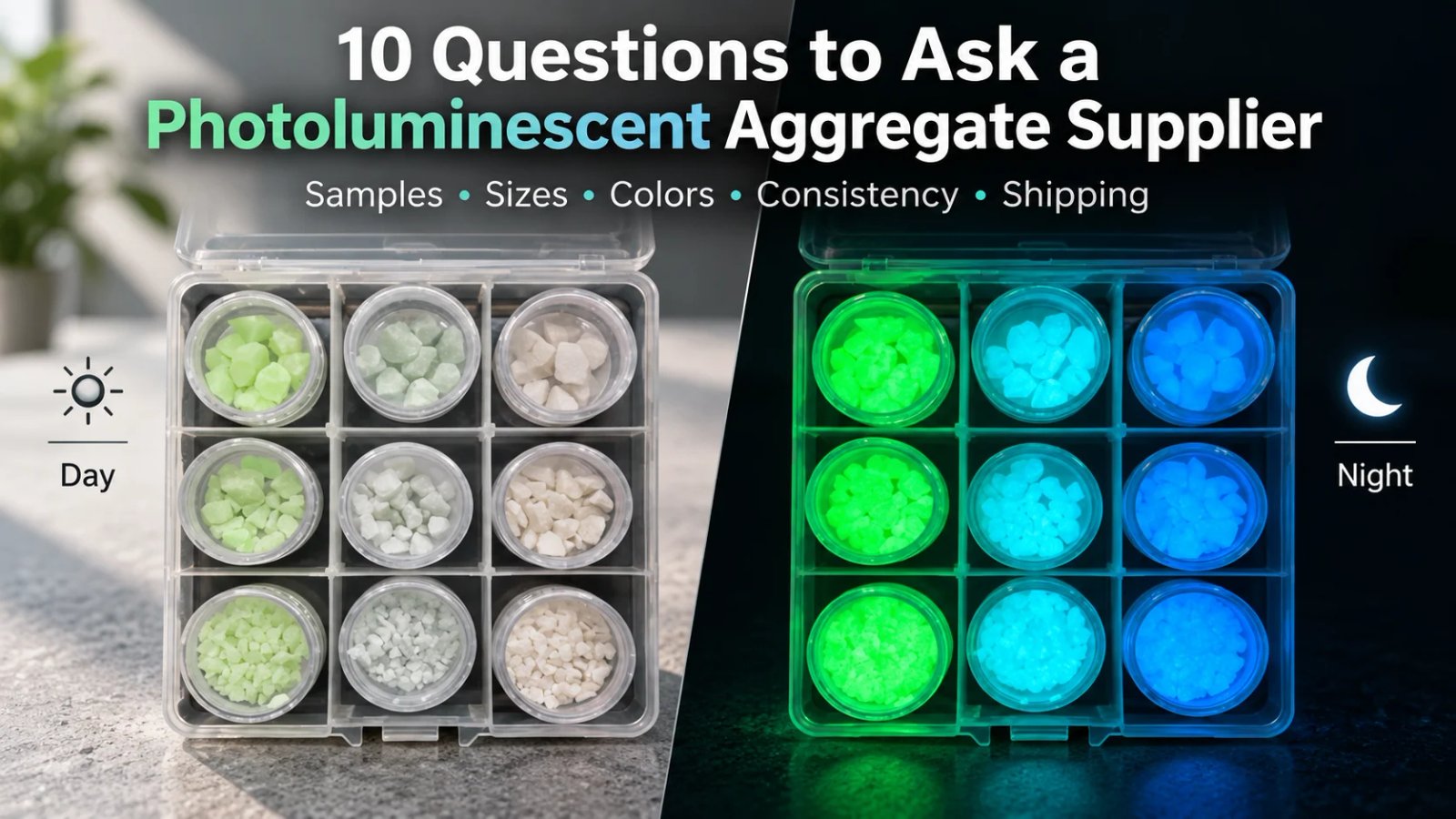
Choosing a photoluminescent aggregate supplier takes more than comparing prices per kilogram. Two glow aggregates may look similar in a product photo yet perform differently when installed in concrete, asphalt or a landscape paving system.
Before ordering, ask about application suitability, particle sizes, glow performance, samples, batch consistency and technical documents. Installation advice, recommended quantities, packaging, production lead time and shipping also affect whether the material fits your project.
This guide helps contractors, distributors, landscape designers and project buyers prepare those questions. Use comparable sample tests and clear project information to assess the finished surface you want, alongside color, price and delivery.
Is the Aggregate Suitable for Your Pavement System?
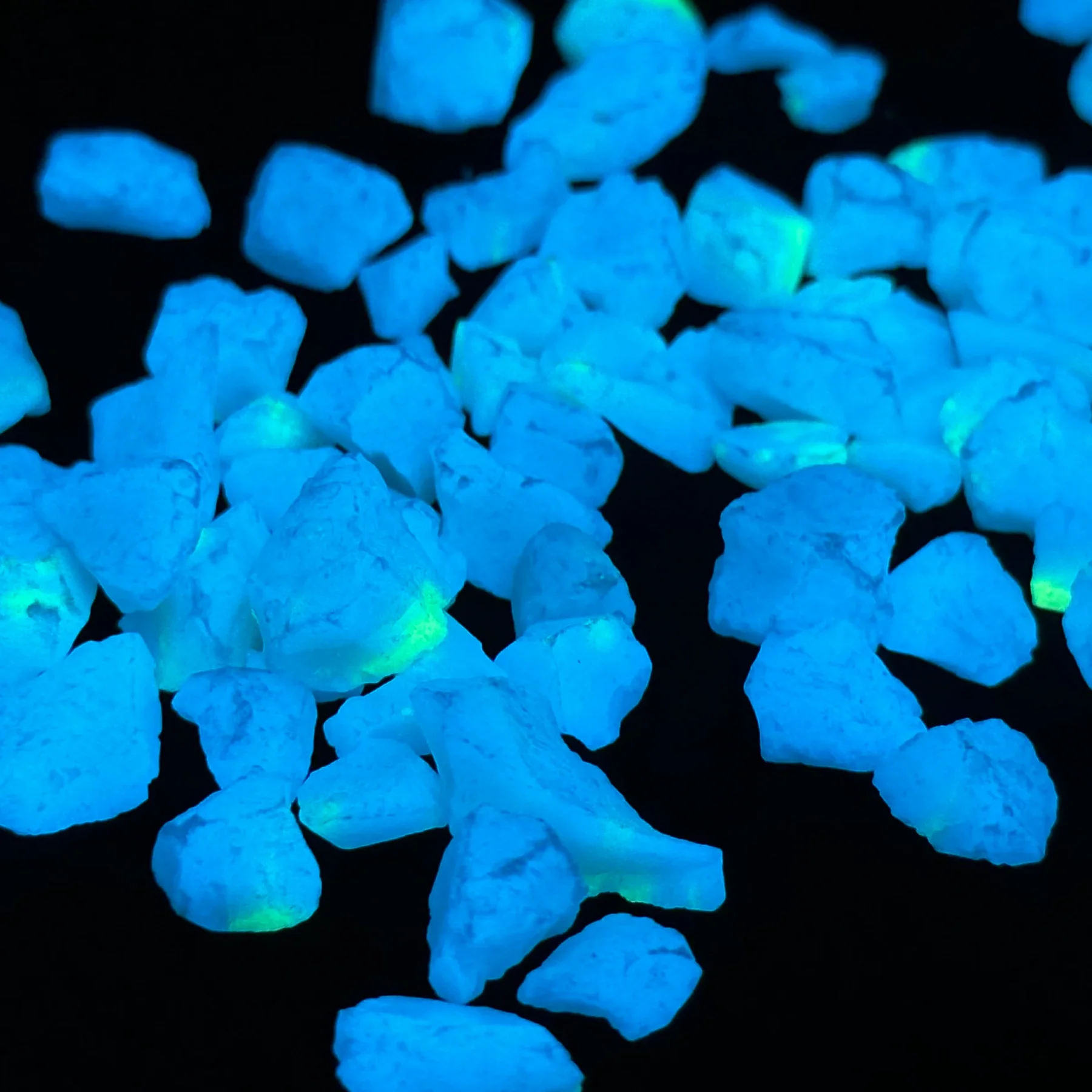
Start with the intended application.
Ask the supplier whether the photoluminescent aggregate is designed for:
-
outdoor paving
-
concrete
-
exposed aggregate concrete
-
asphalt
-
resin-bound systems
-
landscape decoration
-
poolside paving
-
pedestrian pathways
This matters because not every glow material is suitable for every installation method.
A decorative product intended for indoor crafts is very different from aggregate intended to become part of a permanent outdoor pavement.
The supplier should understand the difference.
A useful conversation begins with:
“This is my project. Is your material suitable for this application?”
not simply:
“Do you sell glow stones?”
Which Particle Size Ranges Can the Supplier Confirm?
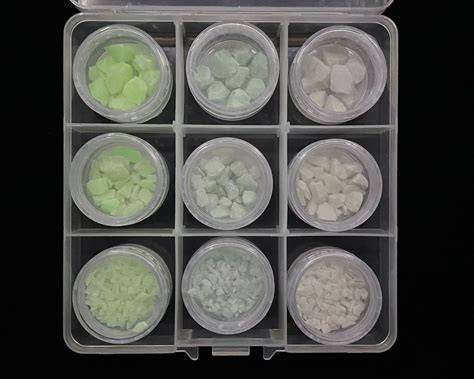
Particle size changes both installation and appearance.
Common project sizes may include:
1–5mm
5–10mm
10–20mm
But buyers should ask whether these are actual screened ranges or only approximate descriptions.
Why does this matter?
Because an inconsistent product containing too much fine powder and too many oversized pieces may create an uneven finished surface.
For example, a buyer ordering 5–10mm aggregate normally expects most of the material to fall within that range.
Before a larger order, request:
-
actual product photos
-
close-up size comparison
-
physical sample
-
size specification if available
This is especially important when several sizes will be used in the same project.
Which Glow Colors Are Available?
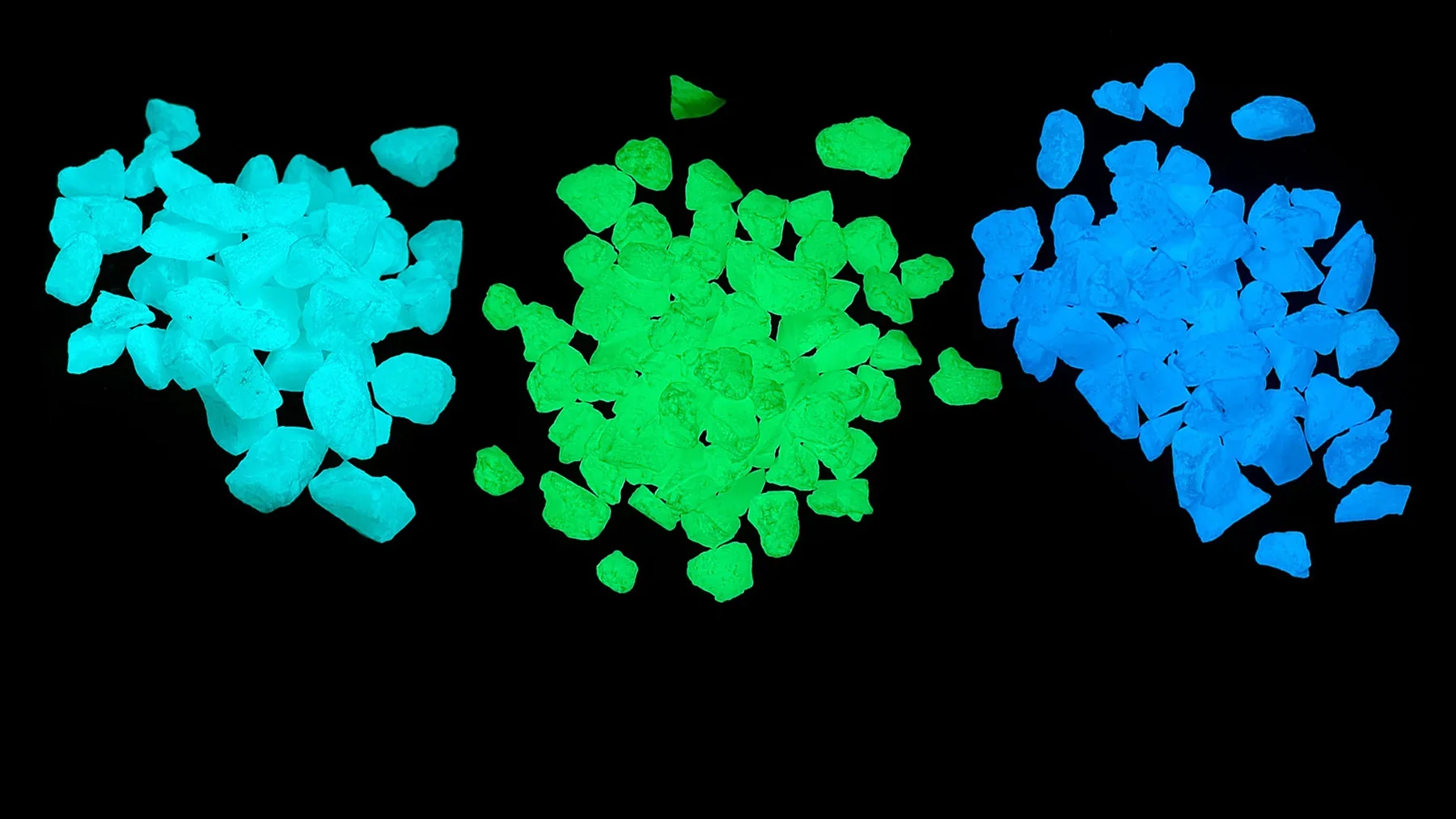
The most common project colors often include:
-
blue
-
blue-green
-
yellow-green
But color selection should not be made from a screen alone.
Nighttime photographs can change dramatically depending on:
-
camera exposure
-
phone processing
-
charging conditions
-
surrounding darkness
-
editing
Ask the supplier to provide physical samples if the project is large enough.
Then compare all colors under the same lighting conditions.
A supplier who understands project work should be comfortable with this approach.
Under What Conditions Was Glow Performance Tested?
This question can reveal a lot about the supplier.
If the answer is only:
“Our stones glow for many hours.”
ask for more detail.
Useful questions include:
-
What charging source was used?
-
How long was the sample charged?
-
When was brightness evaluated?
-
Was the test performed in complete darkness?
-
Is there any photoluminescence test data available?
The important point is not to chase one impressive marketing number.
It is to make sure different samples are being compared under comparable conditions.
For project buyers, a controlled side-by-side sample test is usually more useful than separate promotional photographs.
Can You Test Samples in the Actual Pavement System?
For permanent pavement, the answer should ideally be yes.
A sample lets the buyer evaluate:
-
daytime color
-
particle size
-
particle shape
-
initial glow
-
afterglow
-
color preference
-
installation behavior
For a serious project, go one step further.
Use the sample to make a small test panel using the actual:
concrete, asphalt or resin system.
A loose stone sample cannot show:
-
embedment depth
-
final surface exposure
-
pavement contrast
-
finished texture
-
real nighttime visibility
That is why sample testing should happen before the full quantity is ordered whenever possible.
Is the Product Consistent From Batch to Batch?
This is particularly important for large projects.
Imagine completing half of a 2,000 m² pathway and then receiving a second batch with noticeably different:
-
particle size
-
daytime appearance
-
glow color
-
brightness
-
particle shape
That can create a visible difference across the project.
Ask the supplier how they manage batch consistency.
For larger orders, it can also be useful to discuss whether the full project quantity can be produced or reserved from the same production batch.
Buyers should also consider ordering a reasonable contingency quantity rather than relying on a small repeat order months later.
What Technical Documents Can the Supplier Provide?
A professional B2B project may require more than product photographs.
Depending on the project and market, buyers may ask for documents such as:
-
TDS
-
SDS / MSDS
-
product specifications
-
packaging information
-
test reports
-
installation recommendations
The exact documentation needed depends on the country and project.
The important thing is whether the supplier can support a technical discussion.
For contractors and distributors, this can become especially important when the material needs to be presented to:
-
architects
-
consultants
-
project owners
-
government clients
-
procurement departments
A supplier who can provide clear technical information is easier to work with than one who can only send a price list.
Does the Supplier Understand Installation?
Photoluminescent aggregate is not a finished pavement by itself.
Its performance depends heavily on installation.
A useful supplier should understand basic questions such as:
-
Should the aggregate be mixed or surface-seeded?
-
How much of the particle should remain exposed?
-
Can it be used in concrete?
-
Can it be rolled into asphalt?
-
What particle size suits the intended surface?
-
How should a sample section be prepared?
This does not mean the material supplier replaces the pavement engineer or local contractor.
But a supplier familiar with real applications can help buyers avoid obvious mistakes.
For example, simply mixing expensive glow aggregate deep throughout a concrete slab may waste a large amount of material.
If the supplier never asks how the product will be installed, that is worth noticing.
What Quantity Does the Supplier Recommend?
Be careful with suppliers who provide the same kg/m² recommendation for every project.
Consumption depends on:
-
particle size
-
application method
-
desired glow density
-
substrate
-
pattern
-
surface exposure
A scattered decorative effect requires a different quantity from a dense luminous surface.
So before asking:
“How many kilograms do I need?”
provide:
-
total area
-
pavement type
-
selected particle size
-
glow color
-
desired visual effect
-
installation method
The recommendation becomes much more meaningful.
What Is the MOQ and Packaging?
This sounds like a simple commercial question, but it affects real project planning.
Ask:
-
minimum order quantity
-
standard bag or carton size
-
net weight
-
export packaging
-
pallet options
-
sample packaging
-
OEM packaging availability if relevant
For distributors, packaging may be very different from project supply.
A contractor may prefer larger project packaging.
A retailer may need smaller consumer-ready units.
The supplier should understand which market you are buying for.
What Is the Production Lead Time?
Do not ask only:
“Is it in stock?”
Ask what happens when the order becomes larger.
A 20kg sample order and a multi-ton project order are completely different.
Confirm:
-
sample preparation time
-
normal production lead time
-
lead time for large quantities
-
whether custom colors or sizes require additional time
-
expected loading date
This matters because the luminous material normally needs to arrive before or during the relevant paving stage.
A delayed shipment can affect the entire construction schedule.
How Will the Material Be Shipped?
International buyers should discuss logistics early.
The lowest factory price is not always the lowest landed cost.
Ask about:
-
shipment weight
-
packaging dimensions
-
palletization
-
sea freight suitability
-
air/courier options for samples
-
export documents
-
delivery terms
For a small sample, courier shipping may make sense.
For a large paving project, sea freight may be much more economical.
The most useful quotation is therefore not always:
USD/kg only.
Project buyers often need to understand:
material cost + packing + freight + import cost.
Can the Supplier Support a Trial Order?
A trial order can be useful before moving into a large project or distribution agreement.
A buyer may first test:
-
one color
-
several particle sizes
-
sample packaging
-
actual installation
-
local customer response
This reduces risk for both sides.
For distributors, a small first order can also help identify which specifications sell best in the local market.
For project contractors, the goal is different:
the trial quantity should be enough to create a representative test area.
What Happens If the Project Specification Changes?
Real construction projects change.
The architect may change:
-
pavement color
-
particle size
-
glow color
-
total area
-
design pattern
The client may move from full coverage to edge bands.
The concrete contractor may change the finishing system.
Ask whether the supplier can adjust the material recommendation accordingly.
This is where a supplier who understands the application becomes more useful than one who only processes orders.
Ask About the Daytime Appearance
Many buyers focus completely on nighttime glow.
But the pavement will usually be visible during the day for much longer.
Ask for:
-
daylight product photos
-
installed daytime photos
-
close-up surface photos
Some glow aggregate appears pale or light-colored during the day.
Its appearance may change depending on the concrete or asphalt background.
For landscape and architectural projects, daytime appearance should be approved before full installation.
Ask for Real Project Photos — Not Only Studio Samples
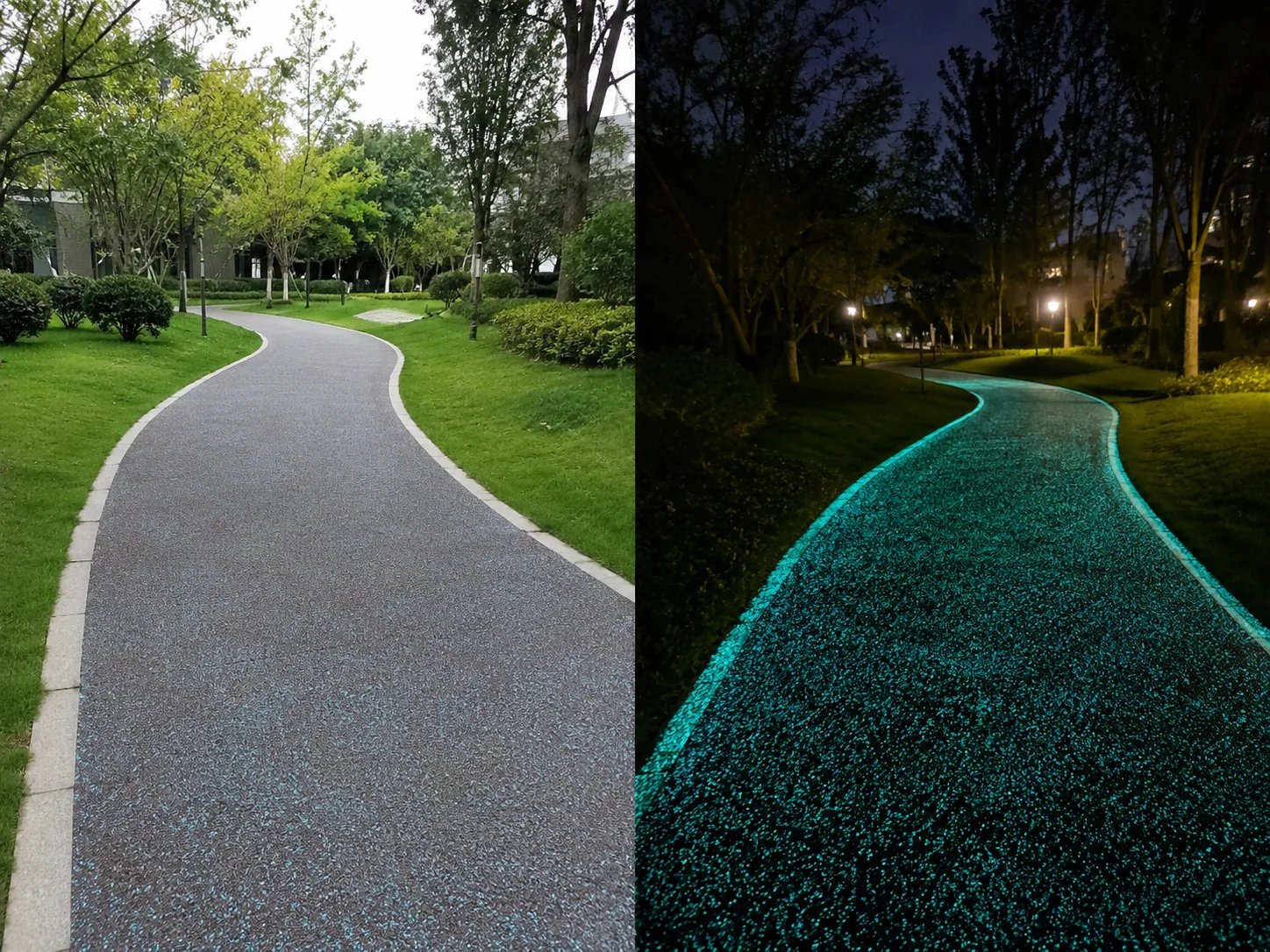
Studio photos are useful for product identification.
They do not prove how the material looks after installation.
For larger projects, ask the supplier whether they can provide examples of:
-
pathways
-
concrete surfaces
-
asphalt
-
landscape applications
-
nighttime installations
-
daytime installations
Look for consistency between the product and the installed result.
This can also help you understand what level of glow density is realistic.
Watch for Overly Perfect Night Photos
A very bright nighttime photo is not automatically a sign of a better product.
Night photography can easily exaggerate glow.
Long exposure, high ISO or automatic night mode can make a surface look much brighter than it appears to the eye.
A stronger supplier presentation will normally include more than one type of image:
daytime
nighttime
close-up
real project
sample comparison
This gives the buyer more information to work with.
Compare Total Project Value, Not Only Price per Kilogram
Consider two suppliers.
Supplier A offers a lower price.
But the material requires more quantity to achieve the desired visible effect, or the supplier provides little application support.
Supplier B costs more per kilogram but helps the contractor optimize:
-
particle size
-
distribution
-
surface exposure
-
test-panel design
It is possible that Supplier B produces the lower total installed cost.
This is why B2B procurement should compare:
product price + consumption + installation + logistics + project risk
rather than product price alone.
What to Include in a Photoluminescent Aggregate RFQ
If you want a useful quotation, avoid sending only:
“Price?”
A stronger RFQ might look like this:
Project: Landscape pedestrian pathway
Country: Thailand
Area: 600 m²
Substrate: Concrete
Glow Color: Blue-Green
Particle Size: 5–10mm
Desired Effect: Medium-density scattered glow
Application: Surface-seeded aggregate
Project Stage: Sample testing
With this information, a supplier can give a much more useful response.
Red Flags When Comparing Suppliers
Be cautious if a supplier:
-
cannot clearly identify particle size
-
refuses to provide daylight photos
-
only provides heavily edited glow images
-
cannot explain basic installation
-
gives exactly the same consumption rate for every project
-
cannot provide basic product documentation
-
changes product specifications frequently
-
cannot explain packaging or lead time
One red flag does not automatically mean the supplier is unsuitable.
But several together should make a project buyer slow down and test the material more carefully.
What a Professional Supplier Should Ask You
Supplier qualification works both ways.
A serious supplier should also ask questions.
For example:
What is the application?
How many square meters?
Concrete or asphalt?
What glow color do you want?
What particle size are you considering?
What nighttime effect are you trying to achieve?
If the supplier immediately sends a price without understanding the project, the recommendation may be too generic.
Good project communication should be two-way.
Frequently Asked Questions
Should I always request samples?
For larger or permanent paving projects, samples are highly recommended.
Is the cheapest supplier usually the best choice?
Not necessarily. Total consumption, material consistency, technical support, shipping and installation performance all affect project cost.
How many colors should I test?
Testing blue, blue-green and yellow-green under the same conditions can help clarify which visual effect fits the project.
Should I ask for test reports?
For commercial projects, available technical documentation can be useful. The required documents depend on the project and local market.
Can one supplier specification work for every pathway?
No. Particle size, color, coverage and installation should be selected according to the actual project.
Should I order extra material?
A reasonable project contingency can help reduce the risk of costly repeat shipments or batch differences. The exact amount depends on installation complexity.
A Useful Purchasing Principle
For a permanent paving project, do not buy photoluminescent aggregate the same way you would buy a decorative craft material.
You are not only buying stones.
You are buying one component of a pavement system expected to perform outdoors for years.
The better purchasing question is therefore:
“Can this supplier help me achieve the required finished surface?”
rather than simply:
“Who has the lowest price?”
Final Thoughts
Choosing a photoluminescent aggregate supplier should involve more than comparing quotations.
Before ordering, verify:
product specification
particle size
glow color
sample performance
batch consistency
technical documentation
installation compatibility
packaging
lead time
logistics
The best time to identify a problem is during sample testing — not after hundreds of square meters have already been installed.
For larger projects, share the actual project information with the supplier first.
That usually leads to a much better material recommendation and a much more accurate quotation.