


Photoluminescent pavement is often used to create attractive glowing pathways, but its value is not limited to decorative surfaces.
In landscape projects, some of the most useful applications are actually found at steps, curves, pathway edges, ramps, and changes in elevation. These areas require greater visual attention at night because pedestrians need to recognize changes in direction and surface level.
Instead of covering an entire pavement area with photoluminescent material, a carefully planned design can use glow aggregates as visual guidance points.
This guide explains where photoluminescent materials can be used most effectively and what contractors should consider before installation.
Why Pathway Edges Are Important
A completely illuminated pathway is not always necessary.
In many landscape projects, the most important information is simply showing pedestrians:
- Where the pathway begins
- Where the pathway ends
- Where the edge is located
- Where the direction changes
- Where the walking surface changes
Photoluminescent aggregates can be installed along pathway edges to create a visible boundary after dark.
This approach can reduce material consumption while creating a clear visual effect.
Using Glow Materials Around Steps
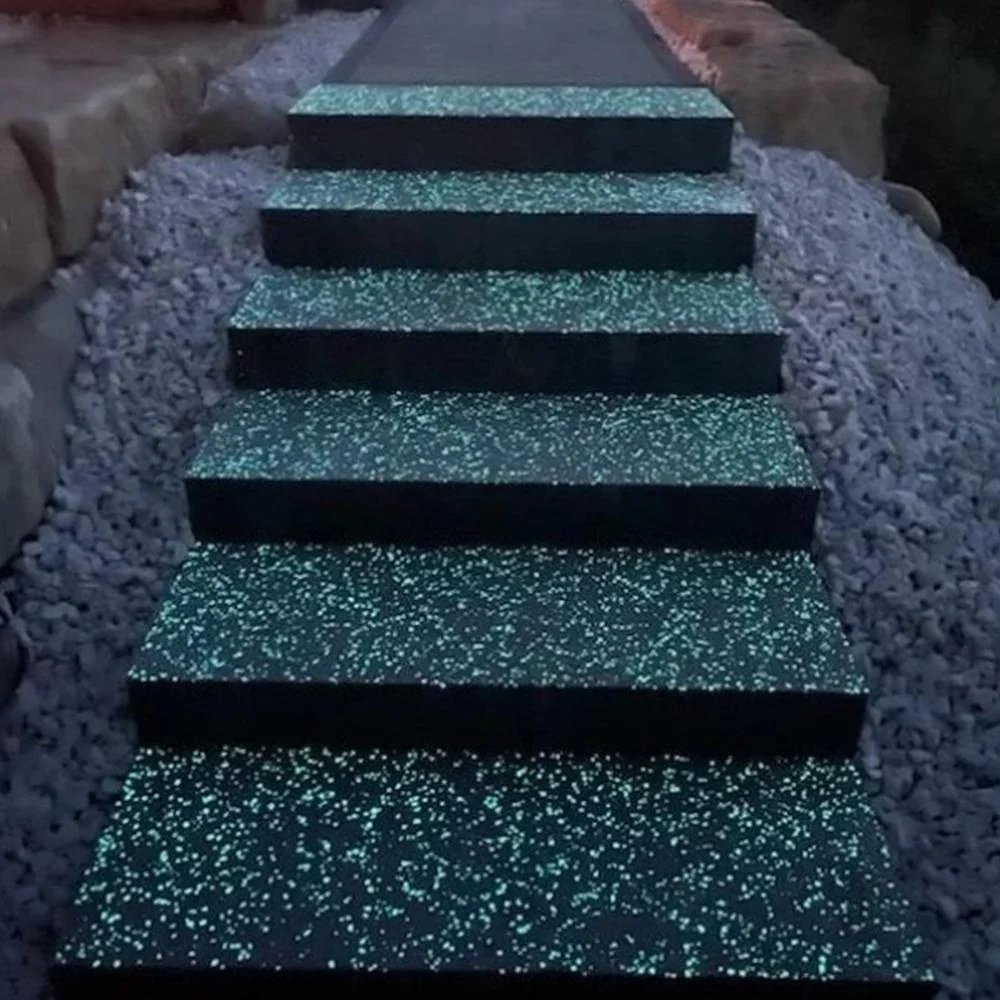
Steps are one of the most important locations for nighttime visual guidance.
A change in elevation may be difficult to recognize in low-light conditions, especially in:
- Parks
- Gardens
- Resorts
- Scenic areas
- Residential landscapes
Photoluminescent materials can be incorporated into the visible edge or surrounding surface of steps.
For example, a contractor may use a continuous line of glow aggregate along the front edge of each step.
The goal is not to make the entire staircase glow.
The goal is to make the change in elevation easier to recognize.
Marking Curves and Changes in Direction
Straight pathways are easy to follow.
Curved pathways are different.
At night, pedestrians may not immediately recognize where the path turns, particularly when the surrounding landscape is dark.
A continuous photoluminescent edge can visually communicate the direction of the pathway.
This works particularly well for:
- Curved garden paths
- Park walkways
- Resort pathways
- Scenic trails
- Decorative pedestrian routes
For a stronger design effect, the glowing line can follow the natural curve rather than forming sharp geometric sections.
Creating a Visual Boundary Without Continuous Lighting
Traditional pathway lighting usually requires:
- Light fixtures
- Electrical wiring
- Power supply
- Regular maintenance
Photoluminescent materials work differently.
They can create a passive nighttime visual effect after being charged by daylight or other light sources.
For landscape designers, this creates another option:
Use conventional lighting where illumination is required, and photoluminescent materials where visual guidance is sufficient.
This hybrid approach can be more practical than trying to make one system perform every function.
Use Different Designs for Different Areas
Not every part of a pathway needs the same amount of glow material.
A practical project can divide the pavement into several zones.
Main Walking Area
Use a relatively simple surface design to maintain walking comfort.
Pathway Edge
Add a controlled line or band of photoluminescent aggregate.
Curves
Increase the visual continuity of the glow line to clearly show the direction.
Steps
Use a more noticeable pattern around the change in elevation.
Entrance and Exit
Create a stronger visual feature to identify the beginning or end of the pathway.
This zoning approach can make the project more economical and visually organized.
Avoid Making the Glow Pattern Too Complicated
One common design mistake is using too many colors, shapes, or patterns.
A pathway should remain easy to understand at night.
For most projects, simple patterns work better:
- Continuous lines
- Dotted edge lines
- Curved borders
- Repeating geometric patterns
The glow should support the landscape design rather than compete with it.
Consider Surface Safety

Photoluminescent materials should not compromise pedestrian safety.
When used around steps, ramps, or walking surfaces, contractors should consider:
- Surface texture
- Slip resistance
- Particle exposure
- Bonding strength
- Drainage
- Walking comfort
The material should be integrated into an appropriate pavement or resin system rather than simply placed loosely on a high-traffic surface.
For areas with significant pedestrian traffic, the complete surface system should be evaluated rather than judging the glow material alone.
Match the Glow Design to the Landscape

A successful photoluminescent pathway should look natural during the day and distinctive at night.
For example:
Garden project:
Use subtle glow aggregate along planting areas and curved paths.
Resort project:
Use coordinated colors and patterns to create a premium landscape appearance.
Park project:
Use clear pathway edges and directional patterns.
Scenic area:
Use the glow material to emphasize natural curves and walking routes.
The best designs integrate the photoluminescent material into the landscape rather than making it look like an additional decoration.
A Practical Design Strategy
For contractors planning a new project, a simple approach is to identify the areas where pedestrians need the most visual information.
Start with:
1. Steps
Mark changes in elevation.
2. Curves
Show changes in direction.
3. Edges
Define the walking boundary.
4. Intersections
Help pedestrians understand which direction to take.
5. Entrances
Create a recognizable visual starting point.
This targeted application can often produce a stronger design effect than distributing the same amount of material randomly across the entire pavement.
Should the Entire Pathway Glow?
Not necessarily.
This is one of the most important design considerations.
A pathway does not need to be completely covered with photoluminescent aggregate to create an effective nighttime visual effect.
In many projects, strategic placement is more important than maximum coverage.
Using glow materials around steps, edges, curves, and directional changes can make the material work harder while keeping the overall design clean.
Final Thoughts
Photoluminescent pavement can be more than a decorative nighttime surface.
When properly designed, it can help visually define pathway edges, highlight steps, emphasize curves, and guide pedestrians through landscape spaces.
The most effective projects do not simply ask, “How much glow material should we use?”
They ask:
“Where does nighttime visual guidance provide the most value?”
That change in thinking can lead to a more attractive, practical, and cost-efficient photoluminescent pavement design.
Keywords: Photoluminescent Pavement, Glow Stone Pathway, Photoluminescent Aggregate, Glow in the Dark Pathway, Landscape Pathway Design, Glow Stone, Outdoor Pavement, Pedestrian Pathway Safety